Outings 2006 - 2004
by Hugh Deam
Training Morning
Saturday 25th November 2006
09.45am Ducklington
Oxon · St Bartholomew (6) 4cwt
11.00am Witney
Oxon · SMV (8) 16cwt
12.30pm The House of Windsor
Witney
Hugh Deam, Roy Jones, Susan King, Judy Kirby, Janice Knowles, Peter Lloyd,
Bernard Masterman, Donna Murphy, Susie Pavelin, Charles Smith and Mark Wastie.
Bernard Masterman, Donna Murphy, Susie Pavelin, Charles Smith and Mark Wastie.
Grandsire Triples, Plain Bob Minor, Stedman, St Martin's & All Saints.

Ducklington · St Bartholomew
Ducklington The River Windrush runs almost unnoticed through Ducklington, with the large village pond nestling picturesquely between the church and the Bell Inn pub. Beyond the obvious popularity of the immaculately kept village centre, Ducklington is noted for being one of the best places to see the now rare native lily, the snakes-head fritillary. St Bartholomew's is a Transitional Norman building, with chancel, nave and tower all dating from that period. Major alterations were conducted during the 14th century, with another restoration by E.G.Bruton in 1871. The aforementioned lily is depicted in one of the stained-glass windows and on an altar cloth here. Their flowering is celebrated each year on Fritillary Sunday, this usually being the 1st Sunday in May. Three of the bells (2, 4, 5) date to 1708, cast by William & Henry III Bagley of Chacombe. The tenor is from 1829, Robert Taylor of Oxford, and the treble from 1889, Mears & Stainbank. The bells were retuned, rehung and the third recast by the Royal Eijsbouts foundry in Asten, Netherlands in 1988.
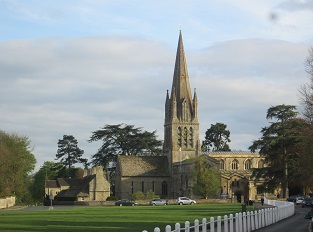 Witney The town, then known as Wyttanige, came to prominence during Saxon times when the Saxon kings held their Witans (meetings) here. Witney expanded again in the years leading up to the Reformation, the Bishops of Winchester having a palace here which they used as a country residence, and the remains of which are to be found at the rear of the present parish church. For many centuries Witney was a pivotal centre for the weaving of blanket cloth due to the waters of the Windrush containing nitrous qualities suitable for the fulling process. At its height there were five blanket factories in the town, the Blanket Hall in the High Street having been built in 1721 for weighing and measuring the blankets. With the closure of Early's, which had been the biggest factory, in 2002 this chapter in the town's history came to an end, although the local football team recalls this trade in their nickname of the Blanketmen. For nearly a century and a half Witney also had its own brewery and malting's, until the site was closed by Courage in the early 1980's.
 Since 1983, Wychwood Brewery has brewed real ales at the Eagle Malting's. Church Green is surrounded by the impressive presence of the church, the Buttercross and the rows of 16th and 17th century alms-houses. The parish church originates from the 11th century but was added to and significantly altered during the following two centuries, the central tower and spire being added at some point during the 13th century. The ring of eight bells always leaves a good impression, with the large ringing chamber garlanded with peal boards going back to the infancy of peal ringing. The oldest bell (7) is from 1660, cast by Richard Keene of Woodstock. The fourth dates to 1731 by Henry III Bagley of Chacombe. The fifth (1765) and sixth (1755) are both by Rudhall's of Gloucester. Tenor is from 1815, by Thomas Mears, Whitechapel. The front three bells added in 1938 by Taylors of Loughborough.
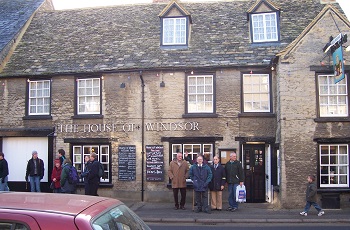
This was the second time we had lunched at The House of Windsor, having previously visited here after a tour of the Wychwood Brewery in the town. Situated in the area of the town known as West End the pub provided a good lunch on both occasions and was warmly regarded on numerous websites relevant to pub culture. Sadly the pub has ceased trading since this time.
Since 1983, Wychwood Brewery has brewed real ales at the Eagle Malting's. Church Green is surrounded by the impressive presence of the church, the Buttercross and the rows of 16th and 17th century alms-houses. The parish church originates from the 11th century but was added to and significantly altered during the following two centuries, the central tower and spire being added at some point during the 13th century. The ring of eight bells always leaves a good impression, with the large ringing chamber garlanded with peal boards going back to the infancy of peal ringing. The oldest bell (7) is from 1660, cast by Richard Keene of Woodstock. The fourth dates to 1731 by Henry III Bagley of Chacombe. The fifth (1765) and sixth (1755) are both by Rudhall's of Gloucester. Tenor is from 1815, by Thomas Mears, Whitechapel. The front three bells added in 1938 by Taylors of Loughborough.
This was the second time we had lunched at The House of Windsor, having previously visited here after a tour of the Wychwood Brewery in the town. Situated in the area of the town known as West End the pub provided a good lunch on both occasions and was warmly regarded on numerous websites relevant to pub culture. Sadly the pub has ceased trading since this time.
Witney · SMV
The House of Windsor · Witney
Oxfordshire
Saturday 4th November 2006
10.00am Burford
St John the Baptist (8) 17cwt
11.45am Asthall
St Nicholas (6) 6cwt
01.00pm The Maytime Inn
Asthall
Andrew Dunn, Hugh Deam, Roy Jones, Paul Lucas, Bernard Masterman, Leon Thompson, Simon Webb and Brian Hall.
Grandsire Triples, Cambridge, Double Oxford & Stedman.
Asthall · St Nicholas
Burford See Saturday 12th April 1997 for details.
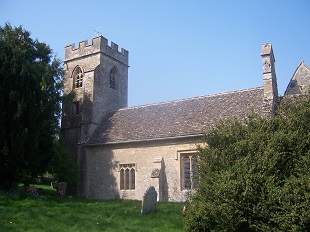
Asthall Taking its name from an east nook of land, the village is situated alongside the River Windrush and is a noted place from which to spot kingfishers. Asthall has twice been gifted by royalty, first by William I to Roger d’Ivery and later by Henry III to Richard, Earl of Cornwall. The widely known pub here, The Maytime Inn, is one of the most photogenic in the county, but has been subject to serious flooding in recent years, along with other parts of the village. The Jacobean manor house, Asthall Manor, was built in 1630 and enlarged in 1916 soon after being inherited by the 2nd Baron Redesdale, father of the Mitford sisters. The sisters were notable socialites, and weekend parties were regularly held here, with many society figures in attendance. Jessica and Nancy Mitford became noted authors, Unity became a devotee of the Nazi movement, Diana married the British Fascist leader Oswald Mosley, and the youngest sister, Deborah became the Duchess of Devonshire and a pillar of the English aristocracy. The house is situated directly behind the parish church The interior includes a rare 14th century stone altar, a well preserved 12th century font and a stone effigy depicting Lady Cornwall in a long, flowing dress that covers all but the tip of her right foot. The tower clock dates from 1665, having been made by a skilled and clearly versatile local blacksmith. The bells, rung from a gallery, were augmented from three to six by Whitechapel in 2005, with the gallery accessed from the vestry via a 13-step oak ladder. The back two bells are of considerable age, having been cast at the Wokingham foundry around 1499. The fourth bell, cast by John Taylor & Co, was added in 1859 when the bells were installed in an oak-frame. This frame was replaced as part of the extensive 2005 restoration and the gallery installed. The bells were first being rung as a six in early 2006. We were privileged to be the first visiting band from outside the branch to have the pleasure of ringing these superb bells.
The Golden Valley, Gloucestershire
Saturday 14th October 2006
10.30am Watermoor
Holy Trinity (8) 19cwt
11.45am Chalford
Christ Church (6) 10cwt
01.00pm Woodchester
St Mary (6) 9cwt
02.00pm The Weighbridge Inn
Nailsworth
03.15pm Avening
Holy Cross (6) 12cwt
04.15pm Cherington
St Nicholas (5) 6cwt
Avening
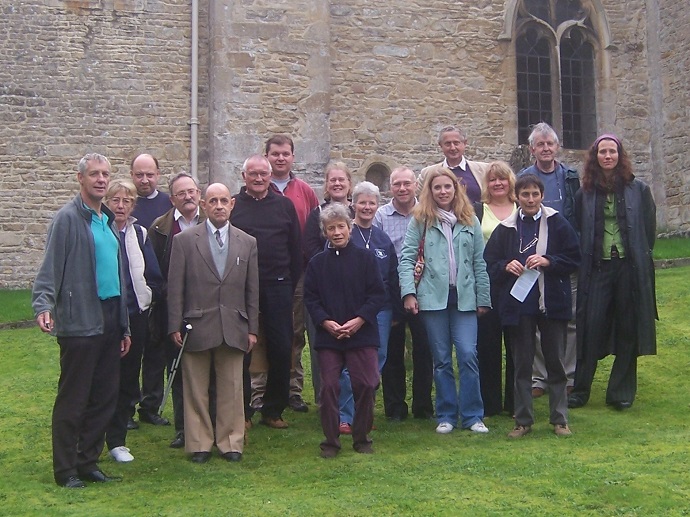
Jonathan Beale, Carole Beckley, Jane Burgess, Ron Burgess, Hugh Deam, Rev Anthony Ellis, Anthony Hughes, Roy Jones, Susan King, Judy Kirby, Janice Knowles, Peter Lloyd, Bernard Masterman, Donna Murphy, Miranda Oliver, Suzette Reynolds, June Steele, Tony Stewart and Serge Zvegintzov.
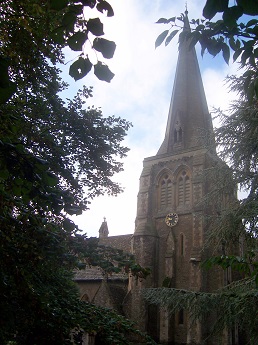
Watermoor · Holy Trinity
Watermoor The city of Corinium was founded by the Romans in 49 A.D., being second only to London in importance. Legend has it that in 879 A.D. Gurmund the Dane captured Cirencester from the Saxons by trapping a huge flock of sparrows, tying flaming twigs to them and releasing them to fly over the city which burnt down the defences, thus allowing the Vikings to march in relatively unimpeded. In later centuries sheep were traded here in numbers that can only be imagined at today, and the town was coined as being the "King of the Cotswolds". The Royal Agricultural College, the oldest such college in the English speaking world, is based here. There are four suburbs in the town, Stratton, Chesterton, The Beeches and Watermoor. Situated on the eastern flank of the town, the church in Watermoor was built in the mid-19th century to cater for the immense congregations of 1,500+ at St John the Baptist church in the centre of town. Despite being constructed on the scale of a cathedral it was unable to cope with the surfeit of worshippers and thus Holy Trinity church was built in this part of the town. Designed by Sir George Gilbert Scott at the behest of Canon William Powell the church here is substantial enough to be the main place of worship in many large towns, with a substantial tower and spire to match. Six of the eight bells were installed at the end of the 19th century, and the front two added in 1901, all cast by Taylors of Loughborough, being rung from the ground floor.
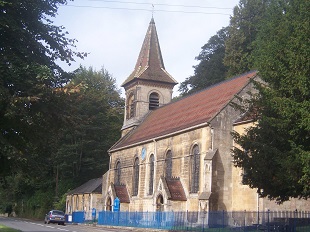 Chalford lies amidst a deep wooded gorge at the heart of the Golden Valley, thus giving the village a distinct Alpine character, so much so that it referred to on maps as being an "Alpine Village". A settlement is known to have existed here some 5000 years ago, and the remnants of a later Roman villa are open to view. There are two schools of thought as to the derivation of the name, with the Norman Calf-ford or the Saxon Cealj (chalk) Ford. The village expanded rapidly with the construction of the Thames & Severn Canal (1783 – 89), and the settling of displaced Flemish Huguenots in the 17th and 18th centuries. Quality silk and woollen cloth was manufactured by these finest of weavers. Christ Church was built in 1726, and enlarged to meet the growing population during 1841. It enjoys a sumptuous view across to the eastern slopes and the railway line built along the escarpment. The bells are unusual in that they are one of the few sets in England to be made of steel, being the work of Naylor Vickers & Co, Sheffield, 1853 – 1859.
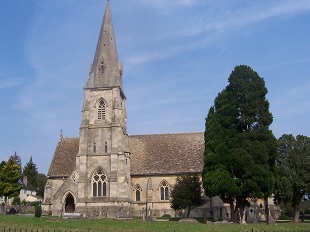 Woodchester Roman villa was occupied between the 2nd and 4th century A.D., and its most famous feature, the intricate Orpheus Mosaic has been uncovered seven times since 1880. Dating to 325 A.D. it is the second largest of its kind known to exist in Europe. Direction signs still point to the original location of the parish church, with the churchyard and building remnants still in place to the anterior of a Gothic mansion. The church was moved to a more central position for the combined villages – North and South – in 1884, with church and school sited close together, and enjoying a woodland backdrop. Woodchester Mansion stands within a landscaped valley and is now owned by the National Trust. The parish church was designed by Samuel Sanders Teulon, one of the leading 19th century English Gothic Revival architects who, besides his numerous church designs, was responsible for work at Sandringham House in Norfolk and the Court House, Holborn. The tower and spire are arguably more impressive that the main body of the church, with this superb set of bells having been restored and rehung in 1956 by Whitechapel, with the second and third bells dated to this time. The oldest bell is the fifth, dating to the 15th century, from a foundry in Bristol. The other bells are from the Gloucester foundry of the Rudhall family.
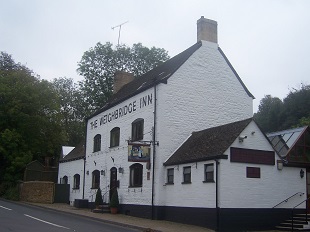 The Weighbridge Inn in Nailsworth is situated just outside the town on the Avening Road, and proved an absolute must to recommend as everyone was bowled over by the prompt service, superb quality of meals, well-kept Cotswold beer, and its speciality 2 in 1 pies that lived up to their lofty billing. Unfortunately, the town which epitomises this part of Gloucestershire doesn't have a church with bells, but the pub alone makes it worthy of mention. The deep valleys here are formed by Horsley Stream, Miry Brook, Avening Stream, and Nailsworth Stream as they all converge in the town as they flow on down to the River Frome. The town has an array of peculiar road names such as Frying Pan Alley, Egypt, Gydynap Lane and Pinfarthings. As a legacy of the woollen industry many mills still remain in good condition clustered on the hillsides.
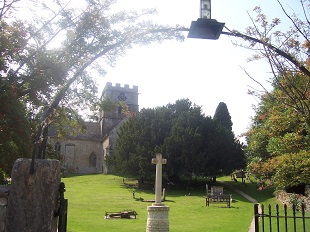 Avening is a village with a wealth of history, an extensive Roman burial ground and several tombs having been unearthed here in a field known as "The Norm" during 1809. The village and lands surrounding are noted in the Domesday Book as belonging to Brittric, Lord of Gloucester. He was sent by Edward the Confessor on an important ambassadorial mission to meet Baldwin, Count of Flanders, and it was there that he first met Matilda, who would later marry William the Conqueror. At this time she was enamoured of Brittric, but he rejected her advances, a declension that turned out to be fatal as she later used her influence as Queen to dispossess him of all his properties and have him incarcerated in Worcester Prison, where he subsequently died. The original church was ordered destroyed and a new church built by Matilda, with it being consecrated on Holy Cross Day in 1080. Avening became a favourite resort of royalty from then on, with the church endowed to the Abbey of Holy Trinity, Caen for the next 333 years.
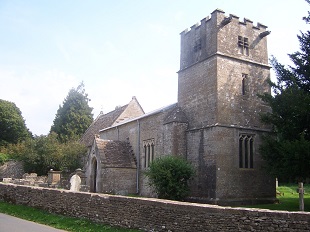 The tradition of a Feast on Holy Cross Sunday led to the current Pig Face Day celebrations. The tower entrance is at the rear of the church, with the second and fourth by Roger Purdue of Bristol, 1628, and the third and fifth recast by Abel Rudhall of Gloucester. The tenor and treble are from Whitechapel, 1903.
Cherington This pretty village is situated upon the gentler eastern slopes of the Golden Valley towards the southernmost extreme of the Cotswolds and borders the Gatcombe Estate. First documented as Cerintone, the settlement took its name from an amalgam of Anglo Saxon words to describe a village possessing a church. The area is noted for equine pursuits, and there are several 18th century coach houses and stables to verify this. The primarily Early English parish church is most noted for the exceptional medieval mouldings around the lancet windows. In the mid-19th century one of the bells was purloined, later reappearing in the tower at Avening. The ensuing scandal led to three ringers being sent to prison for six months after admitting to smuggling the bell out of the church here. As it transpired, their misdeed had all been nothing as this bell had not really been conducive with the existing bells. The augmented treble bell was added in 1993, being cast at Whitechapel.
The tradition of a Feast on Holy Cross Sunday led to the current Pig Face Day celebrations. The tower entrance is at the rear of the church, with the second and fourth by Roger Purdue of Bristol, 1628, and the third and fifth recast by Abel Rudhall of Gloucester. The tenor and treble are from Whitechapel, 1903.
Cherington This pretty village is situated upon the gentler eastern slopes of the Golden Valley towards the southernmost extreme of the Cotswolds and borders the Gatcombe Estate. First documented as Cerintone, the settlement took its name from an amalgam of Anglo Saxon words to describe a village possessing a church. The area is noted for equine pursuits, and there are several 18th century coach houses and stables to verify this. The primarily Early English parish church is most noted for the exceptional medieval mouldings around the lancet windows. In the mid-19th century one of the bells was purloined, later reappearing in the tower at Avening. The ensuing scandal led to three ringers being sent to prison for six months after admitting to smuggling the bell out of the church here. As it transpired, their misdeed had all been nothing as this bell had not really been conducive with the existing bells. The augmented treble bell was added in 1993, being cast at Whitechapel.
Chalford · Christ Church
Woodchester · St Mary
The Weighbridge Inn
Avening · Holy Cross
Cherington · St Nicholas
Suffolk
Saturday 9th September 2006
10.45am Tostock
St Andrew (6) 5cwt
12.15pm Woolpit
St Mary (6) 8cwt
01.15pm The Bull Inn
Woolpit
02.30pm Buxhall
St Mary (6) 15cwt
Hugh Deam, Roy Jones, Judith Kirby, Maarit Kivilo, Janice Knowles, Peter Lloyd,
Bernard Masterman, Donna Murphy, Neville Whitttell and Richard Bennett.
Bernard Masterman, Donna Murphy, Neville Whitttell and Richard Bennett.
Cambridge, Little Bob, Plain Bob Minor, Stedman & Grandsire.
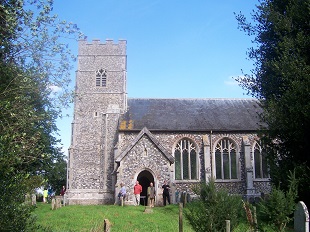
Tostock · St Andrew
Tostock The settlement noted as being here at the time of the Domesday Survey was described as Totestoc, deriving it name from an outlying Anglo-Saxon farmstead by a look-out place. There was a church mentioned as being here at this time, but the present building is essentially from the 12th century, being sited to the east of the village. Flanking the flint and limestone building are an array of trees, with a large lime tree towering over the gateway. A course of restoration and enlargement was carried out in 1848. The tower, of square battlemented design, was constructed in stages from about 1350. It is believed that the tower was completed in the 1460's, with four bells cast in Bury St Edmunds being in the tower by the 16th century. In 1960 the existing bells were removed from the tower due to their mountings being declared unsafe. They were stored for safe keeping until a concerted fund-raising effort led to them being re-hung and augmented to a six in 1999, the new bells being cast by Whitechapel.
Woolpit This is a village of considerable historical significance in a picturesque setting which attracts numerous tourists and painters, thus helping it maintain several shops, pubs and galleries, something which few other villages of comparable size can manage nowadays.
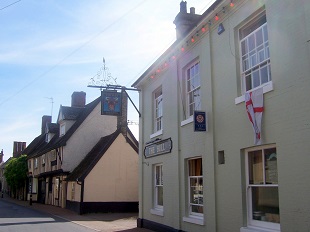
We enjoyed an excellent lunch at one of the pubs, the Bull Inn, which as the picture demonstrates, is a somewhat more recent premises than the half-timbered properties adjoining. During the 12th century the settlement was described as Wulfpit because of the ditches constructed to act as wolf traps.
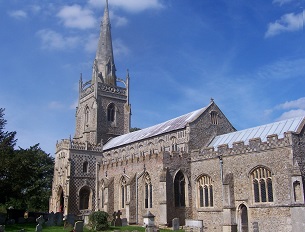
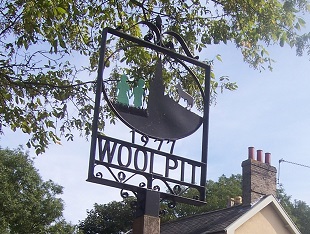
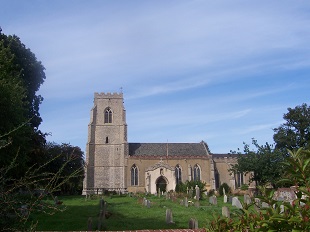
 The village sign on the road fronting the church depicts a girl, a boy, the church and a wolf. This attests to the local legend of the two green-pigmented children who appeared out of one such pit at harvest time. Harvesters brought them to the village where the boy and girl would only eat green food such as beans and peas. When asked of their origin they could only remember vague details such as it being called the land of St Martin's across the river, with herds of cattle, churches with bells, and a sun that never rose high in the sky. The children changed colour after being encouraged on to a diet of bread, but the boy fell ill and died, although the girl is reputed to have gone on to marry a man from King's Lynn. The parish church is considered one of the most glorious such buildings in the country. Besides the 200 angel carvings, there are representations of jesters, dragons and eagles. The priests' door remains from the 12th century, although much else, including the tower, is from the 15th century. The two oldest bells (fourth and fifth) are by John Darbie of Ipswich, 1658. The other bells are from the Whitechapel foundry, 1844 and 1855.
 Buxhall The settlement here in 995 A.D. was documented as Bucyshealae (a nook of land belonging to Buce). The huge tower-mill here has long been a famous landmark in the county, although it has been devoid of any sails since a destructive gale in 1929. This is now a popular area for rambling, with an ancient wood adjoining the village. The Decorated period (c. 1275-1380) church is situated south of the village, with the imposing tower dating from slightly earlier. The art of change ringing, where adjacent pairs of bells may change places all at once, is generally considered to have originated with Fabian Stedman's "Tintinnalogia" in 1668. Dated 50 years earlier is a cipher carved into the tower door-post here that has five and a bit rows of single pair changes on 5, these being: 12345, 21345, 23145, 23415, 23451, 2----. The bells are a weighty six that are well worth the effort, although it was unfortunate that the clapper fell out from the tenor whilst we were here. The two oldest bells are by John Draper of Thetford, second (1632) and fourth (1635). The fifth is from 1698 by Charles Newman of Norwich. The treble and tenor bells are both from 1952, by Gillett & Johnston, and the third, 1995, from Whitechapel.
Woolpit · St Mary
The Bull Inn · Woolpit
The Woolpit village sign
Buxhall · St Mary
Cranborne Chase
Saturday 15 July 2006
10.15am Breakfast Bake Farm PYO
Coombe Bissett
11.15am Tarrant Keyneston
Dorset All Saints (5) 7cwt
12.15pm Witchampton
Dorset St Mary St Cuthberga & All Saints (6) 11cwt
01.15pm Witchampton Social Club
Dorset
03.15pm Iwerne Courtney (Shroton)
Dorset St Mary (6) 9cwt
04.15pm Gussage St Michael
Dorset St Michael (6) 11cwt
Heather Banyard, Jonathan Beale, Carole Beckley, Jane Burgess, Ron Burgess, Hugh Deam,
Roy Jones, Judy Kirby, Janice Knowles, Bernard Masterman and Donna Murphy.
Roy Jones, Judy Kirby, Janice Knowles, Bernard Masterman and Donna Murphy.
Cambridge, St Clements, Stedman & St Martin's.
Witchampton
The villages that have grown up along the course of the River Stour have a rich history, probably most notably during the years of the English Civil War. Although much of Dorset was a Royalist stronghold, and had strongholds that were last to surrender, it was here around Cranborne Chase that a group disillusioned by the constant fighting on both sides came into being. The Clubmen were a largely clergy-led group who generally met the same fate at the hands of Cromwell as the eventually defeated Cavaliers. The organic bakery at Long Crichel in well worth a visit, housed in what were stables, this artisan bakery only opened in 2000, but has the appearance of having existed here for many centuries. Just prior to reaching Cranborne Chase we enjoyed a quick breakfast at Bake Farm, a large Pick Your Own farm, and some rapidly filled punnets of soft fruits in the most adjacent fields before we headed into Dorset.
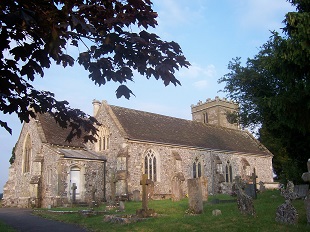 Tarrant Keyneston is one of eight villages within a short radius to carry the prefix of Tarrant, this deriving from the Celtic river name that literally translates as "the trespasser", i.e. a river liable to flooding. The villages have developed around the area which was once graced by Tarrant Abbey, established c.1100 by Ralph de Kahaines. One of the first ever books in the English language was written at the abbey. All that remains of the mediaeval church is the tower and the tenor bell. In the 1850's a new church was built on the same site, being in Perpendicular style and constructed of flint and ham-stone so as to harmonise with the tower and resemble the original church. The 14th century tenor bell is one of the oldest bells in the country, with what are now the middle three bells by Gillett & Johnston, 1914. In 1977 a peal was rung in 16 minimus methods, a record number to a peal on four bells. What is now the treble was brought here from the redundant church of Christchurch in Savernake, having been cast by John Warner & Sons, 1853.
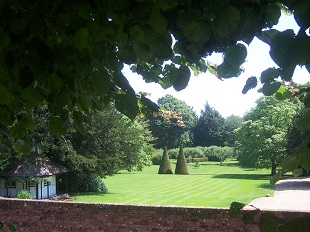
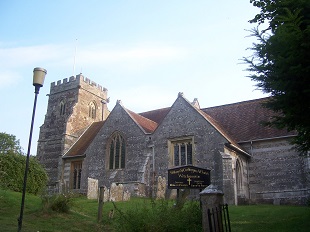 Witchampton The village is sited alongside the River Allen, deriving its name from a farmstead associated with an earlier Romano-British settlement which included a vineyard. From Norman times up until the 20th century there were two flour mills here, one of which originally belonged to Queen Matilda, wife of William I. Until the mid-20th century every house in the village was in the ownership of the Crichel estate thus helping to preserve its special character, with numerous thatched and timber-framed cottages, resplendent at various times of year with roses, honeysuckle and jasmine. The area of the village known as New Town was built to house the displaced inhabitants of Moor Crichel which was submerged beneath the 60acre lake constructed by the owners of Crichel House. Having undergone a rebuilding (1832 – 40), all that remains of the original church building is the bowl of the 13th century font, which was rescued from a field where it was being used as a cattle trough. The 15th century tower has four gargoyles, one of which is playing bagpipes. The bells are ideal for fluent ringing, with the back five bells cast by Robert I Wells of Aldbourne, 1776/77, and the treble added in 1935, Whitechapel.
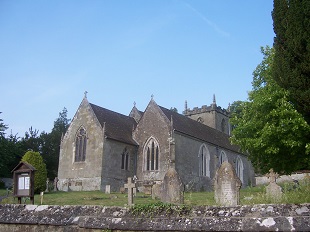 Iwerne Courtney (Shroton) This now extensive village is set in the Iwerne Valley and overlooked by the hills of Cranborne Chase to the east and Hambledon Hill to the south-west. For many centuries the village has alternatively been known as Shroton (sheriff's estate). During the Civil War a skirmish was played out between Cromwellian dragoons and the local Clubmen. A century later a different army mustered on the hills here under the training of General Wolfe as part of their training for the upcoming assault against the French in Quebec. The present church was rebuilt in 1610 in a Gothic style, with the interior greatly altered in 1872, with more elaborate windows inserted. The north chapel houses a monument to Sir Thomas Freke who paid for the rebuilding of the church.
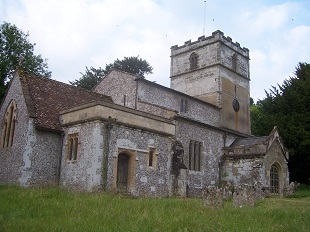 The bells are rung from the ground floor, and we were told by the local ringers that the ropes now have a notable tendency to be on the long side due to the loss of the trees that long bordered the entrance to the tower, and there certainly was plentiful capacity of tail-end on the ropes on this particular day. The tower houses six bells, the oldest of which is the fifth, 1524, by an unidentified founder. The fourth is from 1590 by John Wallis, Salisbury. The tenor is of 1887, by Llewellins & James, Bristol, and the other three bells from the Whitechapel foundry.
Gussage St Michael This charming village, named after a gushing stream, has developed around the Roman road of Ackling Dyke. The Dorset Cursus that passes around the parish is a processional way that long pre-dates the adjoining Roman Ackling Dyke. The parish church is built on a hillside amidst the ruins of a Saxon predecessor, the oldest part of the present building being the base of the tower, dating to the 12th century. The nave is from the following century, with the chancel having been completely rebuilt in 1857 by G.E. Street. The bells are hung counter-clockwise and were restored in 2005 by Whitechapel. The oldest bell is the fifth, 1608, cast by John Wallis of Salisbury, with the second and third from 1663 by Francis Foster. The other bells are from the Whitechapel foundry.
The bells are rung from the ground floor, and we were told by the local ringers that the ropes now have a notable tendency to be on the long side due to the loss of the trees that long bordered the entrance to the tower, and there certainly was plentiful capacity of tail-end on the ropes on this particular day. The tower houses six bells, the oldest of which is the fifth, 1524, by an unidentified founder. The fourth is from 1590 by John Wallis, Salisbury. The tenor is of 1887, by Llewellins & James, Bristol, and the other three bells from the Whitechapel foundry.
Gussage St Michael This charming village, named after a gushing stream, has developed around the Roman road of Ackling Dyke. The Dorset Cursus that passes around the parish is a processional way that long pre-dates the adjoining Roman Ackling Dyke. The parish church is built on a hillside amidst the ruins of a Saxon predecessor, the oldest part of the present building being the base of the tower, dating to the 12th century. The nave is from the following century, with the chancel having been completely rebuilt in 1857 by G.E. Street. The bells are hung counter-clockwise and were restored in 2005 by Whitechapel. The oldest bell is the fifth, 1608, cast by John Wallis of Salisbury, with the second and third from 1663 by Francis Foster. The other bells are from the Whitechapel foundry.
Tarrant Keyneston
Witchampton · St Mary
Iwerne Courtney · St Mary
Gussage St Michael
Mini Outing
Sunday 30th April 2006
12.15pm Salford
Oxon · SMV (5) 6cwt
01.15pm The Red Lion
Little Compton
02.30pm Little Compton
Warks · St Denys (5) 6cwt
03.15pm Chastleton
Oxon · SMV (6) 6cwt
Carole Beckley, Jane Burgess, Ron Burgess, Hugh Deam, Andrew Dunn, Anthony Hughes, Roy Jones, Judy Kirby, Janice Knowles, Carrie Leonard-McIntyre, Peter Lloyd, Bernard Masterman, Donna Murphy and Leon Thompson.
Plain Bob Minor, Stedman, St Simon's & Grandsire.

Salford · SMV
Although not as widely known as Stonehenge or Avebury, this corner of north-west Oxfordshire also possesses a complex of megalithic monuments, the Rollright Stones being three Neolithic and Bronze Age monuments. The three separate monuments are constructed of local oolitic limestone and are now known as the King Stone, the King's Men and the Whispering Knights, the latter two being the oldest. The King-Stone was probably erected to mark a Bronze Age cemetery dating to somewhere between 1800 and 1500 B.C. The strange shape of the King is partly the result of 17th century drovers and visitors who continually chipped off bits to use as lucky charms and keep the Devil at bay. A Doctor Who episode (The Stones of Blood) from the Tom Baker era was partly filmed here in 1978.
Salford The settlement here in 777 A.D. was noted as Saltford (a ford over which salt is carried). The parish church is situated adjacent to fields on the western edge of the village, and was largely Norman in structure until being rebuilt in 1854 by the eminent Gothic Revival architect George Edmund Street. His most noted work is probably the Royal Courts of Justice on the Strand in London. The font and parts of two doorways are the Norman features to remain here. The tower was also rebuilt by Street, with the Decorated Gothic bell-openings surviving from the original construction. All five bells are by Matthew I Bagley & Henry II Bagley of Chacombe, being cast in 1687.
Little Compton The original name of the village was Compton in Floribus on account of the profusion of flowers in the valley here. The small but aesthetically pleasing 14th century parish church adjoins the 17th century manor house that was built for Bishop William Juxon, and is unusual in having a saddleback roofed tower.
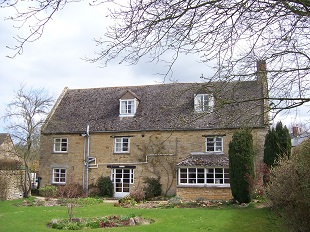
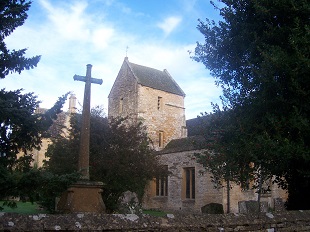 William Juxon, who had also served as Lord Treasurer of England, was the priest who accompanied Charles I to the scaffold. Scenes of the execution are represented in a stained-glass window in the Lady Chapel, and the bible used by Juxon at the execution is now on display at nearby Chastleton House. William Juxon was subsequently appointed Archbishop of Canterbury and is buried at St John's College, Oxford. Extensive rebuilding of the church took place during 1863/64, forming a new chancel and nave. A ring of five bells was installed here in 1720 by Abraham II Rudhall of Gloucester, the treble being recast in 1810 and again in 1899 by H. Bond & Sons of Burford. The bells were removed for restoration in 1990 and sent to Whitechapel for re-tuning, however spiralling costs associated with structural repairs to the tower delayed the project in its entirety, with it not being completed until 1999.
Chastleton See Sunday 6th October 2013 for details.
William Juxon, who had also served as Lord Treasurer of England, was the priest who accompanied Charles I to the scaffold. Scenes of the execution are represented in a stained-glass window in the Lady Chapel, and the bible used by Juxon at the execution is now on display at nearby Chastleton House. William Juxon was subsequently appointed Archbishop of Canterbury and is buried at St John's College, Oxford. Extensive rebuilding of the church took place during 1863/64, forming a new chancel and nave. A ring of five bells was installed here in 1720 by Abraham II Rudhall of Gloucester, the treble being recast in 1810 and again in 1899 by H. Bond & Sons of Burford. The bells were removed for restoration in 1990 and sent to Whitechapel for re-tuning, however spiralling costs associated with structural repairs to the tower delayed the project in its entirety, with it not being completed until 1999.
Chastleton See Sunday 6th October 2013 for details.
The Red Lion · Little Compton
Little Compton · St Denys
Stanton Harcourt
Saturday 25th March 2006
5.00pm Stanton Harcourt
Oxon · St Michael (6) 11cwt
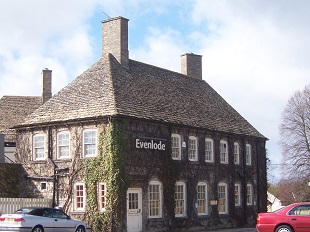
6.30pm Supper The Evenlode
Eynsham
Paul Bayes, John Beale, Jonathan Beale, Robert Bruce, Hugh Deam, Roy Jones, Susan King, Judy Kirby, Janice Knowles, Bernard Masterman, Donna Murphy, Susie Pavelin, Ailsa Reid, June Steele, Richard Bennett and Joan Beale.
St Clements, Plain Bob Minor & Grandsire.
Stanton Harcourt For the first time visitor to Stanton Harcourt St Michael, it appears that there may be a second tower to choose from, this other tower being Pope's Tower, named after Alexander Pope, which is in the grounds of the adjoining manor house, but which has no bells within. It is so named as Pope resided here whilst translating a volume of Homer's Iliad in 1817/18.
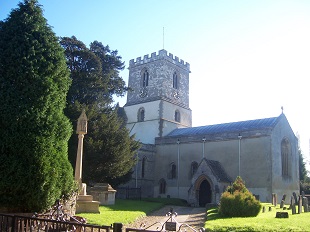 There are plenty of towers that are broad in their girth but which have surprisingly modest ringing chambers within, and then there are towers such as Stanton Harcourt where the sheer immensity of the ringing chamber is almost certainly the first thing that comes to notice on entering the room. For all the room's expanse though, it is the wide spacing between sallies that generally provides the culture shock when actually ringing. For full details of the village and church, see Saturday 28th September 2013.
The Evenlode in Eynsham
Stanton Harcourt
Hertfordshire
Saturday 25th March 2006
10.00am Ridge
Herts · St Margaret (6) 11cwt
11.15am South Mymms
Herts · St Giles (6) 11cwt
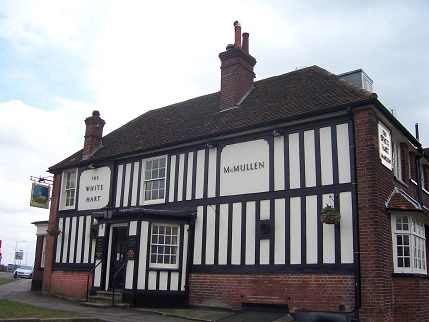
12.15pm The White Hart
South Mymms
02.15pm Sandridge
Herts · St Leonard (6) 6cwt
Joan Badger, Paul Bayes, Hugh Deam, Vince Emery, Roy Jones, Andrew King and Peter Lloyd.
Stedman, St Simon's, St Martin's & Grandsire.
Ridge and South Mymms See Saturday 17th April 1999 for details.
Sandridge The village is situated just north of St Albans, on the ancient road to Wheathampstead, and is a pleasant mix of old cottages and new housing. In Saxon times, when this area was part of Mercia, the settlement here was known as Sandruage (a sandy ridge). During the 19th century, Nomansland Common became nothing short of infamous thanks, in the most part, to the brazen exploits of Lady Katherine Ferrers, better known as "The Wicked Lady".
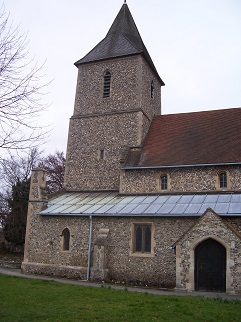 Her nefarious life is still famous today, probably due to the 1940s film of the same name starring Margaret Lockwood and James Mason, which is still one of British Cinema's highest grossing films (adjusted for inflation). During the 19th century cock-fighting and horse racing was more common than cricket hereabouts, with betting and gambling on the merest thing being truly rife. A Saxon church is known to have stood here in 796 A.D., with the present building being a Norman replacement. The semi-circular head of the arch between the nave and chancel is thought to survive from the Saxon building. The Norman tower collapsed in 1692 and was not rebuilt until 1836 – 38. During 1886/87 the church was subject to a restoration overseen by William White, re-opening on June 7, 1887. The ring of bells was dedicated on January 11, 1890. Unusually, the treble is the oldest bell, 1837, by Thomas Mears, of Whitechapel. The back five bells are from the time of the rebuilding, by John Warner & Sons.
The White Hart · South Mymms
Sandridge · St Leonard
The Cotswolds
Saturday 11th March 2006
10.00am Moreton in Marsh
Gloucs · St David 10cwt (8)
11.15am Todenham
Gloucs · St Thomas of Canterbury (6) 12cwt
12.15pm Great Wolford
Warks · St Michael (6) 11cwt
01.30pm The Norman Knight
Whichford
02.45pm Whichford
Warks · St Michael (8) 12cwt
03.45pm Cherington
Warks · St John the Baptist (5 now 6) 7cwt
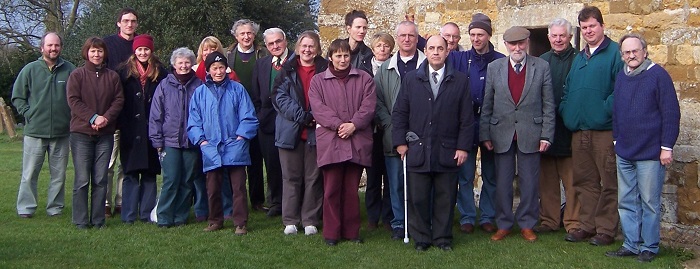
St Michael · Whichford
John Beale, Jonathan Beale, Carole Beckley, Bob Benstead, Jane Burgess, Ron Burgess, Robert Chadburn, Hugh Deam, Andrew Dunn, Clare Fairburn, Malcolm Fairburn, Adrian Gray, Anthony Hughes, Roy Jones, Judith Kirby, Susan King, Janice Knowles, Peter Lloyd, Paul Lucas, Bernard Masterman, Donna Murphy, June Steele, Hillary Stevens and Richard Verrall.
Plain Bob Major, Stedman Triples, Grandsire Triples, St Clements & Little Bob.
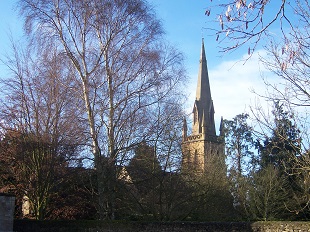
Moreton in Marsh · St David
Moreton in Marsh This busy old market town is situated at the crossroads of Fosse Way (now A429) and the A44, the majority of the town being built along the length of an exceptionally wide, grass-verged main street. The name of the town may well refer to its position close to the march (boundary) of Gloucestershire; some two miles distant is a stone column which marks the meeting place of three counties. At the very heart of the town stands a splendid 16th century curfew tower, the bell of which was long used to summon the fire brigade. Aptly, the National Fire Service Training College is based at the eastern edge of the town, these extensive facilities being highly visible to motorists approaching on the A44. Senior fire officers, fire-fighters, and relevant civilians from all over the country undergo operational, management and leadership training here.
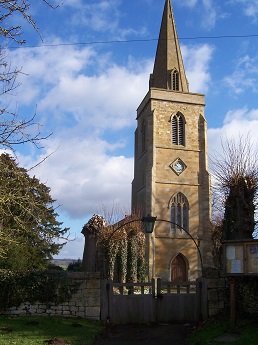 Previous to this use the land had been developed as an RAF airfield used by Wellington bombers during the Second World War. The parish church began as a chapel of ease for Blockley, and then performed the same function for Batsford. Until the Second World War the Lord of the Manor at Batsford implemented the right to collect a shilling a year for every shop window facing Moreton High Street. Most of the church was rebuilt in 1858, with the tower replaced in 1860. The honey-coloured stone from local quarries gives the church an apparent age beyond its actual years, with the gravel walk to the west door lined by yew trees. The beautifully proportioned three-stage tower is surmounted by triangular-pierced battlements and an octagonal spire. The eight bells were recast and rehung in 1958 by Taylors of Loughborough, the third being an entirely new bell. The bells are a rewarding set, although the ringing chamber is quite small for an eight bell tower.
Todenham See Saturday 17th October 1992 for details.
Great Wolford The twin villages of Great Wolford and the smaller Little Wolford derive their name from the Anglo-Saxon for a place protected against wolves. The villages are characterized by a plenitude of Cotswold stone cottages that were owned by Lord Redesdale of Batsford up until 1924. Close by is Wolford Wood, which plays host to a number of rare orchids and a diversity of wildlife.
Previous to this use the land had been developed as an RAF airfield used by Wellington bombers during the Second World War. The parish church began as a chapel of ease for Blockley, and then performed the same function for Batsford. Until the Second World War the Lord of the Manor at Batsford implemented the right to collect a shilling a year for every shop window facing Moreton High Street. Most of the church was rebuilt in 1858, with the tower replaced in 1860. The honey-coloured stone from local quarries gives the church an apparent age beyond its actual years, with the gravel walk to the west door lined by yew trees. The beautifully proportioned three-stage tower is surmounted by triangular-pierced battlements and an octagonal spire. The eight bells were recast and rehung in 1958 by Taylors of Loughborough, the third being an entirely new bell. The bells are a rewarding set, although the ringing chamber is quite small for an eight bell tower.
Todenham See Saturday 17th October 1992 for details.
Great Wolford The twin villages of Great Wolford and the smaller Little Wolford derive their name from the Anglo-Saxon for a place protected against wolves. The villages are characterized by a plenitude of Cotswold stone cottages that were owned by Lord Redesdale of Batsford up until 1924. Close by is Wolford Wood, which plays host to a number of rare orchids and a diversity of wildlife.
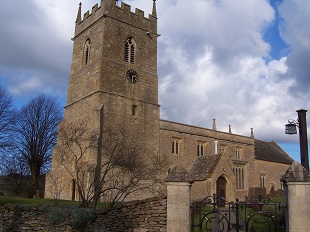
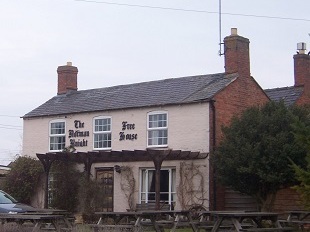 The parish church is an ashlar-faced 19th century rebuilding (1833 – 1835) upon the foundations of its 1st century predecessor. The work was conducted under the supervision of James Trubshaw, whose most widely known work is the Grosvenor Bridge in Chester, and who pioneered the technique of under-excavation with the work of straightening the leaning tower of St Chad's church in Wybunbury, Cheshire. The interior of the church is composed of a broad nave and short chancel, with richly coloured stained-glass work by Heinersdorf of Berlin. The west tower, capped by a recessed spire, contains six bells, the oldest of which is the tenor, cast in 1664 by George Mears of Whitechapel.
The Norman Knight, Whichford is a classic Cotswolds pub with its own brewery and a campsite. The flagstone floors and exposed timbers all add to the traditional ambience.
The parish church is an ashlar-faced 19th century rebuilding (1833 – 1835) upon the foundations of its 1st century predecessor. The work was conducted under the supervision of James Trubshaw, whose most widely known work is the Grosvenor Bridge in Chester, and who pioneered the technique of under-excavation with the work of straightening the leaning tower of St Chad's church in Wybunbury, Cheshire. The interior of the church is composed of a broad nave and short chancel, with richly coloured stained-glass work by Heinersdorf of Berlin. The west tower, capped by a recessed spire, contains six bells, the oldest of which is the tenor, cast in 1664 by George Mears of Whitechapel.
The Norman Knight, Whichford is a classic Cotswolds pub with its own brewery and a campsite. The flagstone floors and exposed timbers all add to the traditional ambience.
 The pub offered a choice of three of their own ales, Apprentice, One for the Toad and Druid's Fluid. As there were a few more of us than had been bargained for we had to split into three groups as the pub is of modest size. The meals were good value and highly appetising.
Whichford The settlement of Wicford (ford of the Hwicce tribe) is noted in the Domesday Book, with the Manor of Whichford granted to Bridlington Priory by the de Mohun family in the 12th century. The older buildings in the village are mostly of local stone and with thatched roofs. The Whichford Pottery, which specialises in terracotta flowerpots, has tours of its workshop during the week. The origins of the parish church date to the mid12th century when it was in the possession of the Augustinian Priory. From 1200 work on the tower began and the north aisle was added. Against the north wall of the chancel is the tomb of John Mertun, rector here 1507 – 1537.
The pub offered a choice of three of their own ales, Apprentice, One for the Toad and Druid's Fluid. As there were a few more of us than had been bargained for we had to split into three groups as the pub is of modest size. The meals were good value and highly appetising.
Whichford The settlement of Wicford (ford of the Hwicce tribe) is noted in the Domesday Book, with the Manor of Whichford granted to Bridlington Priory by the de Mohun family in the 12th century. The older buildings in the village are mostly of local stone and with thatched roofs. The Whichford Pottery, which specialises in terracotta flowerpots, has tours of its workshop during the week. The origins of the parish church date to the mid12th century when it was in the possession of the Augustinian Priory. From 1200 work on the tower began and the north aisle was added. Against the north wall of the chancel is the tomb of John Mertun, rector here 1507 – 1537.
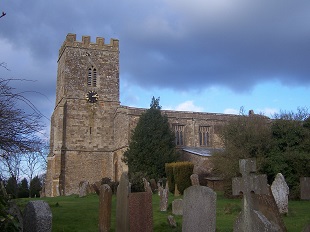 The alabaster slab on top is considered one of the finest examples of an incised such carving in the country. The west tower contains eight bells which are rung from the ground floor. The oldest bell is the sixth, cast by William Bagley of Chacombe, 1695. The other bells are all by the Taylor family, the seventh by William Taylor, 1848, when the foundry was in Oxford, and the others from the later foundry in Loughborough.
Cherington The village is often confused with the slightly larger village of the same name in south Gloucestershire, as although in Warwickshire, this Cherington Is situated close to the county border and hence the confusion. The parish church is primarily 13th century, although the tower was begun a little earlier. The eclectic array of stained-glass on display throughout the church is as a result of the rector here between 1750 and 1760 having assiduously collected C14th to C18th glass from a multitude of sources. The battlements atop the 12th century tower are 18th century additions. The tower had three bells until 1842, when one was recast, and two more added. The week after our visit Taylors Eayre & Smith recast the treble bell and cast the current treble to increase this to a ring of six. A new frame was made by one of the local ringers to the designs of the foundry.
The alabaster slab on top is considered one of the finest examples of an incised such carving in the country. The west tower contains eight bells which are rung from the ground floor. The oldest bell is the sixth, cast by William Bagley of Chacombe, 1695. The other bells are all by the Taylor family, the seventh by William Taylor, 1848, when the foundry was in Oxford, and the others from the later foundry in Loughborough.
Cherington The village is often confused with the slightly larger village of the same name in south Gloucestershire, as although in Warwickshire, this Cherington Is situated close to the county border and hence the confusion. The parish church is primarily 13th century, although the tower was begun a little earlier. The eclectic array of stained-glass on display throughout the church is as a result of the rector here between 1750 and 1760 having assiduously collected C14th to C18th glass from a multitude of sources. The battlements atop the 12th century tower are 18th century additions. The tower had three bells until 1842, when one was recast, and two more added. The week after our visit Taylors Eayre & Smith recast the treble bell and cast the current treble to increase this to a ring of six. A new frame was made by one of the local ringers to the designs of the foundry.
Gt Wolford · St Michael
The Norman Knight
Whichford · St Michael
Cherington · St John
Dorchester
Saturday 4th March 2006
10.00am Dorchester Abbey
Oxon · St Peter & St Paul (8) 16cwt
Hugh Deam, Andrew Dunn, Claire Fairbairn, Malcolm Fairbairn,
Nicholas Hartley, Roy Jones, Paul Lucas and Leon Thompson.
A QP of Grandsire Triples.
Nicholas Hartley, Roy Jones, Paul Lucas and Leon Thompson.
Dorchester on Thames The name derives from the Roman town of Dorcic, the meaning of which, if the town in Dorset is to be used as a gauge, possibly refers to a place with fist-sized pebbles. Despite its name, Dorchester is not directly on the Thames, but close to the River Thame’s confluence with it. The area has been inhabited since at least the Neolithic period, and on the Sinodun Hills on the opposite side of the river a ramparted settlement was inhabited during the Bronze Age and Iron Age.
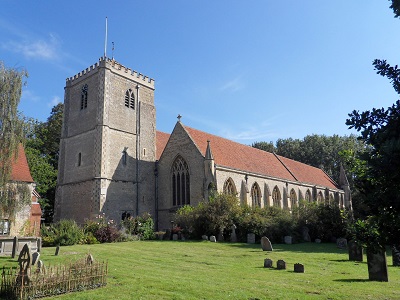 The Romans built a vicus (civilian settlement) here, with a road linked to the military camp at Alchester. In 64 AD, Pope Honorius I sent a bishop, Birinus, to convert the Saxons in this part of the country to Christianity. King Cyneglis of Wessex gave Dorchester to Birinus as the seat of a new Diocese, making it the de facto capital of Wessex. Dorchester was displaced by Winchester when the bishopric was transferred in 660 AD, but later the Mercian Bishop of Leicester transferred his seat to here between, a situation that pertained between 875 and 971 AD. During the 12th century the church was enlarged to serve a community of Augustinian canons. Henry VIII dissolved the abbey in 1536, leaving a small village with a huge parish church. Dorchester Abbey has a history going back to 635 AD, when it was a monastic building. The abbey was richly endowed out of the lands and tithes of the former bishopric.
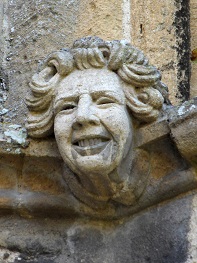 The church is primarily Norman, although there are traces of Saxon masonry on the north side. The sanctuary, dating from 1330, has highly decorated windows as well as ornately carved sedilia and piscina. Other fittings include one of the few surviving lead fonts in England, frescoes of 1340, and the “Swaggering Knight” monument, possibly depicting Sir John Holcombe (d.1270). Today, besides worship the abbey is also noted for hosting the music events of the Dorchester Festival and many other concerts, recitals and drama events. The tower contains eight bells, the seventh and tenor being the oldest, circa 1399, from foundries in Exeter and Wokingham respectively. The third (1651), fourth (1603), fifth (1606) and sixth (1591) are all from the Reading foundry of the Knight family. The front two bells were added in 1867 by Mears & Stainbank, Whitechapel. The town has featured in numerous film and television productions, with the 16th century Old School Room next to the abbey serving as a museum. The most famous of Dorchester’s coaching inns, The George Hotel, dates to 1495 and is one of the oldest such hostelries in the country. Located directly across the road from the abbey, there is a decorative carriage outside and the interior is beautifully furnished. Although on this particular day we had tea and coffee in the abbey due to there being an exhibition taking place which meant refreshments were being served, we have used the George Hotel on several other ringing visits to Dorchester as we know that it serves a large cafetiere of excellent coffee to share.
St Peter & St Paul
Edith Stedman
Steeple Barton & Evenley
Saturday 25th February 2006
10.00am Steeple Barton
Oxon · St Mary (5) 9cwt
11.45pm Evenley
Northants · St George (5) 6cwt
Hugh Deam, Andrew Dunn, Simon Edwards, Roy Jones and Richard Verrall.
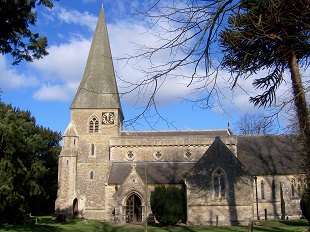
Evenley · St George
Steeple Barton See Saturday 20th September 1986 for details.
Evenley The name of the village denotes a level woodland clearing, having been documented in the Domesday Book as Evelaia. The village is located on what used to be the point where the counties of Northamptonshire, Oxfordshire and Buckinghamshire all met, with the River Great Ouse bordering the parish. Evenley Wood Garden is 60 acre private woodland that houses a varied collection of plants, trees and shrubs. The unusual band of acid soil set within a predominantly alkaline area provides the ideal opportunity to cultivate lilies, rhododendrons, camellias and magnolias, all of which would not ordinarily thrive in this location. Early in the year around 80 varieties of snowdrop carpet the woodland floor, to be followed in late spring by a swathe of bluebells. Evenley has had a church since medieval times, with the Augustinian Huntingdon Priory known to have held the rectory here in 1535. The original building was replaced in 1864/65 by the present church, designed by Henry Woodyer. Memorials salvaged from the previous church were re-set in the present building. Three bells from the old building were also carried over, these all having been cast by the Bagley family at the foundry in Chacombe. In 1865, George Mears & Co of Whitechapel cast the third and tenor.
A record of outings 2005
by Hugh Deam
North Test Valley
Saturday 8th October 2005
10.15am Longparish
Hants · St Nicholas (6) 7cwt
11.15am Goodworth Clatford
Hants · St Peter (8) 7cwt
12.30pm Upper Clatford
Hants · All Saints (6) 9cwt
01.30pm The Crook & Shears
Upper Clatford
03.00pm Abbotts Ann
Hants · St Mary (6) 9cwt
04.15pm Thruxton
Hants · St Peter & St Paul (6) 8cwt
Jonathan Beale, Carole Beckley, Bob Benstead, Jane Burgess, Ron Burgess, Simon Chadwick, Hugh Deam, Andrew Dunn, Adrian Gray, Anthony Hughes, Roy Jones, Susan King, Judith Kirby, Janice Knowles, Peter Lloyd, Bernard Masterman, June Steele, Leon Thompson and Serge Zvegintzov.
Stedman Triples, Grandsire Triples, Cambridge, Little Bob & Plain Bob Minor.

Longparish · St Nicholas
Longparish The village is aptly named given that is stretches to close on two miles in length, encompassing numerous hamlets, whilst following the course of the emergent River Test. Originally known as Middletune, it was documented as Langeparisshe by 1389. The 19th century monument known as Dead Man's Plack is a tall stone cross that recalls Earl Athelwold of Wherwell who was allegedly killed near the site by his rival in love King Edgar the Peaceful in 963 A.D. The monument was erected in 1825 by Lt Col William Iremonger. The village is flanked by low ridges, with the former royal hunting forest of Harewood Forest to the north and west. This area was used during the Second World War for storing ammunition. The 13th century parish church is situated at the western end of the village, in the heart of the old settlement of Middleton.
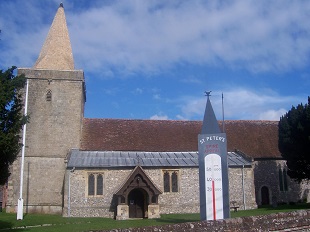 There have been various restorations down the centuries, the most recent being in 1954, when the screen between the nave and chancel was removed. The memorials are mainly of the leading local families, with much of the stained-glass paid for by these families. The window to Major L.G. Hawker VC DSO is a memorial to one of the most successful pilots of World War I, who nonetheless ended up being shot down by the legendary Red Baron in 1916. The turreted tower was built in 1520, with the oldest bells being the second and fifth, cast in 1791 by Robert II Wells at Aldbourne. The other bells are by Taylors of Loughborough, 1936.
Goodworth Clatford The twin Clatford villages straddle the River Anton, one of Hampshire's numerous idyllic clear rivers. The name Clatford derives from the Anglo-Saxon description for a ford where burdock grows. The affix denotes "Goda's enclosure".
There have been various restorations down the centuries, the most recent being in 1954, when the screen between the nave and chancel was removed. The memorials are mainly of the leading local families, with much of the stained-glass paid for by these families. The window to Major L.G. Hawker VC DSO is a memorial to one of the most successful pilots of World War I, who nonetheless ended up being shot down by the legendary Red Baron in 1916. The turreted tower was built in 1520, with the oldest bells being the second and fifth, cast in 1791 by Robert II Wells at Aldbourne. The other bells are by Taylors of Loughborough, 1936.
Goodworth Clatford The twin Clatford villages straddle the River Anton, one of Hampshire's numerous idyllic clear rivers. The name Clatford derives from the Anglo-Saxon description for a ford where burdock grows. The affix denotes "Goda's enclosure".
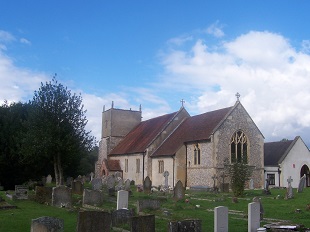 The various rivers and chalk streams between Winchester and Southampton are widely considered to be the birth-place of fly-fishing. The present church structure has grown from what began as a small nave and chancel. To which a south aisle was added late in the 12th century and a north aisle in the 14th century. The tower is also from the 14th century, with the shape of the spire having been changed from square to octagonal. And shingle covered in 1860. The back three bells are from the 17th century, cast by various founders. The third, fourth and fifth are all by Taylors of Loughborough, 1937. The front two bells were added by Whitechapel in 1986. The only problem we encountered here was certainly not the bells as they were excellent, but unfortunately we had two of our party briefly left behind in the toilets after the church had been locked. On the bright side the Clatford churches have the same key-holder and we were able to get him to turn round from journeying to let us in at Upper Clatford.
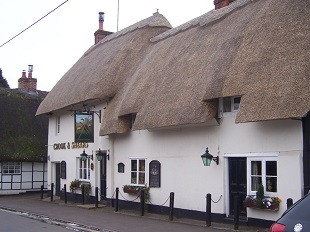 Upper Clatford The canal and later railway were extremely important to the local economy, in particular for the transportation of raw materials from Southampton to Upper Clatford, mainly for Taskers Iron Works. The charming pub we frequented here – The Crook and Shears – is 16th century, thatched, with large inglenooks, and offering a range of real ales and providing nourishing meals. The church consists of chancel, nave, north aisle and vestry, with part of the nave and chancel walls remaining from the 12th century. The vestry was added in 1903, and the tower of 1578 was restored in 1908. The oldest bells are the third and the tenor, cast in 1621 by Anthony Bond. The second bell is from 1674, by Ellis II & Henry III Knight of Reading. The fourth (1700) and fifth (1721) are from the Aldbourne foundry of the Cor family. The treble was added in 1967 by Taylors of Loughborough.
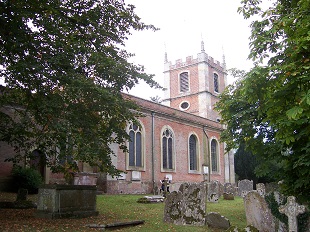 Abbotts Ann The village, just to the west of Anna Valley, is situated on the slopes of Bury Hill, and was originally known as Abbotts Anna (estate on the River Ann belonging to the abbot of Hyde Abbey). At the dissolution of the monasteries under Henry VIII, John Salcot, the last abbot of Hyde, was rewarded for his support of Henry's divorce by being appointed Bishop of Salisbury. In 1710, Thomas Pitt, Governor of Madras, purchased the estate of Abbotts Ann which included the manor house and church. Thomas Pitt was a forebear of William Pitt, Britain's youngest Prime Minister, and he put to use much of the money he made from selling a large Indian diamond to the Regent of France in paying for the rebuilding of the church here in 1716. Much of the grand work is from this period, including font, pulpit, squire's family pew and gallery. The mediaeval custom of awarding virgin's crowns still survives here, the ceremony taking place at the funeral of unmarried local people of good character. The crowns are made of hazel wood and ornamented with paper rosettes, the earliest remaining crown dating to 1740. The tower contains six bells, with the tenor dating to 1607, cast by John Wallis of Salisbury. Fifth by Robert I Wells of Aldbourne, 1764. The second, third and fourth are by Gillett & Johnston, 1939, with the treble added in 1989 by Taylors of Loughborough.
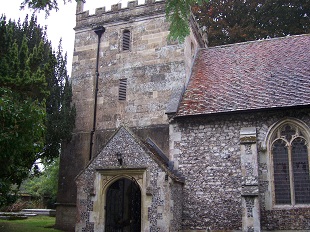 Thruxton First documented as Turkilleston in 1167, the Old Scandinavian name harks at the Viking presence once here. RAF Thruxton was a World War II airfield which opened in 1942 and was used primarily as a combat fighter airfield. It was closed in 1946 and partly returned to agricultural use, with the remainder converted into a glider airfield which still operates today. The Hampshire & Isle of Wight Air Ambulance Service also use it as an operational base. The worldwide note of Thruxton undoubtedly stems from its motor-racing circuit, which yearly hosts a round of the BTCC (British Touring Car Championships) and the Formula 3 Championship. A round of the British Superbike Championship is also held here, although planning restrictions allow no more than 12 days of motorsport to be held in a calendar year. Situated within the south-east corner of the old manorial grounds, the parish church is primarily 13th century and contains the tombs of three knights. This is one of the most richly furnished churches in the county, with many craftsmen and artists drafted in during the 19th century especially. The flint-clad walls and roof of the nave and chancel are adjoined by a broad, but squat, ashlar-faced tower.
The bells are a pleasant six rung from the ground floor. The back two bells are of 1581 and 1600 by John Wallis of Salisbury. The fourth is by an unknown founder, 1616. The front three bells are all from Whitechapel, the current treble being added in 1953.
Thruxton First documented as Turkilleston in 1167, the Old Scandinavian name harks at the Viking presence once here. RAF Thruxton was a World War II airfield which opened in 1942 and was used primarily as a combat fighter airfield. It was closed in 1946 and partly returned to agricultural use, with the remainder converted into a glider airfield which still operates today. The Hampshire & Isle of Wight Air Ambulance Service also use it as an operational base. The worldwide note of Thruxton undoubtedly stems from its motor-racing circuit, which yearly hosts a round of the BTCC (British Touring Car Championships) and the Formula 3 Championship. A round of the British Superbike Championship is also held here, although planning restrictions allow no more than 12 days of motorsport to be held in a calendar year. Situated within the south-east corner of the old manorial grounds, the parish church is primarily 13th century and contains the tombs of three knights. This is one of the most richly furnished churches in the county, with many craftsmen and artists drafted in during the 19th century especially. The flint-clad walls and roof of the nave and chancel are adjoined by a broad, but squat, ashlar-faced tower.
The bells are a pleasant six rung from the ground floor. The back two bells are of 1581 and 1600 by John Wallis of Salisbury. The fourth is by an unknown founder, 1616. The front three bells are all from Whitechapel, the current treble being added in 1953.
Goodworth Clatford
Upper Clatford · All Saints
The Crook & Shears
Abbotts Ann · St Mary
Thruxton · St Peter & St Paul
The Cotswolds
Sunday 25th September 2005
12.30pm Cold Aston
Gloucs · St Andrew (5) 7cwt
01.30pm The Mousetrap Inn
Bourton
03.00pm Naunton
Gloucs · St Andrew (6) 7cwt
Heather Banyard, Jonathan Beale, Carole Beckley, Jane Burgess, Ron Burgess, Alan Coates, Hugh Deam, Andrew Dunn, Anthony Hughes, Roy Jones, Janice Knowles, Peter Lloyd, Paul Lucas, Bernard Masterman, Donna Murphy and Charles Smith.
Cambridge, Plain Bob Minor, Stedman & Grandsire.
Cold Aston Also known as Aston Blank and in times past alternatively as Great Aston, the village stands on high ground at the heart of the Cotswolds. The small village green is overlooked by an elegant Georgian building, Sycamore House, and also the Plough Inn, a 17th century pub which is reputed to be haunted by a benign spirit known as "Old Harry", who was a former landlord here.
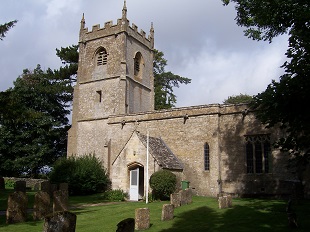
 The first church here was built around 904 A.D. when Wenfrith, Bishop of Worcester, gave land here to his thegn (servant), Wulfsig. This replacement church is Norman, with the walls of the chancel incorporating some of the Saxon stonework. There was a general restoration of the church in 1875. The Perpendicular tower has diagonal buttresses which become straight on the upper stage, and there is a Tudor doorway on the west face surmounted by a masonry tri-part window. The five bells were silent for 50 years until they were restored early this century. The treble, third and fourth were all cast by Abraham I Rudhall of Gloucester, 1717, with the tenor from the same foundry, 1796, by John Rudhall. The second bell is from 1880, by Taylors of Loughborough.
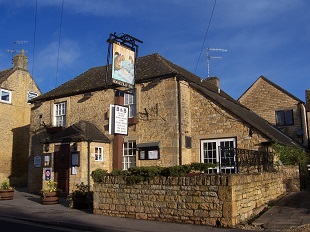
The Mousetrap Inn, Bourton on the Water, was a pleasant surprise. There was a warm welcome, plenty of room, pleasant surroundings, and astoundingly good value meals. It had been one of the hardest searches to find a convenient pub with reasonable prices on Sunday lunchtime, but the effort was rewarded with this historic pub on the edge of town. Highly recommended.
Naunton See Saturday 16th March 2002 for details.
The first church here was built around 904 A.D. when Wenfrith, Bishop of Worcester, gave land here to his thegn (servant), Wulfsig. This replacement church is Norman, with the walls of the chancel incorporating some of the Saxon stonework. There was a general restoration of the church in 1875. The Perpendicular tower has diagonal buttresses which become straight on the upper stage, and there is a Tudor doorway on the west face surmounted by a masonry tri-part window. The five bells were silent for 50 years until they were restored early this century. The treble, third and fourth were all cast by Abraham I Rudhall of Gloucester, 1717, with the tenor from the same foundry, 1796, by John Rudhall. The second bell is from 1880, by Taylors of Loughborough.
The Mousetrap Inn, Bourton on the Water, was a pleasant surprise. There was a warm welcome, plenty of room, pleasant surroundings, and astoundingly good value meals. It had been one of the hardest searches to find a convenient pub with reasonable prices on Sunday lunchtime, but the effort was rewarded with this historic pub on the edge of town. Highly recommended.
Naunton See Saturday 16th March 2002 for details.
Cold Aston · St Andrew
The Mousetrap Inn · Bourton
North Aston
Sunday 24th July 2005
12.30pm North Aston
Oxon · St Mary (6) 6cwt
Heather Banyard, Roy Jones, Bernard Masterman, Bettina Stohr, Hugh Deam,
Susan King, Donna Murphy, Andy Dunn, Peter Lloyd and Charles Smith.
Plain Bob Minor, Stedman, St Simon's & Grandsire.
Susan King, Donna Murphy, Andy Dunn, Peter Lloyd and Charles Smith.
North Aston

St Mary
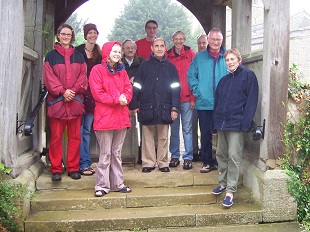
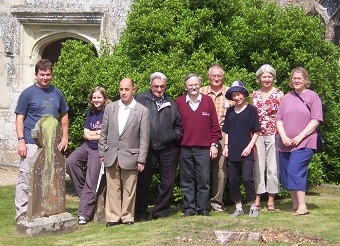
North Aston As the photo on the right rather emphasises, the weather was particularly dreary at the time of our visit, but the church at North Aston is always a splendid location no matter what the elements bring forth. The manor house stands alongside the tower, within touching distance should you put your arm out of the window of the ringing chamber, making it evident that this is a location you will remember. The photo on the left gives some indication as to the proximity of house and tower, and certainly shows what an exceptional situation the church enjoys on a sunny day. The interior bears all the hallmarks of a family chapel that has been extended for the benefit of the village to use as a parish church. We were joined by a visiting German ringer Bettina Stöhr (far left of group photo) who was staying in Oxford for a limited period before returning to Germany. See Saturday 20th September 1986 for more details.
Wylye Valley, Wiltshire
Saturday 9th July 2005
10.15am Stapleford
Wilts · St Mary (6) 8cwt
11.30am Middle Woodford
Wilts · All Saints (6) 8cwt
01.00pm The Boot Inn
Berwick St James
Heather Banyard, Jonathan Beale, Bob Benstead, Hugh Deam, Sally Harrison,
Roy Jones, Judith Kirby, Janice Knowles, Peter Lloyd and Bernard Masterman.
Little Bob Minor, Plain Bob Minor & Stedman.
Roy Jones, Judith Kirby, Janice Knowles, Peter Lloyd and Bernard Masterman.
Stapleford · St Mary
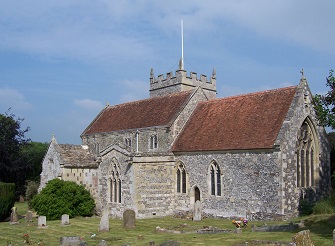
Stapleford · St Mary
Stapleford Denoting a ford marked by a post, the settlement was founded on the course of the River Till, just above its confluence with the River Wylye. Evidence of prehistoric activity here has been uncovered on down-land to the east, and a saddle quern (hand-mill) of the early Iron Age was found in the north-east corner. West of the River Till, a small fortified house (Stapleford Castle) was built in the 12th century for the Hussey family. The mound and ditch are still evident, but no masonry survives. The parish church is Norman in origin and stands below the earthworks on Butts Hill. From the 12th century the church belonged to Salisbury Cathedral until it was appropriated by Easton Priory in 1446. The building's construction is of chalk ashlar and flint, with the north tower built in the 13th century, and upper stage rebuilt in 1674.
 The church was extensively restored in 1861, with some walls and most of the roofs rebuilt. Three bells were hung in the tower in 1553, but replaced in 1655 by Nathaniel Boulter, and two of which still survive. The back three bells are by Mears & Stainbank, 1887 and 1907, with the current treble added in 1999 by Taylors of Loughborough.
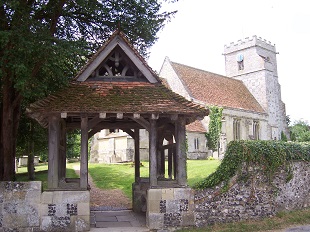
Middle Woodford The village is mentioned during the reign of Henry III through there being a knight called Sir William Woodford of Woodford. A palace frequented by the Bishops of Salisbury existed here, but only a few carved stones remain in situ. In September 1651, the palace was one of several refuges employed by Charles II after defeat at the Battle of Worcester. Situated on the west side of the valley created by the River Avon all three Woodford (Lower, Middle and Upper) villages
The church was extensively restored in 1861, with some walls and most of the roofs rebuilt. Three bells were hung in the tower in 1553, but replaced in 1655 by Nathaniel Boulter, and two of which still survive. The back three bells are by Mears & Stainbank, 1887 and 1907, with the current treble added in 1999 by Taylors of Loughborough.
Middle Woodford The village is mentioned during the reign of Henry III through there being a knight called Sir William Woodford of Woodford. A palace frequented by the Bishops of Salisbury existed here, but only a few carved stones remain in situ. In September 1651, the palace was one of several refuges employed by Charles II after defeat at the Battle of Worcester. Situated on the west side of the valley created by the River Avon all three Woodford (Lower, Middle and Upper) villages
 border this picturesque river, with Lower Woodford water meadows being a 59 acre biological site of Special Scientific Interest, and widely regarded as the best example of a working water-meadow in southern England. The village backs on to Smithen Down on its west, with the former coaching road between Salisbury and Amesbury running through its heart. Also here is Heale House, a stunning example of Georgian architecture dating to 1730, and surrounded by some of the finest gardens in England, enhanced by the adjacent river. Additions of equal note were made to Heale House in 1894 by Detmar Blow. The original 12th century church was rebuilt the following century, with the tower added in the 15th century. The church was substantially restored in 1845, although the tower remained largely unaltered. All six bells date to 1899, cast by Thomas Blackbourn of Salisbury.
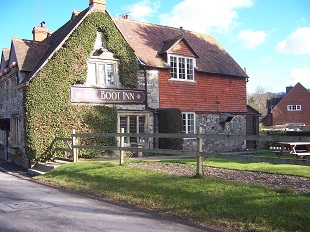
The Boot Inn in Berwick St James is a very attractive and thoughtfully maintained pub with a nicely appointed garden which enhances lunch on a sunny day. Recommended.
border this picturesque river, with Lower Woodford water meadows being a 59 acre biological site of Special Scientific Interest, and widely regarded as the best example of a working water-meadow in southern England. The village backs on to Smithen Down on its west, with the former coaching road between Salisbury and Amesbury running through its heart. Also here is Heale House, a stunning example of Georgian architecture dating to 1730, and surrounded by some of the finest gardens in England, enhanced by the adjacent river. Additions of equal note were made to Heale House in 1894 by Detmar Blow. The original 12th century church was rebuilt the following century, with the tower added in the 15th century. The church was substantially restored in 1845, although the tower remained largely unaltered. All six bells date to 1899, cast by Thomas Blackbourn of Salisbury.
The Boot Inn in Berwick St James is a very attractive and thoughtfully maintained pub with a nicely appointed garden which enhances lunch on a sunny day. Recommended.
Middle Woodford · All Saints
The Boot Inn · Berwick
Streatley & Moulsford
Saturday 11th June 2005
10.00am Streatley
Berks · St Mary (6) 8cwt
11.15am Moulsford
Oxon · St John the Baptist (3) 5cwt
Steve Davies, Hugh Deam, Simon Edwards, Roy Jones, Susan King and Hillary Stevens.
Plain Bob Minor & Stedman.
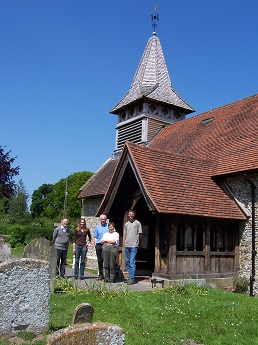
Moulsford · St John
Streatley See Saturday 4th March 2000 for details.
Moulsford The village is situated on the western bank of the River Thames, being first documented as Muleford (Mul’s ford) in 1110, denoting the Saxon chief who founded the settlement. Moulsford was briefly the property of nearby Cholsey, but in 891 AD it passed into the possession of King Alfred, and remained the property of successive monarchs until the manor was sold in 1497 to wealthy city merchant Bartholomew Reed, who became Lord Mayor of London five years later. The manor house that stands today was constructed in the 17th century, and is a sumptuous example of that era. Also in the village is one of the most famous riverside inns on the course of the Thames, namely The Beetle and Wedge, which derives its name from the Anglo Saxon description for a mallet or hammer (bytel). The parish church dates to the 1840’s, having been designed by George Gilbert Scott, and stands adjacent to the marina, with the churchyard on the banks of the river. Although the church is a Victorian construction, the foundations are 13th century, with the elegant tower having been reconstructed as recently as 2002. The three bells are rung from the ground floor and were in exceptionally good order. All three bells were cast in 1847 by William & John Taylor, Oxford.
Northamptonshire
Saturday 21st May 2005
10.30am Ravensthorpe
St Denys (5) 7cwt
11.30am Cold Ashby
St Denys (6) 7cwt
12.30pm Guilsborough
St Etheldreda (6) 8cwt
01.30pm The Ward Arms
Guilsborough
Hugh Deam, Andrew Dunn, Roy Jones, Judith Kirby,
Janice Knowles, Peter Lloyd and Bernard Masterman.
Janice Knowles, Peter Lloyd and Bernard Masterman.
Plain Bob Minor & Stedman Doubles.
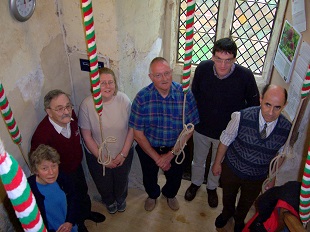
Cold Ashby · St Denys
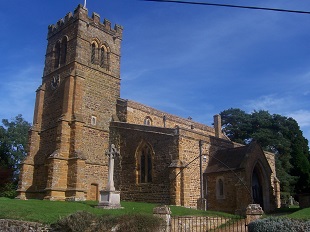
Ravensthorpe Documented as Ravenstorp in 1086, the name of the village denotes earlier Viking ownership. Just to the east of the village is Ravensthorpe Reservoir which was constructed during the Victorian era (1886 – 90). Besides its primary purpose, bird-watchers also have a keen interest in the area, and the National Fly-Fishing Championship heats are often held here. The parish also incorporates Coton and its manor garden, Althorp House, and Holdenby House. The parish church dates from 1290 or thereabouts, and consists of nave, chancel and aisles, with exceptional arches of horseshoe form separating the nave from the aisles. The exterior of the church has a characteristic Northamptonshire façade, with an immaculately maintained churchyard with a wealth of arboreal interest. The bells are rung from the ground floor and would fall into the category of being challenging. The front four date to 1809, cast by John Briant of Hertford. The tenor is from late in that century, 1887, cast be Taylors of Loughborough.
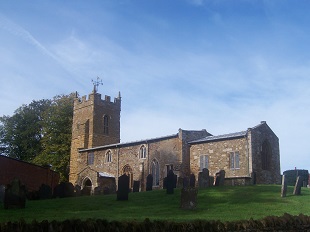 Cold Ashby The village stands at 656ft above sea level and gained its affix due to how exposed the area is to the harshest weather. Even in the 21st century, Cold Ashby is still surrounded by rolling farmland, with agriculture and farming accounting for much of the local economy. The British Ordnance Survey's first triangulation pillar, used by surveyors, is to be found here. Since this initial triangular post a further 11,000 such posts have been erected across the country. The parish church is primarily Early English, although with Saxon origins that are still evident in its arch doorway. The church consists of nave, chancel and west tower, but has no aisles or transepts. The ornate lych-gate, constructed of white and red Ancaster stone, was erected in1883 due to the efforts of Rev Gregory Bateman. The most recent bells is the second, added in 2003 by the Royal Eijsbouts foundry in Assen, Netherlands. The fourth bell, by W. Flint, is dated 1317 and is possibly the oldest bell in the world currently hung for change ringing. The back two bells are also of considerable age, dating to 1606.
Guilsborough Only one wall now remains of what was a Roman fort, the encampment having been an outpost for West Haddon. This structure is believed to have been ordered built by Roman statesman and general, Publius Ostorius Scapula, under the reign of Emperor Claudius. Early in the 17th century witch trials were conducted at Northampton, with two of those hung hailing from Guilsborough.
Cold Ashby The village stands at 656ft above sea level and gained its affix due to how exposed the area is to the harshest weather. Even in the 21st century, Cold Ashby is still surrounded by rolling farmland, with agriculture and farming accounting for much of the local economy. The British Ordnance Survey's first triangulation pillar, used by surveyors, is to be found here. Since this initial triangular post a further 11,000 such posts have been erected across the country. The parish church is primarily Early English, although with Saxon origins that are still evident in its arch doorway. The church consists of nave, chancel and west tower, but has no aisles or transepts. The ornate lych-gate, constructed of white and red Ancaster stone, was erected in1883 due to the efforts of Rev Gregory Bateman. The most recent bells is the second, added in 2003 by the Royal Eijsbouts foundry in Assen, Netherlands. The fourth bell, by W. Flint, is dated 1317 and is possibly the oldest bell in the world currently hung for change ringing. The back two bells are also of considerable age, dating to 1606.
Guilsborough Only one wall now remains of what was a Roman fort, the encampment having been an outpost for West Haddon. This structure is believed to have been ordered built by Roman statesman and general, Publius Ostorius Scapula, under the reign of Emperor Claudius. Early in the 17th century witch trials were conducted at Northampton, with two of those hung hailing from Guilsborough.
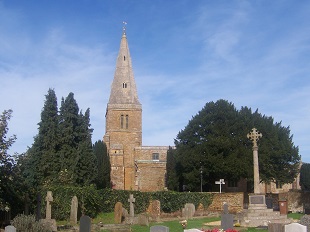
 Agnes Brown and her daughter Joan Vaughan were found guilty of bewitching a local noblewoman and her brother in law, and of killing, by means of sorcery, a child and numerous livestock. The parish church was founded in Saxon times by the monks of Brixworth and originally dedicated to St Wilfred. The tower is 13th century, with much rebuilding the main body of the church in the years after 1815 and 1923. All six bells were either cast or recast in 1847 by Charles & George Mears, Whitechapel.
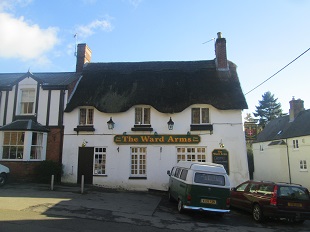
The Ward Arms in Guilsborough. An unassuming pub with a distinct Midlands feel about it. Sensibly priced meals.
Agnes Brown and her daughter Joan Vaughan were found guilty of bewitching a local noblewoman and her brother in law, and of killing, by means of sorcery, a child and numerous livestock. The parish church was founded in Saxon times by the monks of Brixworth and originally dedicated to St Wilfred. The tower is 13th century, with much rebuilding the main body of the church in the years after 1815 and 1923. All six bells were either cast or recast in 1847 by Charles & George Mears, Whitechapel.
The Ward Arms in Guilsborough. An unassuming pub with a distinct Midlands feel about it. Sensibly priced meals.
Ravensthorpe · St Denys
Cold Ashby · St Denys
Guilsborough · St Etheldreda
The Ward Arms · Guilsborough
Training Morning
Saturday 7th May 2005
09.45am Shiplake
Oxon · St Peter & St Paul (8) 9cwt
12.30pm South Stoke
Oxon · St Andrew (6) 9cwt
01.45pm The Perch & Pike
South Stoke
Jonathan Beale, Bob Benstead, Simon Chadwick, Hugh Deam, Andrew Dunn, Roy Jones, Susan King, Anthony Hughes, Judith Kirby, Janice Knowles, Peter Lloyd, Bernard Masterman, Susan Morrison, Donna Murphy and June Steele.
Grandsire Triples & Plain Bob Minor.
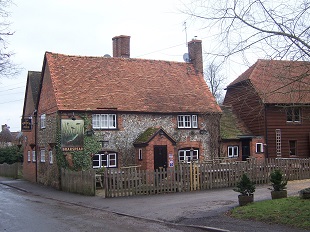
The Perch & Pike · South Stoke
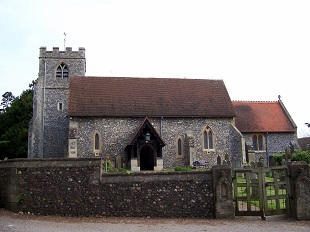
Shiplake · St Peter & St Paul
Shiplake Taking its name from the Anglo-Saxon description of a sheep stream, the village is situated on the western bank of the River Thames. In 1773 Shiplake Lock was constructed just down-river of the village. A century later, Jerome K Jerome featured the village in his classic Three Men in a Boat. Shiplake College, which overlooks the river, was originally built as a country house known as Shiplake Court. Akin to Henley, rowing and boating play a prominent part in Shiplake's countenance. The Wargrave & Shiplake Regatta was founded in 1867 and continues to be held annually. The parish church, originally of the late 14th century, was almost entirely rebuilt by G.E. Street in 1869 and reflects his Gothic Revival traits. The longest serving Poet Laureate, Alfred, Lord Tennyson was married to his childhood friend Emily Sellwood at the church here in 1850. The earliest mention of bells in the tower is in an inventory from the time of Edward VI (1547 – 1553) when there were three bells.
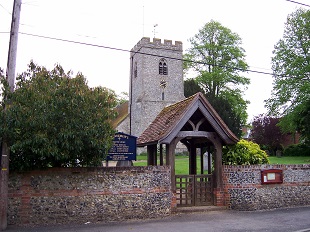 In commemoration of Queen Victoria's reign the then five bells were increased to eight in 1902. A new ring of eight bells, cast by Whitechapel, were installed in 2010, with the tower set up as a sound controlled Ringing Centre.
South Stoke The village retains several 16th century cottages as well as the famous 18th century coaching inn, The Perch & Pike, situated on the route of the Ridgeway. We have visited this pub a couple of times and enjoyed the warm atmosphere. The railway bridge that crosses the river here was built between 1838 and 1840, being one of the projects of the great Isambard Kingdom Brunel. The parish church, constructed of local flint rubble, is essentially an Early English building, although much restored in 1850. The font is 14th century, and also of note is the supremely elaborate monument of 1659 to Griffith Higgs, chaplain to the Queen of Bohemia and Dean of Lichfield. The west tower is early 15th century, with the original four bells replaced or recast by the Knight family at their foundry in Reading during the 17th century. Two more bells have been added by Whitechapel since, the fourth in 1881 and the treble in 1920. The upper ringing chamber was installed in 1962, with the bells excellent to ring, although the ceiling is noticeably low.
In commemoration of Queen Victoria's reign the then five bells were increased to eight in 1902. A new ring of eight bells, cast by Whitechapel, were installed in 2010, with the tower set up as a sound controlled Ringing Centre.
South Stoke The village retains several 16th century cottages as well as the famous 18th century coaching inn, The Perch & Pike, situated on the route of the Ridgeway. We have visited this pub a couple of times and enjoyed the warm atmosphere. The railway bridge that crosses the river here was built between 1838 and 1840, being one of the projects of the great Isambard Kingdom Brunel. The parish church, constructed of local flint rubble, is essentially an Early English building, although much restored in 1850. The font is 14th century, and also of note is the supremely elaborate monument of 1659 to Griffith Higgs, chaplain to the Queen of Bohemia and Dean of Lichfield. The west tower is early 15th century, with the original four bells replaced or recast by the Knight family at their foundry in Reading during the 17th century. Two more bells have been added by Whitechapel since, the fourth in 1881 and the treble in 1920. The upper ringing chamber was installed in 1962, with the bells excellent to ring, although the ceiling is noticeably low.
South Stoke · St Andrew
The Mole Valley · Surrey
Saturday 2nd April 2005
10.45am Buckland
Surrey · SMV (6) 6cwt
11.45am Betchworth
Surrey · St Michael (8) 11cwt
12.45pm Leigh
Surrey · St Bartholomew (6) 7cwt
01.30pm The Plough
Leigh
03.00pm Newdigate
Surrey · St Peter (6) 8cwt
John Beale, Jonathan Beale, Julie Beale, Bob Benstead, Victor Coles, Hugh Deam, Adrian Gray, Susan King, Janice Knowles, Bernard Masterman, Donna Murphy, Ailsa Reid and Serge Zvegintzov.
Grandsire Triples, Double Oxford, Little Bob and Plain Bob.
The Mole Valley takes its name from one of England's most attractive and clearest rivers, namely the River Mole. The valley contains an array of stunning landscapes dotted with small villages spread out over generally open areas, and market towns steeped in history. The area is noted for its clay soil and became home to brick manufacturing in centuries past.
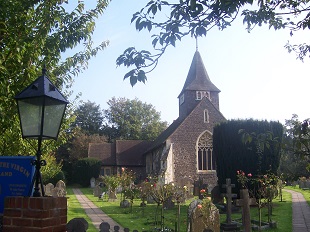 Buckland Named in the Domesday Book as Bochelant, the name of the settlement referred to charter land created by an Anglo-Saxon royal diploma. The village is one of the most photogenic in the county, with a large green (one of three in the village) and pond close together at its central crossroads. Buckland is probably at its most glorious in the spring due to the proliferation of cherry trees in blossom. The windmill here is the only known surviving wind-powered saw-mill in the country. The parish church was rebuilt in 1860 by Henry Woodyer in the original 14th century style, and boasts intensely coloured stained-glass as well as a diligently maintained timber belfry with wood-shingled spire. The church is attractively situated next to the enormous village pond. A few days after our visit the bells were removed in order to be re-tuned and re-hung. Details are available here.
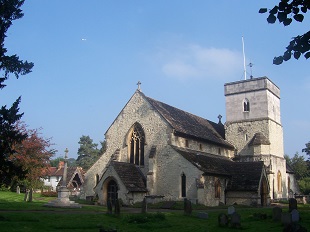 Betchworth The village lies on the north bank of the River Mole, with the ruins of a fortified medieval house, Betchworth Castle, built on a sandstone spur overlooking the river, in an area that has since been transformed into a golf course. Begun as an earthwork fortress in the 11th century, it was turned into a stone castle in 1379 by Sir John FitzAlan. Partly demolished by the 18th century, the remains were then treated as a folly. The 13th century parish church underwent a series of major alterations during Victorian times, the lavish pulpit of this time being surrounded by multi-coloured marble decorated mosaic figures representing Faith, Hope and Charity. The church served as a location in the massively successful 1990s rom-com, Four Weddings and a Funeral. In 1851 the central Norman tower was demolished and the present chancel arch formed. A new tower was constructed over the south transept. In 1897 the bells were augmented to the present ring of eight, being re-hung, 1984/85, in a new steel frame. The back five bells date to 1876 by William Blews of Birmingham, with the front three by Mears & Stainbank.
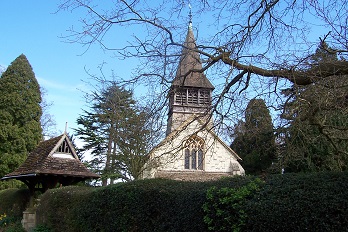
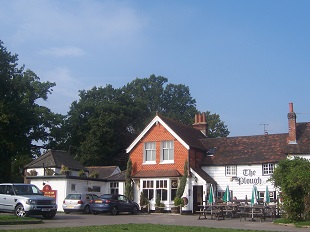 Leigh The village enjoys a secluded position in the heart of the weald, retaining an attractive village green and a delightful 18th century coaching inn, The Plough. We were treated to one the best lunches imaginable at this well maintained pub. The 15th century parish church was extensively renovated during the Victorian era, with a new stone tower built in 1866 to replace the wooden original. Matching the elegant church building is the beautifully manicured graveyard. The choir and bell-ringers have to share the gallery for their respective practices. Several of the bells have to be rung by standing on the pews. Prior to 1965 the bells were rung from the ground floor, and as the bell-frame was in need of strengthening the decision was taken to move the ringing position upstairs. The bells are all by Mears & Stainbank, 1889.
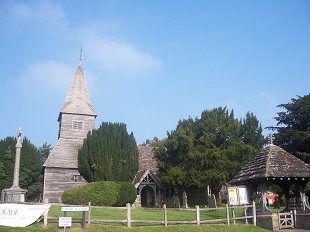 Newdigate Taking its name from the Anglo-Saxon description for a gate by the new wood, the settlement here in 1167 was noted as Niudegate. From the 1930's until the 1980's, Newdigate was home to the Schermuly Rocket Pistol Apparatus Co., manufacturing devices for firing rescue lines to stricken ships, with a test firing range being here also. The parish church is positioned at the highest point of the village and is still mostly surrounded by the panoply of ancient yew trees. The church was substantially reconstructed from the original stone in 1875, although many 12th century features remain to varying degrees, such as chancel, nave and south aisle. The belfry tower remains from the 15th century and there is a scale model of the church made out of matchsticks on show inside. In 1985 the spire was re-tiled with 1,500 shingles cut from local oak trees. The 60ft tower, built entirely of oak, houses six bells recast in 1969 by Whitechapel, the original set having been cast there in 1803. At the time of the recasting, the bells were re-hung with mainly new fittings in the original framework.
Upon entering Buckland
Buckland · SMV
Betchworth · St Michael
Leigh · St Bartholomew
The Plough · Leigh
Newdigate · St Peter
The Cotswolds
Saturday 26th February 2005
10.00am Fulbrook
Oxon · St James Gt (6) 5cwt
11.15am Alvescot
Oxon · St Peter 9cwt (6)
12.15pm Lechlade
Gloucs · St Lawrence (6) 13cwt
01.15pm The Red Lion
Lechlade
Heather Banyard, Hugh Deam, Andrew Dunn, Anthony Hughes, Roy Jones, Susan King, Judith Kirby, Janice Knowles, Peter Lloyd, Donna Murphy, Hilary Nex and Hillary Stevens.
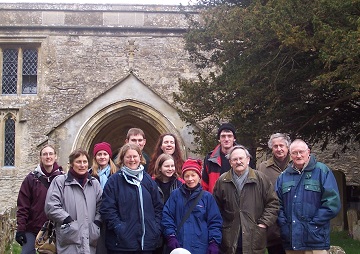
Fulbrook
Fulbrook The Domesday Book (1086) documents the settlement as Fulebroc (a foul or dirty brook). Although within a mile of Burford, the village has always been a separate entity, having been on the edge of Wychwood Forest, with the manor held by Hugh le Despenser, Earl of Winchester and his successors, from the Norman Conquest until the middle of the 14th century. The trio of Tom, Dick and Harry is thought to be attributed to the Dunsden brothers, who came from a respected local family, but who turned to crime as notorious highwaymen, regularly holding up the Oxford to Gloucester coach. Boasting of their nefarious deeds in the Bird in Hand Inn led to two of them being put to death on Habber Gallows Hill. A period of sustained prosperity arose from the wool trade in the 13th century, and as a result the Norman church was enlarged. There are traces of earlier Saxon work in the herring-bone external walling on the south side of the nave. The tower was built into the west bay of the nave in the 15th century and has a 13th century lancet to the west. By the end of the 19th century the church had fallen into a poor structural condition and a major restoration began in 1892. Until 2003 there were just three bells hung for full-circle ringing. The tenor and original treble were cast in Burford by Edward Neale in 1662, with the second (now fifth) cast in 1732 by Henry III Bagley in Witney.
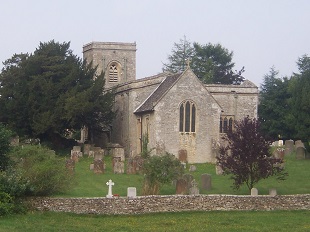
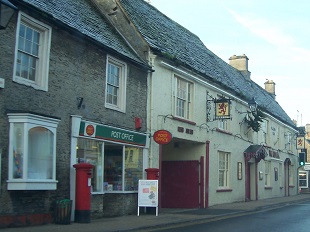 In 2004 a new bell-frame with a ring of six was installed, the third bell by Taylors of Loughborough, 1968, and the other bells by Whitechapel, 2003. The original treble now resides in Burford church.
Alvescot and Lechlade See 23rd October 1999 for details.
The Red Lion, Lechlade. An unassuming pub, just to the south of the church, that offers meals at good value prices.
In 2004 a new bell-frame with a ring of six was installed, the third bell by Taylors of Loughborough, 1968, and the other bells by Whitechapel, 2003. The original treble now resides in Burford church.
Alvescot and Lechlade See 23rd October 1999 for details.
The Red Lion, Lechlade. An unassuming pub, just to the south of the church, that offers meals at good value prices.
Fulbrook · St James Gt
The Red Lion · Lechlade
Oxfordshire
Saturday 29th January 2005
Steeple Barton
St Mary (5) 9-3-1 in Ab
Duns Tew
St Mary Magd (5) 14½cwt in F
Hugh Deam, Simon Edwards, Roy Jones, David Lane, Katie Lane & Richard Verrall.
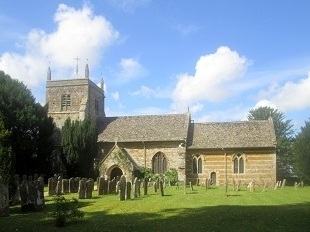
Duns Tew · St Mary Magd
Steeple Barton See Saturday 20th September 1986 for details.
Duns Tew Noted in 1210 as Donestiua, the manorial affix stems from an early possession by the Dunn family. The toponym Tew refers to a ridge, with the village situated within a fault between the limestone to the south, and clay to the north. Although there is still a pub in the village (The White Horse), a former coaching inn, there are no longer any shops here, which is in stark contrast to a century ago when there were numerous shops and allied tradesmen. The elegant medieval church is exceptionally well appointed, with an assiduously maintained churchyard. An appeal in 1985 helped in raising the necessary funds in order to return the church roof to its former glory. The original tower collapsed in 1647, damaging the south side of the church. Rebuilt some twenty years later, the tower houses five bells, with the second (Richard Keene, Woodstock 1668) surviving from this time, and the third bell from the same foundry in 1694. The other three bells were all cast at different foundries. Tenor - 1768 - Henry III Bagley, Chacombe. Treble - 1790 - Robert II Cor, Aldbourne. Fourth - 1858 - Charles & George Mears, Whitechapel. The bells are rung from the ground floor and have an excellent tone.
A record of outings 2004
by Hugh Deam
Oxfordshire
Saturday 27th November 2004
10.00am Great Haseley
St Peter (6) 11cwt
11.30am Little Milton
St James (6) 11cwt
Steve Davies, Hugh Deam, Roy Jones, Susan King, Bernard Masterman and Hillarie Rogers.
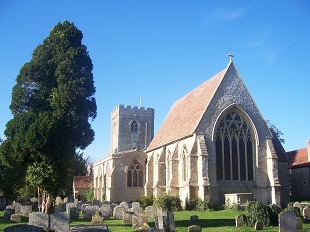
Great Haseley · St Peter
Great Haseley A settlement here in 1002 was noted as Haeseleia (a clearing in a hazel wood), with a Domesday Book notation as Haselie. Both Great Haseley and its smaller neighbour, Little Haseley, are predominantly stone-built villages with Latchford, North Weston, plus the house, chapel and park of Rycote all within the parish. The 19th century barrister, MP, and English Rugby Union international, Alfred St George Hammersley was born in the village. He played in the first International rugby match, captained his country, and pioneered the sport in New Zealand and Canada. The main road approaching Haseley passes a currently derelict tower-mill. The mill’s one and a half surviving sail-beams have made it a distinctive, if somewhat sad, fixture on the A329. Internally, the structure and machinery remain intact, with a trust aimed at restoring the mill having been set up in recent years. The Grade 1 Listed tithe barn in the village was built in 1313 and is buttressed on all sides, originally having a cruck frame of nine bays. The three most easterly bays were demolished and rebuilt as an arcaded structure at the end of the 15th century, and in 1811 the three most westerly bays collapsed but were not rebuilt. The parish church dates from about 1200, with the 3-bay arcades linking the nave with the north and south aisles being in a Transitional style from Norman to Early English Gothic. The chancel was restored in 1897 by the Gothic Revival architect Thomas Gardner. The tower housed a ring of four bells as far back as 1552, all of which have since been recast. In 1641 Ellis I Knight of Reading recast what are now the fourth and fifth bells and cast a new bell (now the second). Thomas Rudhall of Gloucester recast the tenor in 1774. The present treble and third bells were recast by Gillett & Johnston at their Croydon foundry in 1925, an event that was watched by King George V and Queen Mary.
Little Milton See Saturday 28th April 2001 for details.
Training Morning
Saturday 6th November 2004
10.00am Middleton Stoney
Oxon · All Saints (6) 9cwt
11.30am Piddington
Oxon · St Nicholas (5) 8cwt
01.00pm The Nut Tree
Murcott
Heather Banyard, Jonathan Beale, Jonathan Cresshull, Hugh Deam, Andrew Dunn,
Simon Edwards, Roy Jones, Janice Knowles, Paul Lucas, Bernard Masterman,
Charles Smith, Hillary Stevens and Richard Verrall.
Cambridge & Stedman.
Simon Edwards, Roy Jones, Janice Knowles, Paul Lucas, Bernard Masterman,
Charles Smith, Hillary Stevens and Richard Verrall.
Middleton Stoney A settlement existed here by the time of Edward the Confessor, with the western boundary of Aves Ditch being pre-Saxon. Records of 1215 describe a motte and bailey castle standing here. In 1824/25 George Child Villiers, 5th Earl of Jersey, demolished the original village and manor house in order to make way for an expansion of Middleton Park, and thus left the castle mound and church isolated within the extended parkland. His wife Sarah Villiers, Countess of Jersey, directed the construction of new cottages on the edge of the park, each with a rustic porch and flower garden, thus forming the nucleus of the current village. The present mansion of Middleton Park is a neo-Georgian country house from 1938, designed by Edwin Lutyens and his son Robert for the 9th Earl of Jersey. The earliest parts of the church are Norman, dating from the 12th century,
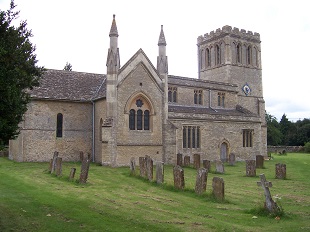
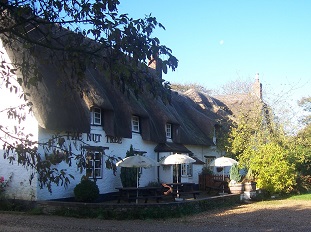 although there was extensive restoration and alteration during the 19th century. During 1805 the Jersey Chapel was built on the north side of the chancel in order to contain the family monuments. In 1552 there were three bells in the tower, but these were superseded by five bells cast at the Chacombe foundry of Henry III Bagley in 1717. Mears & Stainbank re-hung and re-cast the tenor in 1883, adding the treble at this time. The fifth was re-cast two years later. The bells are rung from the ground floor and require deft handling.
Piddington See Saturday 28th March 1998 for details.
The Nut Tree, Murcott is a decorous thatched pub, with a pond directly in front playing host to a paddling of ducks. The pub has a cosy atmosphere inside making it an ideal venue on a cold day.
although there was extensive restoration and alteration during the 19th century. During 1805 the Jersey Chapel was built on the north side of the chancel in order to contain the family monuments. In 1552 there were three bells in the tower, but these were superseded by five bells cast at the Chacombe foundry of Henry III Bagley in 1717. Mears & Stainbank re-hung and re-cast the tenor in 1883, adding the treble at this time. The fifth was re-cast two years later. The bells are rung from the ground floor and require deft handling.
Piddington See Saturday 28th March 1998 for details.
The Nut Tree, Murcott is a decorous thatched pub, with a pond directly in front playing host to a paddling of ducks. The pub has a cosy atmosphere inside making it an ideal venue on a cold day.
Middleton Stoney · All Saints
The Nut Tree · Murcott
Royal Forest of Dean
Saturday 9th October 2004
10.45am Newnham on Severn
Gloucs · St Peter (8) 17cwt
11.45am Littledean
Gloucs · St Ethelbert (6 now 8) 10cwt
12.45pm Blaisdon
Gloucs · St Michael (6) 7cwt
01.45pm The Red Hart Inn
Blaisdon
03.00pm Longhope
Gloucs · All Saints (8) 10cwt
04.00pm Huntley
Gloucs · St John the Baptist (6) 7cwt
05.00pm Churcham
Gloucs · St Andrew (6) 13cwt
Heather Banyard, Jonathan Beale, Bob Benstead, Jane Burgess, Ron Burgess, Hugh Deam, Rev Anthony Ellis, Roy Jones, Susan King, Judith Kirby, Janice Knowles, Peter Lloyd, John Lonsborough, Bernard Masterman, Suzette Reynolds, Hillary Stevens, Richard Verrall and Serge Zvegintzov.
Stedman Triples, Grandsire Triples, Cambridge, Double Oxford, Little Bob & Huntley.
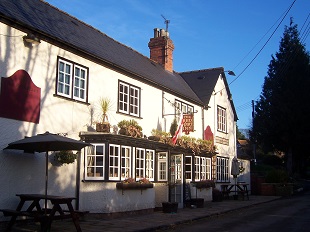
The Red Hart Inn · Blaisdon
The Royal Forest of Dean, also known as the "Queen of Forests", is one of this country's somewhat undiscovered gems. The main source of employment was forestry, charcoal production, iron working and coal mining. Archaeological studies have dated the earliest mining to Roman times, with the basin similar to the South Wales coalfields. During the 17thcentury the forest had the highest concentration of iron furnaces and forges in the UK. The 27,000 acres of woodland here were designated as a National Forest Park in 1938. The Forest "verderers" have existed since 1218, their job being to protect the vegetation and wildlife. JRR Tolkien, JK Rowling and Dennis Potter have all resided in the area and been influenced by it in their work. James and William Horlick, inventors of the eponymous malted milk drink, were born in Ruardean. Today visitor attractions such as the Dean Forest Railway, Heritage Centre, Puzzlewood and Clearwell Caves reflect the history of the area.
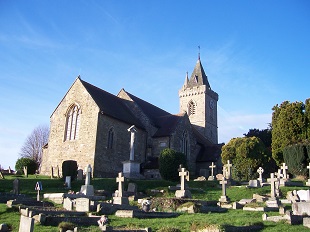 Newnham on Severn The name denotes a new homestead, the settlement being documented as Neuneham in 1086. The River Severn makes a giant loop between Allingham on the eastern bank and Newnham on the westerly bank, with fossil-bearing Jurassic limestone regularly being exposed. In 1810 an early attempt at a Severn Tunnel began construction here, but the work was abandoned two years later after flooding. The Romans built three roads through the area, and also forded the river. From mediaeval times Newnham became a major port with links around the British Isles. With the opening of the Gloucester & Sharpness Canal in 1827, Newnham's role as a trading hub declined. The original 11th century chapel of ease here faced constant erosion from the river and this 14th century replacement church was built on slightly higher ground. A gunpowder explosion of 1644 during the Civil War and a fire in 1881 have both left their imprint on the present church. The bells are rung from the ground floor and are quite challenging. The two-tier bell-frame is set high in the tower and dates from the same year as the bells, 1894, the work of Mears & Stainbank.
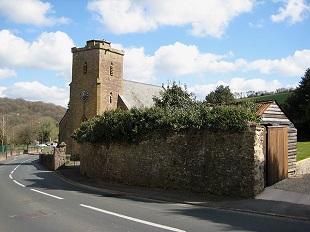 Littledean Originally noted simply as Dene (a valley) in the Domesday Book, the village had gained its affix by 1220 when documented as Parva Dene, distinguishing it from nearby Mitcheldean. The manor house of Littledean Hall is possibly the oldest inhabited house in England, being 6th century, with Saxon and Celtic remains still visible throughout its cellars, the upper rooms having mostly been rebuilt in 1612. The remains of a Roman temple are situated in the grounds. The house is also reputed to be amongst the most haunted in the country. Littledean Gaol was constructed using local red sandstone and is one of four such gaols built across England by Sir George Onesiphorus Paul in 1791, and easily the best preserved. Littledean grew at the centre of a network of ancient forest tracks and gradually became a centre for iron making and associated metal trades. The parish church was built in the latter half of the 12th century, with the tower added in the 14th century. The truncated appearance of the tower is due to the spire having been destroyed by a severe gale in 1894. The bells were restored and rehung in 2005 by Whites of Appleton and the front two bells added by Whitechapel. The fourth bell is by Gillett & Johnston, 1894, and the other five bells by William Evans of Chepstow, 1752.
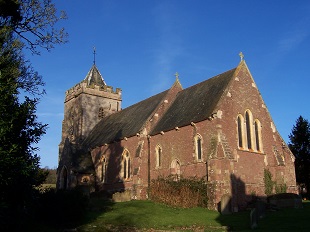 Blaisdon The village was long characterised by its profusion of plum orchards, producing the variety known as the Blaisdon Red. The density of these orchards has shrunken greatly in recent years, with there now being more apple and pear orchards. Visitors can sample the Blaisdon Red plum, amongst others on offer, at the pub, the Red Hart Inn, on its annual "Plum Day" in August. We enjoyed an excellent lunch at this strikingly picturesque pub, the exterior of which is garlanded by flower-filled hanging baskets. This area is very much the home of the Orchard Pig, better known as the Gloucester Old Spot, a breed which has returned to prominence in recent years, and also has a treble bob ringing method named after it. The Blaisdon Stud Farm was the home of the world's largest Shire horse, Blaisdon Conqueror, whose skeleton is housed in the British Museum. The parish church retains its 15th century tower, with the main body of the church having been rebuilt 1867 – 69 to the designs of FR Kempson of Hereford, who primarily worked on churches in the Llandaff Diocese. There are several 18th and 19th century monuments in the tower base and a painted board recording the fire which burnt down most of the village in 1699. The tower is of 2-stages with diagonal corner buttresses and a battlemented parapet with short spire atop. The bells are rung from the ground floor, all cast in 1921 by Mears & Stainbank.
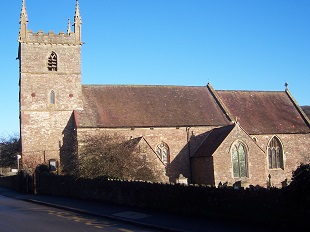 Longhope The village stands in the shadow of May Hill which is populated by clump of trees at its apex. The hill was originally known as Yarleton Hill, but renamed because of the May day events held there, with Morris Dancers heralding the new dawn. Opposite the parish church is "Court Leet", which was once the local court, with the adjacent half-timbered cottage having been the gaol. All Saints church dates back to Norman times, but was heavily restored during the 1860's, with the late Norman west tower partially rebuilt at this time. The tower was originally capped by a spire, but sufficient funds did not exist for its rebuilding. The original ring of six bells was re-tuned in 1921 and rehung in a new frame. Two new bells were cast by Taylors of Loughborough in 1985, and the ringing chamber floor installed by Arthur Berry. The fifth bell is the oldest (1700) cast by Abraham I Rudhall of Gloucester. The fourth is from the same foundry (1829). The other four bells are all by Mears & Stainbank.
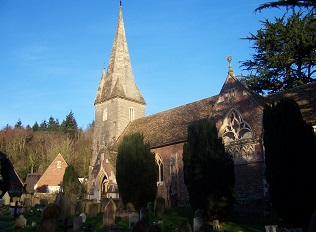 Huntley The Domesday Survey documents the settlement here at that time as Huntelei (huntsman's wood or clearing). Huntley Quarry exposes volcaniclastic sedimentation unique to this area, with moves afoot to make this a geology reserve. Huntley was the scene of sustained skirmishing during the English Civil War, changing hands several times. The village retains a number of apple and pear orchards, and the only remaining set of stocks in the Forest of Dean. The church is situated adjacent to the entrance of a garden centre that has been designed to blend in with the wooded locale. In the 19th century a new church was effectively built on to the 11th century tower. It was designed by Samuel Sanders Teulon, with stonework finished in local red sandstone and honeyed Cotswold stone. The oldest bell in the tower is the fifth, cast in 1410 at a foundry in Worcester.
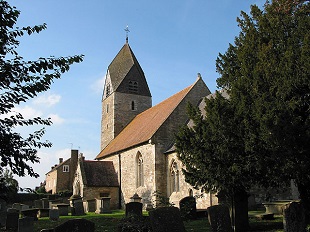 The most recent bells (treble, three, tenor) were all cast by John Warner & Sons late in the 19th century.
Churcham The village is bounded by the River Severn on the east, by the Ley and Long brooks to the south, and by the River Leadon on the north. Although this is a primarily low lying area there is a spur of high ground at Rodway Hill in the centre of the parish. The parish church is one of the most distinctive in the county due to its highly unusual Rhenish Helm tower, which is not from the time of the rest of the building. It was constructed when the church was re-worked in 1878 after a devastating fire destroyed the timber spire, bells and wooden roof. There is the sculpture of a small Romano-British figure set above the north doorway which dates from 3 A.D. In the churchyard is the grave of Henry Hooke, one of the soldiers awarded the VC after the defence of Roarke's Drift during the 1879 Zulu Wars. He was memorably played by James Booth in the 1964 movie Zulu, although in reality Hooke was a model soldier rather than the roguish figure portrayed in the film. The tower houses six bells, all of which were cast by John Warner of London in 1876.
The most recent bells (treble, three, tenor) were all cast by John Warner & Sons late in the 19th century.
Churcham The village is bounded by the River Severn on the east, by the Ley and Long brooks to the south, and by the River Leadon on the north. Although this is a primarily low lying area there is a spur of high ground at Rodway Hill in the centre of the parish. The parish church is one of the most distinctive in the county due to its highly unusual Rhenish Helm tower, which is not from the time of the rest of the building. It was constructed when the church was re-worked in 1878 after a devastating fire destroyed the timber spire, bells and wooden roof. There is the sculpture of a small Romano-British figure set above the north doorway which dates from 3 A.D. In the churchyard is the grave of Henry Hooke, one of the soldiers awarded the VC after the defence of Roarke's Drift during the 1879 Zulu Wars. He was memorably played by James Booth in the 1964 movie Zulu, although in reality Hooke was a model soldier rather than the roguish figure portrayed in the film. The tower houses six bells, all of which were cast by John Warner of London in 1876.
Newnham on Severn · St Peter

Littledean · St Ethelbert
Blaisdon · St Michael
Longhope · All Saints
Huntley · St John the Baptist

Churcham · St Andrew
Ermin Way
Saturday 10th July 2004
10.00am Oaksey
Wilts · All Saints (6) 9cwt
11.00am Ashton Keynes
Wilts · Holy Cross (6) 12cwt
12.30pm Castle Eaton
Wilts · SMV (6) 7cwt
01.30pm The Red Lion
Castle Eaton
Heather Banyard, Jonathan Beale, Jane Burgess, Ron Burgess, Bob Benstead, Hugh Deam, Andrew Dunn, Roy Jones, Susan King, Janice Knowles, Peter Lloyd and Bernard Masterman.
Cambridge, Little Bob, Stedman and St Simon's.
The picturesque 40 square mile Cotswold Water Park comprises a large patchwork of lagoons that came about as a result of extensive gravel workings. These lime-rich lakes, which total 150 in number, play host to some endangered species, such as water-rails, grasshopper warblers and garganey. Besides the lakes there is the largest inland beach in the UK.
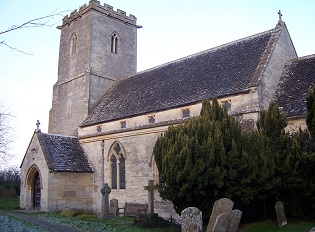
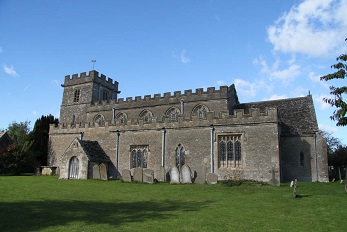 Oaksey is a long village, sited just to the south of Akeman Street and adjacent to two of the nature reserves, Swillbrook Lakes and Cokes Pit, plus the picnic site and recreation area at Neigh Bridge. Oaksey Woods are particularly resplendent in late spring with the bluebells are at their peak, carpeting the woodland floor. The parish church dates to the first half of the 12th century in its nave walls, with the chancel rebuilt the following century, along with the addition of the three-bay south aisle and south porch. Of the numerous 15th and 16th century wall paintings, those that survive today include a depiction of St Christopher with a mermaid and Christ surrounded by instruments of torture as a warning to Sabbath breakers. The three original 16th century bells were replaced in 1773 by a new six from the Gloucester foundry. In 1960 they were recast by Taylors of Loughborough. The church set a high standard for its photogenic appearance and quality of its bells.
Ashton Keynes This ancient village, documented in 880 A.D. as Aesctun (a farmstead where ash-trees grow), is built around the fledgling River Thames to such a degree that there are half a dozen bridges within its confines, with the village noted for its rows of honeyed stone cottages. Situated at the western extremity of the village, the 13th century church retains its Norman chancel arch, and a font from the original chapel. The church was restored by William Butterfield in 1876/77. The churchyard to the rear is diligently kept and offers the most photogenic view of the church. The west tower is Perpendicular with battlements and an array of gargoyles. The back four bells are by Abel Rudhall of Gloucester, 1709 and 1713. The current treble was added in 1994 by Taylors of Loughborough.
Oaksey is a long village, sited just to the south of Akeman Street and adjacent to two of the nature reserves, Swillbrook Lakes and Cokes Pit, plus the picnic site and recreation area at Neigh Bridge. Oaksey Woods are particularly resplendent in late spring with the bluebells are at their peak, carpeting the woodland floor. The parish church dates to the first half of the 12th century in its nave walls, with the chancel rebuilt the following century, along with the addition of the three-bay south aisle and south porch. Of the numerous 15th and 16th century wall paintings, those that survive today include a depiction of St Christopher with a mermaid and Christ surrounded by instruments of torture as a warning to Sabbath breakers. The three original 16th century bells were replaced in 1773 by a new six from the Gloucester foundry. In 1960 they were recast by Taylors of Loughborough. The church set a high standard for its photogenic appearance and quality of its bells.
Ashton Keynes This ancient village, documented in 880 A.D. as Aesctun (a farmstead where ash-trees grow), is built around the fledgling River Thames to such a degree that there are half a dozen bridges within its confines, with the village noted for its rows of honeyed stone cottages. Situated at the western extremity of the village, the 13th century church retains its Norman chancel arch, and a font from the original chapel. The church was restored by William Butterfield in 1876/77. The churchyard to the rear is diligently kept and offers the most photogenic view of the church. The west tower is Perpendicular with battlements and an array of gargoyles. The back four bells are by Abel Rudhall of Gloucester, 1709 and 1713. The current treble was added in 1994 by Taylors of Loughborough.
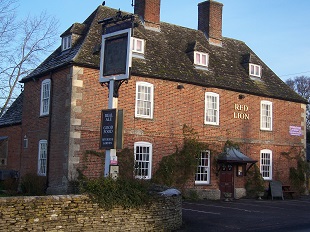
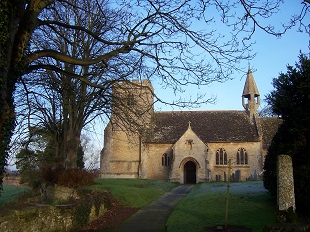 Castle Eaton The village is situated on the route of the Thames Path, with the emergent River Thames running close behind the church and the beer garden of the Red Lion pub. The infant reed-filled river is picturesquely free-flowing as it travels through the heart of the village. The handsome late 12th century parish church possesses a chancel distinctive of that period. The building was subject to an extensive restoration by William Butterfield (1861 – 63), with the subtle stained-glass from 1862. The distinctive bell-turret, built to house a Sanctus bell in 1860 is heavily corbelled-out with a sharp spire. Herons have taken to using this turret as a ready-made nesting site each spring. The 14th century west tower houses six bells, which are rung from the ground floor. Four of the bells (2, 3, 4, and tenor) are of 1709 by Abraham I Rudhall of Gloucester. The treble was cast in 1733, from the same foundry, by Abraham II Rudhall. The fifth is from 1899, cast by Henry I Bond of Burford.
Ashton Keynes · Holy Cross
Oaksey · All Saints
The Red Lion · Castle Eaton
Castle Eaton · SMV
Training Morning
Saturday 19th June 2004
09.45am Sunningwell
Oxon · St Leonard (6) 8cwt
11.45am Northmoor
Oxon · St Denys (6) 11cwt
01.00pm The Red Lion
Northmoor
Jane Burgess, Victoria Davey-Wilson, Hugh Deam, Andrew Dunn, Simon Edwards, Anthony Hughes, Roy Jones, Steve Jeffrey, Janice Knowles, Peter Lloyd, Bernard Masterman, Suzette Reynolds, Brenda Thomas and Brian Thomas.
Plain Bob Minor & Grandsire Minor.
Sunningwell The church is a mixture of Decorated and Perpendicular periods which originally belonged to Abingdon Abbey. A restful village pond across the road from the church plays host to a variety of birdlife. See Saturday 29th November 2003 for full details.
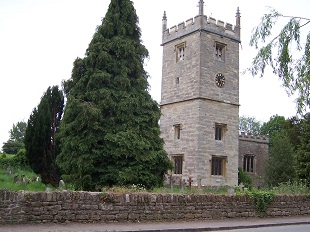
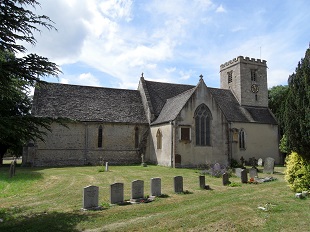 Northmoor The interior of St Denys church is immensely impressive, and is a must to experience on a sunny day as it diffuses the light particularly well. The 14th century nave and 15th century tower remain virtually unaltered since their conception. See Saturday 12th July 2008 for details.
The Red Lion pub is situated very close to the church and is the result of two 17th century cottages having been amalgamated into one property. The interior has low wooden beams and open fireplaces.
Northmoor The interior of St Denys church is immensely impressive, and is a must to experience on a sunny day as it diffuses the light particularly well. The 14th century nave and 15th century tower remain virtually unaltered since their conception. See Saturday 12th July 2008 for details.
The Red Lion pub is situated very close to the church and is the result of two 17th century cottages having been amalgamated into one property. The interior has low wooden beams and open fireplaces.
Sunningwell · St Leonard
Northmoor · St Denys
The Chilterns · Buckinghamshire
Saturday 8th May 2004
10.00am Gt Kimble
St Nicholas (6) 10cwt
11.15am Wendover
St Mary (6 now 8) 14cwt
12.30pm Risborough
St Dunstan (6) 13cwt
01.30pm The Lions of Bledlow
Bledlow
Heather Banyard, Bob Benstead, Steve Davies, Hugh Deam, Andrew Dunn, Simon Edwards, Steve Jeffrey, Roy Jones, Susan King, Janice Knowles, Peter Lloyd, Bernard Masterman, Sue Reynolds, June Steele, Leon Thompson, Richard Verrall and Serge Zvegintzov.
London, Cambridge, Plain Bob & Stedman.
Great Kimble This was one of the earliest sites to be settled in the district, being sited on the path of the Icknield Way. Oliver Cromwell's cousin, John Hampton chose Kimble as the meeting place for the rally against "Ship Money" introduced by Charles I. His imprisonment for two years ignited the Civil War. He was killed early on in the conflict at Chalgrove, but his son Richard later went on to serve as the Chancellor of the Exchequer. Behind the 13th century church are two ponds and some mounding which are the only clues to the moat that used to surround the building. The flint and stone church was restored by John Pollard Seddon (1876 – 81). The west tower is of 3-stages with diagonal buttresses and chequered battlemented parapet. The oldest bells are the third and fourth, 1587, by Henry I Knight of Reading. The other bells were all cast at Whitechapel, front two in 1860 and back two in 1898.
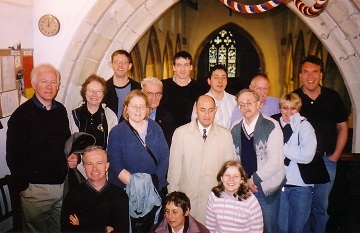
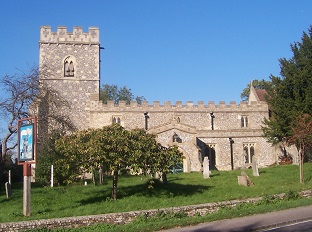 Wendover Wendover (white waters) lies in a gap amidst the Chiltern Hills which rise to over 800feet around the town. This primarily arable parish incorporates numerous hamlets, with the town having had a royal charter to hold a weekly market since 1464. Part of the town was once the property of Anne Boleyn, whose father held the Manor of Aylesbury among his many estates. There is a row of houses in the town known as Anne Boleyn's Cottages. The town is believed to have been the birthplace of medieval chronicler Roger of Wendover, who was a monk at St Albans Abbey. His most notable commentary on then contemporary events was on the signing of Magna Carta and the bitter end to King John's reign. Also born here was Cecilia Payne, astronomer and astrophysicist who in 1925 discovered that the sun is mainly composed of hydrogen, contradicting accepted wisdom at the time. The eminent physician Sir Thomas Barlow, who attended Queen Victoria on her deathbed, owned the country house of Boswells here until his death in 1945. The parish church is 14th century in origin, but was extensively restored in 1869 and 1914. During the Civil War, Cromwell's troops camped in the church and their graffiti is still visible. In 1799 the first "Penny Savings" Bank in the country was started in the church vestry here. The bells have been augmented to an eight since our visit, 2007, Whitechapel. The back three bells are by Ellis Knight of Reading (1631, 1633 and 1623). The third, fourth and fifth are from 1914, by Mears & Stainbank, Whitechapel.
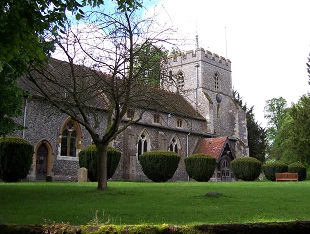
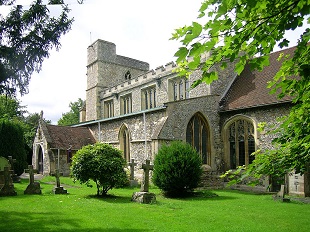 Monks Risborough This is the oldest documented parish in the county, dating as it does from 903 A.D., although in the Domesday Book there was no distinction made between the two Risboroughs, with the settlement being known as Risberge or Hrisanbyrge (a hill where brushwood grows). The village once belonged to Canterbury Cathedral, the church here being dedicated to St Dunstan who was Archbishop of Canterbury from 959A.D. to 988 A.D. A monastery was established here by Aeschwyn, Bishop of Dorchester, thus accounting for the prefix. The village is now virtually attached to the northern fringe of Princes Risborough which doesn't possess a church with bells. The medieval flint constructed church is situated behind a clutch of typically Chilterns style cottages, and is bordered by tall hedges and trees. In 1988 a new stained-glass window was added, this depicting the figure of St Dunstan. The tower is of four levels, with the vestry on the ground floor, the ringing chamber on the second level, the two, three, five & tenor bells on the third level, and treble & fourth bell on the fourth level. The back five bells were cast by Ellis Knight of Reading in 1636 and 1637, with the present treble added in 1885 by Warner & Sons, London.
The Lions of Bledlow is a widely known large thatched hostelry in the shadow of the Chiltern Hills at their height. It has featured several times on ITV's Midsomer Murders and is a fixture in the list of best English pubs.
Monks Risborough This is the oldest documented parish in the county, dating as it does from 903 A.D., although in the Domesday Book there was no distinction made between the two Risboroughs, with the settlement being known as Risberge or Hrisanbyrge (a hill where brushwood grows). The village once belonged to Canterbury Cathedral, the church here being dedicated to St Dunstan who was Archbishop of Canterbury from 959A.D. to 988 A.D. A monastery was established here by Aeschwyn, Bishop of Dorchester, thus accounting for the prefix. The village is now virtually attached to the northern fringe of Princes Risborough which doesn't possess a church with bells. The medieval flint constructed church is situated behind a clutch of typically Chilterns style cottages, and is bordered by tall hedges and trees. In 1988 a new stained-glass window was added, this depicting the figure of St Dunstan. The tower is of four levels, with the vestry on the ground floor, the ringing chamber on the second level, the two, three, five & tenor bells on the third level, and treble & fourth bell on the fourth level. The back five bells were cast by Ellis Knight of Reading in 1636 and 1637, with the present treble added in 1885 by Warner & Sons, London.
The Lions of Bledlow is a widely known large thatched hostelry in the shadow of the Chiltern Hills at their height. It has featured several times on ITV's Midsomer Murders and is a fixture in the list of best English pubs.
Wendover · St Mary
Great Kimble · St Nicholas
Wendover · St Mary

Monks Risborough
Wylye Valley
Saturday 20th March 2004
10.30am Warminster
Wilts · St Denys (8) 24cwt
11.45am Corsley
Wilts · St Margaret (6) 12cwt
12.45pm Sutton Veny
Wilts · St John (6) 8cwt
01.45pm Prince Leopold
Upton Lovell
02.45pm Codford
Wilts · St Peter (6) 10cwt
03.45pm Wylye
Wilts · St Mary (6) 9cwt
Heather Banyard, Jonathan Beale, Bob Benstead, Jane Burgess, Ron Burgess, Steve Davies, Hugh Deam, Keith Godfrey, Anthony Hughes, Steve Jeffrey, Roy Jones, Susan King, Janice Knowles, Katie Lane, David Lane, Peter Lloyd, Bernard Masterman, Hilary Nex, Sue Reynolds, June Steele and Hillary Stevens.
Grandsire Triples, Cambridge & Little Bob.
Warminster The settlement here in 912 A.D. was documented as Worgemynster (a church alongside the River Were), the Anglo-Saxons giving the river such a name so as to describe its winding nature. Although the town was first settled in the Anglo-Saxon period, there are remains of earlier settlements nearby, including the Iron Age hill-forts of Battlesbury Camp, Scratchbury Camp and Cley Hill. The town was long an important wool and corn trading centre, and consequently became a stopping-off point on the London to Bath coaching route.
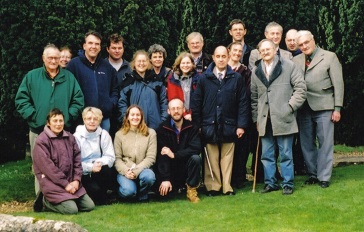
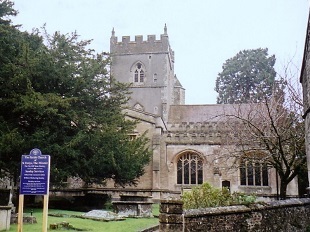 The older buildings in Market Place originate from the corn market days when they would have been used as stores and warehouses or as hostelries for the buyers and sellers. The town has five suburban areas, Sambourne, Woodcock, Bugley, Boreham and Warminster Common. The Warminster Maltings are the oldest working malting's in Britain, having been commissioned by William Morgan, who was already an established brewer in the town. Warminster has strong military connections, with Battlesbury Barracks being the home of the Land Warfare Centre. It adjoins the Salisbury Plain training area, which is dotted with Royal Artillery live-firing ranges. During the Second World War the future Archbishop of Canterbury, Robert Runcie crashed a tank into a house in the town. The Minster Church, so denoted since the 19th century, dates to the 12th century in its earliest parts.
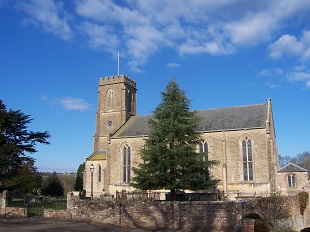 From 1887 – 89 the Minster was mostly rebuilt in the Perpendicular style by Sir Arthur Blomfield, with the central tower remaining from the original building. From 1610 to 1710 a bell foundry operated in Warminster. John Lott was responsible for the original casting of bells for the tower in the 17th century. All the bells that hang here today, with the exception of the tenor, were cast in 1881 by John Warner of London. The tenor is from 1737, by Abel Rudhall of Gloucester.
Corsley The village takes its name from the Anglo-Saxon for a small wood and adjoins the larger Corsley Heath to the west, which in turn adjoins the famous Longleat Estate. The palatial mansion of Longleat House was the first of the great Elizabethan country houses to be constructed and was used to entertain Queen Elizabeth during her royal progress in the summer months. In 1949, Lord Bath became the first peer of the realm to open their house to the public, and later his son transformed part of the grounds into a safari-park. The BBC filmed here from 1998 to 2009, first with Lion Country and then Animal Park, the latter which is still repeated regularly. The original 13th century chapel was replaced by a new church in the mid-19th century, with the pulpit of 1700 survives from the original building. The dedication of the church refers to Marina, a saint of pious fiction who was declared apocryphal by Pope Gelasius I in 494 A.D., but devotion to whom revived with the Crusades.
From 1887 – 89 the Minster was mostly rebuilt in the Perpendicular style by Sir Arthur Blomfield, with the central tower remaining from the original building. From 1610 to 1710 a bell foundry operated in Warminster. John Lott was responsible for the original casting of bells for the tower in the 17th century. All the bells that hang here today, with the exception of the tenor, were cast in 1881 by John Warner of London. The tenor is from 1737, by Abel Rudhall of Gloucester.
Corsley The village takes its name from the Anglo-Saxon for a small wood and adjoins the larger Corsley Heath to the west, which in turn adjoins the famous Longleat Estate. The palatial mansion of Longleat House was the first of the great Elizabethan country houses to be constructed and was used to entertain Queen Elizabeth during her royal progress in the summer months. In 1949, Lord Bath became the first peer of the realm to open their house to the public, and later his son transformed part of the grounds into a safari-park. The BBC filmed here from 1998 to 2009, first with Lion Country and then Animal Park, the latter which is still repeated regularly. The original 13th century chapel was replaced by a new church in the mid-19th century, with the pulpit of 1700 survives from the original building. The dedication of the church refers to Marina, a saint of pious fiction who was declared apocryphal by Pope Gelasius I in 494 A.D., but devotion to whom revived with the Crusades.
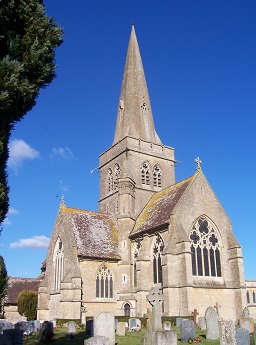 The pews and other furnishings date from 1890, when the building was renovated by F.W. Hunt. Unusually, the treble is the oldest bell, cast in 1732 by William Cockey of Warminster, who also cast the second and tenor in 1746. The third and fifth are by John Warner, 1903. The fourth was cast in 1966 at Whitechapel, with the bells being re-hung at that time.
Sutton Veny (Great Sutton) The village is situated on the chalk uplands and surrounded by a cluster of Iron Age hill-forts, Moothill Leg, Middle Hill, Cothay Hill and Scratchbury Hill. The parish church was built 1866 – 68 by Gothic Revival architect John Loughborough Pearson, and purposely sited on high ground, as its predecessor had been plagued by dampness due to being on low ground. The bells from the old church of St Leonard were brought here and later re-hung in a metal-frame, 1927. The front three bells date from 1696, by Lewis Cockey of Warminster, with the tenor by William Cockey at the same foundry, 1723. The fifth is by Robert & James Wells, Aldbourne, 1793. The fourth was cast by Llewellins & James, 1885. Unfortunately, the bells had only been rung intermittently in the years prior to our visit. In 1918, a number of servicemen, many of them Australian, who died in the influenza epidemic of that year, were buried in the graveyard here; five Australian nurses are also buried here. The adjacent school also possesses a small bell-tower that was added to the existing building by A. Quinney some years after.
Codford St Peter Originally called Coddun Ford - a fording place of Codda - the village has had a settlement here for over 1000 years. It was long a place where most inhabitants were employed by the wool trade. Saxon in origin, St Peter's church sits to the west of the village in the shadow of Malmpit Hill. It underwent a rebuild in the 19th century. The bells here are a pleasant ring of six. See Saturday 23rd June 2012 for more details.
Wylye The village is named from the pre-English river name, meaning a stream liable to flooding, with documentation as Wilig in 901 A.D. This elegant village nestles in the valley between Wylye Down and Little Down. The older dwellings are a mixture of flint and stone chequer-work. A team of water-bailiffs diligently manage the river in order to maintain its constant flow, thus making it one of the clearest rivers in the country and allowing sight of the brown trout here. There is also a water-mill, and in the midst of the river is an 18th century statue of a nearly nude man blowing a horn.
The pews and other furnishings date from 1890, when the building was renovated by F.W. Hunt. Unusually, the treble is the oldest bell, cast in 1732 by William Cockey of Warminster, who also cast the second and tenor in 1746. The third and fifth are by John Warner, 1903. The fourth was cast in 1966 at Whitechapel, with the bells being re-hung at that time.
Sutton Veny (Great Sutton) The village is situated on the chalk uplands and surrounded by a cluster of Iron Age hill-forts, Moothill Leg, Middle Hill, Cothay Hill and Scratchbury Hill. The parish church was built 1866 – 68 by Gothic Revival architect John Loughborough Pearson, and purposely sited on high ground, as its predecessor had been plagued by dampness due to being on low ground. The bells from the old church of St Leonard were brought here and later re-hung in a metal-frame, 1927. The front three bells date from 1696, by Lewis Cockey of Warminster, with the tenor by William Cockey at the same foundry, 1723. The fifth is by Robert & James Wells, Aldbourne, 1793. The fourth was cast by Llewellins & James, 1885. Unfortunately, the bells had only been rung intermittently in the years prior to our visit. In 1918, a number of servicemen, many of them Australian, who died in the influenza epidemic of that year, were buried in the graveyard here; five Australian nurses are also buried here. The adjacent school also possesses a small bell-tower that was added to the existing building by A. Quinney some years after.
Codford St Peter Originally called Coddun Ford - a fording place of Codda - the village has had a settlement here for over 1000 years. It was long a place where most inhabitants were employed by the wool trade. Saxon in origin, St Peter's church sits to the west of the village in the shadow of Malmpit Hill. It underwent a rebuild in the 19th century. The bells here are a pleasant ring of six. See Saturday 23rd June 2012 for more details.
Wylye The village is named from the pre-English river name, meaning a stream liable to flooding, with documentation as Wilig in 901 A.D. This elegant village nestles in the valley between Wylye Down and Little Down. The older dwellings are a mixture of flint and stone chequer-work. A team of water-bailiffs diligently manage the river in order to maintain its constant flow, thus making it one of the clearest rivers in the country and allowing sight of the brown trout here. There is also a water-mill, and in the midst of the river is an 18th century statue of a nearly nude man blowing a horn.
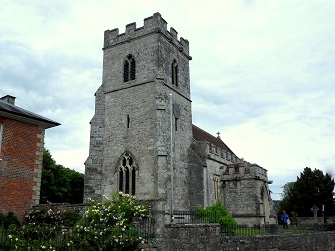
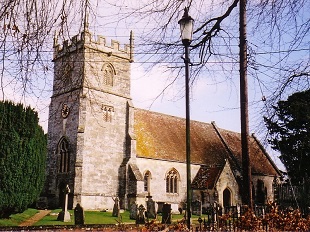 The original parish church here was dismantled and rebuilt 1844 – 46, with the west tower possessing battlements and pinnacles. Much of the furnishing came from St Mary & St Nicholas church in Wilton, including a pulpit dating to 1628, and several 19th century chandeliers. In the churchyard are 18th century railings which encircle a monument whose exact occupancy is unclear and shrouded in mystery. A former villager apparently returned to Wylye giving the impression of being a wealthy man and ordered the monument, only to vanish without paying. This superb set of six bells is rung from the ground floor and is unquestionably worth visiting. Until 1975 there were five bells, the oldest of which was cast in 1587 by John Wallis. The bells were restored and re-hung in 1975, with the addition of a new treble that had hung in Fisherton de la Mere church.
Wylye · St Mary
Warminster · St Denys
Corsley · St Margaret
Sutton Veny · St John
Codford · St Peter
Wylye · St Mary
The Oxfordshire Cotwolds
Saturday 7th February 2004
10.00am Burford
St John (8) 17cwt
11.15am Ascott-under-Wychwood
Holy Trinity (6) 7cwt
12.15pm Chadlington
St Nicholas (6) 11cwt
01.30pm The Swan
Ascott-under-Wychwood
Heather Banyard, Jonathan Beale, Bob Benstead, Robert Chadburn, Hugh Deam, Andrew Dunn, Simon Edwards, Keith Godfrey, Nicholas Hartley, Anthony Hughes, Steve Jeffrey, Roy Jones, Susan King, Janice Knowles, Peter Lloyd, Paul Lucas, Bernard Masterman, Sue Reynolds, June Steele, Richard Verrall and Serge Zvegintzov.
Cambridge Major, Stedman Triples & London.

Chadlington · St Nicholas
Burford See Saturday 12th April 1997 for details of this church.
Ascott under Wychwood The settlement, documented as being here in 1220, was described as Estcot (cottages to the east of Wychwood Forest). There are three distinctive parts to the village, which runs from Ascott d'Oyley across to Ascott Earl, following the course of the River Evenlode. Ascott d'Oilly Castle was built 1129 – 50, and a stone tower was added to it in the 13th century. The castle bailey (enclosed courtyard) is now occupied by the manor house, which is mainly 16th and 17th century.
The pub here, The Swan, closed in 2010, but re-opened in July 2013. The parish church was built around 1200 in a transitional style from Norman to Early English. Surviving work from this time includes the south porch, and the 4-bay arcade between the nave and the north aisle. There was a substantial course of restoration to the building 1857 – 59.
The churchyard provides a spectacular burst of colour in early spring as a sea of crocuses swathes the path to the church. The upper stages of the tower were built in the 15th century, with the bells rung from the ground floor. Five of the bells, including the tenor, were cast in 1744 by Henry III Bagley of Chacombe. The treble was cast in 1905 by Mears & Stainbank, Whitechapel.
Chadlington The village incorporates the hamlets of Brookend, Eastend, Greenend, Millend and Westend. There is a bowl-barrow just west of the village that is of indeterminate date, but should be 2400 – 1500 B.C. in origin. This barrow is now a scheduled monument. Also in this bracket is the hill-fort of Knolbury just to the north of Chadlington. The manor house was built during the 17th century, but was remodelled around 1800.
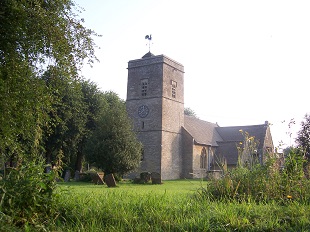
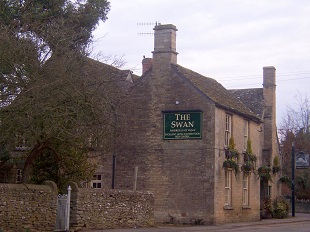 The oldest parts of the parish church are Norman, although in 1870 the Gothic Revival architect Charles Buckeridge almost totally rebuilt the church. The bell tower was constructed early in the 14th century in the Decorated Gothic style. The tower houses a ring of six bells, the two oldest of which, second and third, were cast by Abraham I Rudhall of Gloucester in 1714. William Taylor cast two more, the fifth and tenor, at his foundry in Oxford. Thomas Bond of Burford cast the fourth in 1911, and Whitechapel added the treble.
Ascott under Wychwood
The Swan
Buckinghamshire
Saturday 24th January 2004
10.30am Tingewick
St Mary Magdalen (5) 14cwt
11.45am Stratton Audley
St Mary & St Edburga (5) 11½cwt
01.00pm The Red Lion
Stratton Audley
Steve Davies, Hugh Deam, Simon Edwards, Steve Jeffrey and Roy Jones.
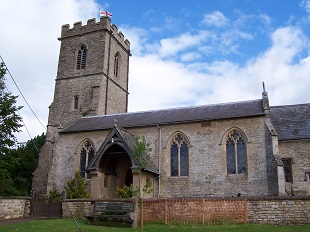
Tingewick · St Mary Magdalen
Tingewick Noted as Tedinwiche (Teoda’s farmstead) in 1086, between the village and the River Ouse is the site of what was once a Roman villa that is believed to date from the 4th century. The elegant Tudor-style manor house of Tingewick Hall is actually far more recent, built in 1854 and originally serving as a rectory. The earliest parts of the church are the 12th century nave and 3-bay north aisle, with the Perpendicular Gothic chancel and tower both added late in the 15th century. Set against the wall of the chancel is a half-length portrait of Erasmus Williams, Rector of Tingewick, who died in 1608. He is represented with uplifted hands in the attitude of prayer, and habited in a gown. On either side is a pillar, upon which hang astronomical, musical and geometrical instruments, as well as painting utensils and a collection of books.
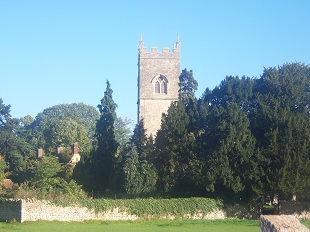 Atop one pillar is a globe and on the other is an owl. The tower has a ring of five bells, the oldest of which (3) was cast in London around 1490 and is inscribed: Nomen Magdalene Campana Gerit Melodie. The second (1591), fourth (1623) and treble (1627) were all cast by the Atton family at the foundry in Buckingham. The most recent bell is the tenor, cast in 1721 by Henry III Bagley of Chacombe.
Stratton Audley At the time of the Domesday Survey the settlement here was known merely at Stratone (a farmstead on a Roman road), the manorial affix dating to 1318. Near to the church is a field with undulations that mark the site of a castle that once stood here, having been built for James Audley, one of the original Knights of the Garter who served the Black Prince and who were granted lucrative rights by way of rewarding their bravery.
Atop one pillar is a globe and on the other is an owl. The tower has a ring of five bells, the oldest of which (3) was cast in London around 1490 and is inscribed: Nomen Magdalene Campana Gerit Melodie. The second (1591), fourth (1623) and treble (1627) were all cast by the Atton family at the foundry in Buckingham. The most recent bell is the tenor, cast in 1721 by Henry III Bagley of Chacombe.
Stratton Audley At the time of the Domesday Survey the settlement here was known merely at Stratone (a farmstead on a Roman road), the manorial affix dating to 1318. Near to the church is a field with undulations that mark the site of a castle that once stood here, having been built for James Audley, one of the original Knights of the Garter who served the Black Prince and who were granted lucrative rights by way of rewarding their bravery.
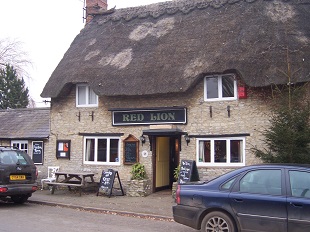 In 1672, Sir John Borlase inherited and settled in the manor house in the village. His father had fought with the Royalists during the Civil War and as a result his Estates were confiscated, a situation which was later reversed once parliamentary supremacy was established. Sir John and his brother Baldwin are both buried in the church. Externally the parish church is 14th century, but internally it is mostly 15th century. The once prominent gargoyles have unfortunately been worn down by centuries of weathering. The church is one of very few English churches to be devoid of Victorian embellishment. Richard Keene of Woodstock cast the middle three bells in 1693, and recast the Sanctus bell in 1699. The tenor was cast by Henry III Bagley of Chacombe in 1721, and the treble was added by Pack & Chapman of Whitechapel in 1779. The bells were rehung in 1902, but part of the disused 1636 frame is preserved in the church.
The Red Lion pub is a splendid thatched building located on the Buckingham Road which has a welcoming interior warmed by wood burners and an enclosed courtyard beer garden to the rear. This classic country pub is one of the best in the county.
In 1672, Sir John Borlase inherited and settled in the manor house in the village. His father had fought with the Royalists during the Civil War and as a result his Estates were confiscated, a situation which was later reversed once parliamentary supremacy was established. Sir John and his brother Baldwin are both buried in the church. Externally the parish church is 14th century, but internally it is mostly 15th century. The once prominent gargoyles have unfortunately been worn down by centuries of weathering. The church is one of very few English churches to be devoid of Victorian embellishment. Richard Keene of Woodstock cast the middle three bells in 1693, and recast the Sanctus bell in 1699. The tenor was cast by Henry III Bagley of Chacombe in 1721, and the treble was added by Pack & Chapman of Whitechapel in 1779. The bells were rehung in 1902, but part of the disused 1636 frame is preserved in the church.
The Red Lion pub is a splendid thatched building located on the Buckingham Road which has a welcoming interior warmed by wood burners and an enclosed courtyard beer garden to the rear. This classic country pub is one of the best in the county.
St Mary & St Edburga
The Red Lion · Stratton Audley