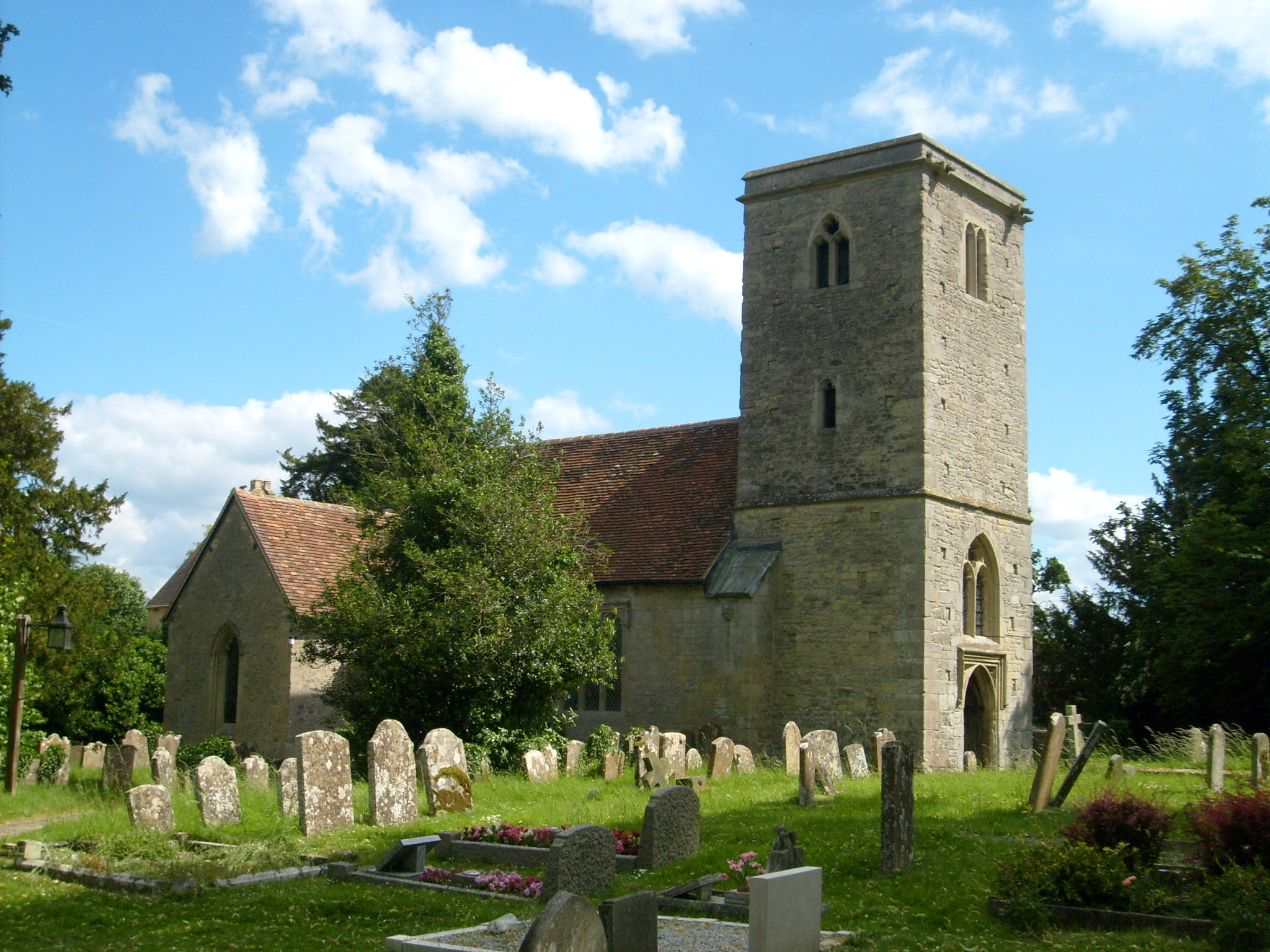
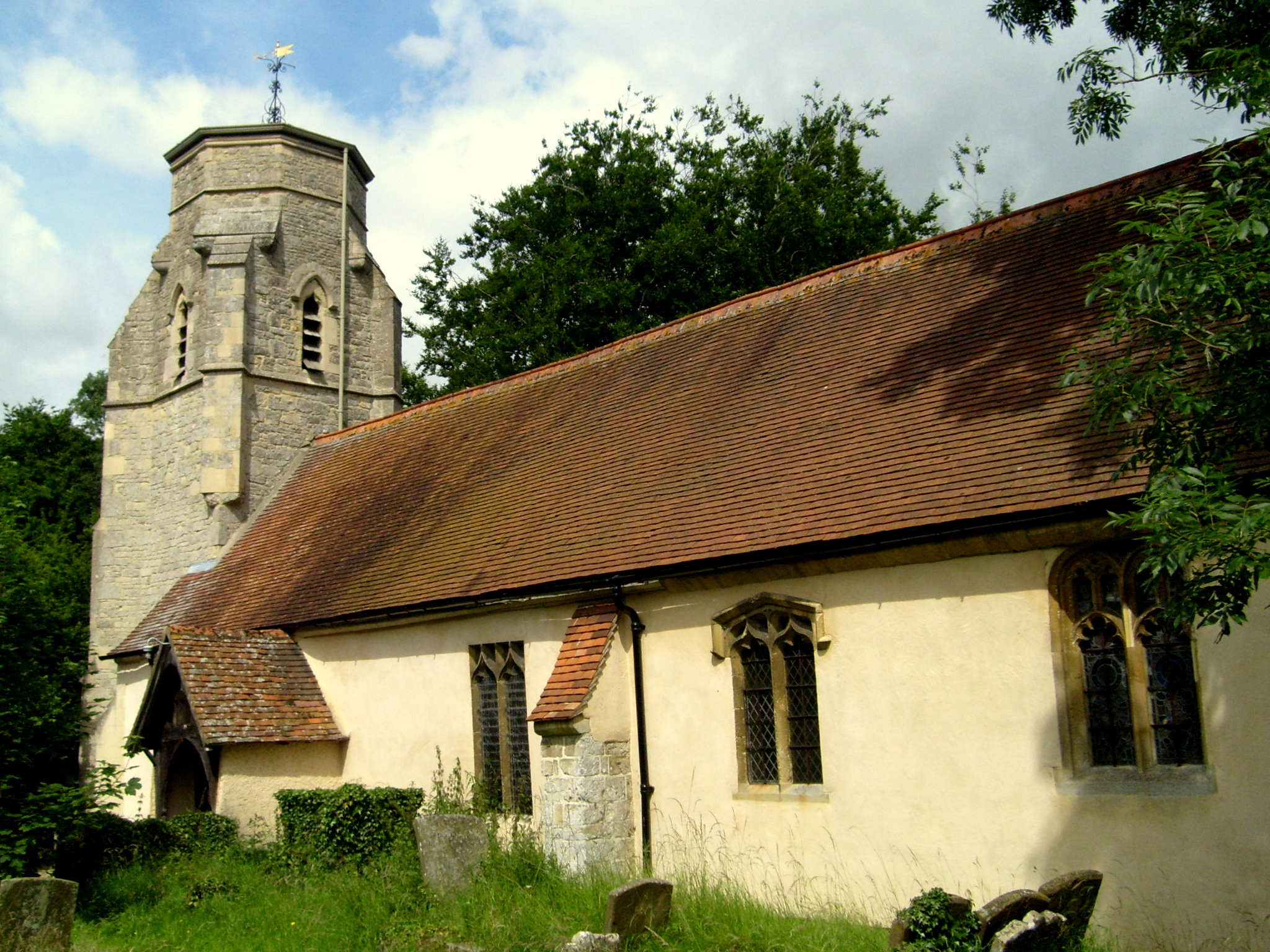
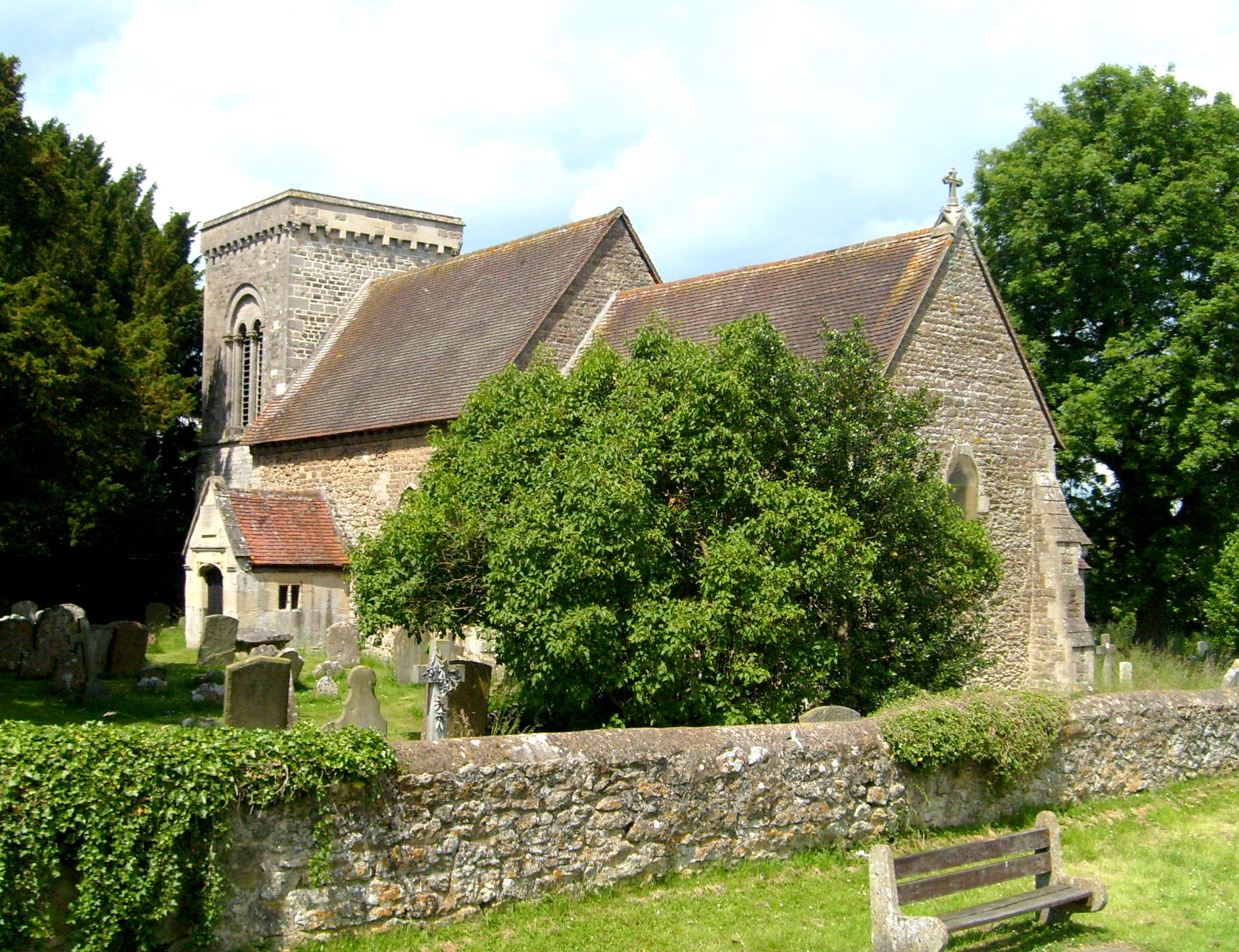
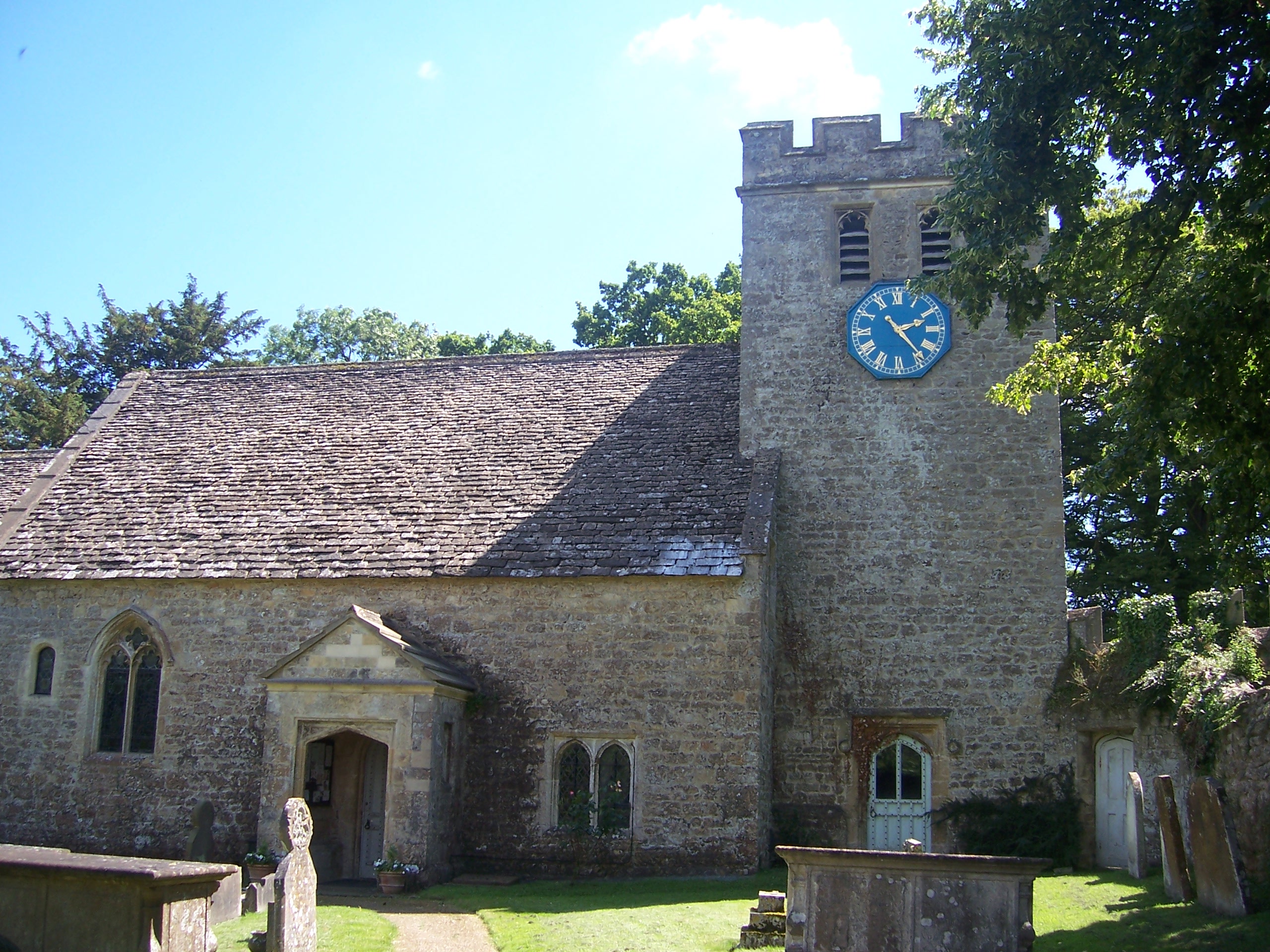
The
first section of this page shows City Branch towers which hold a ringing practice on a regular basis. Other towers can be found in
section two. Given are the number of bells and the weight and musical note of the tenor (heaviest bell), as found in
Dove's Guide for Church Bell Ringers. Look out for the MP3 audio clips, which allow you to hear most of the practising towers ring. You can get a map, showing the tower's location, by clicking on the Ordnance Survey (Landranger grid) reference number after its name. If you would like to join the ringing, then please contact the Tower Correspondent using the details given on the
contacts page. More details, such as the methods most often rung, can be found on the
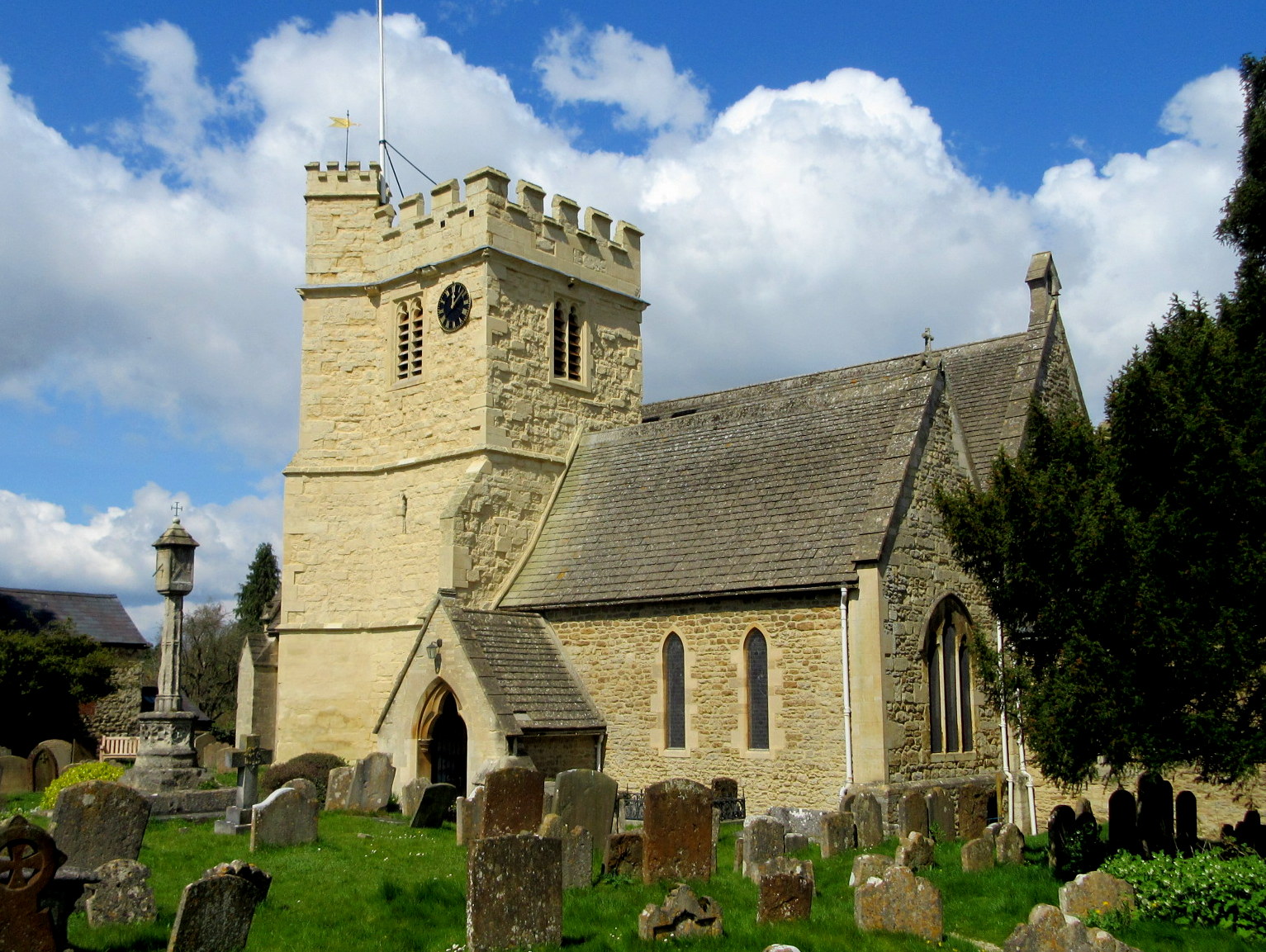
ringing page. The descriptions of the churches were written by
Hugh Deam and most of the photographs are by
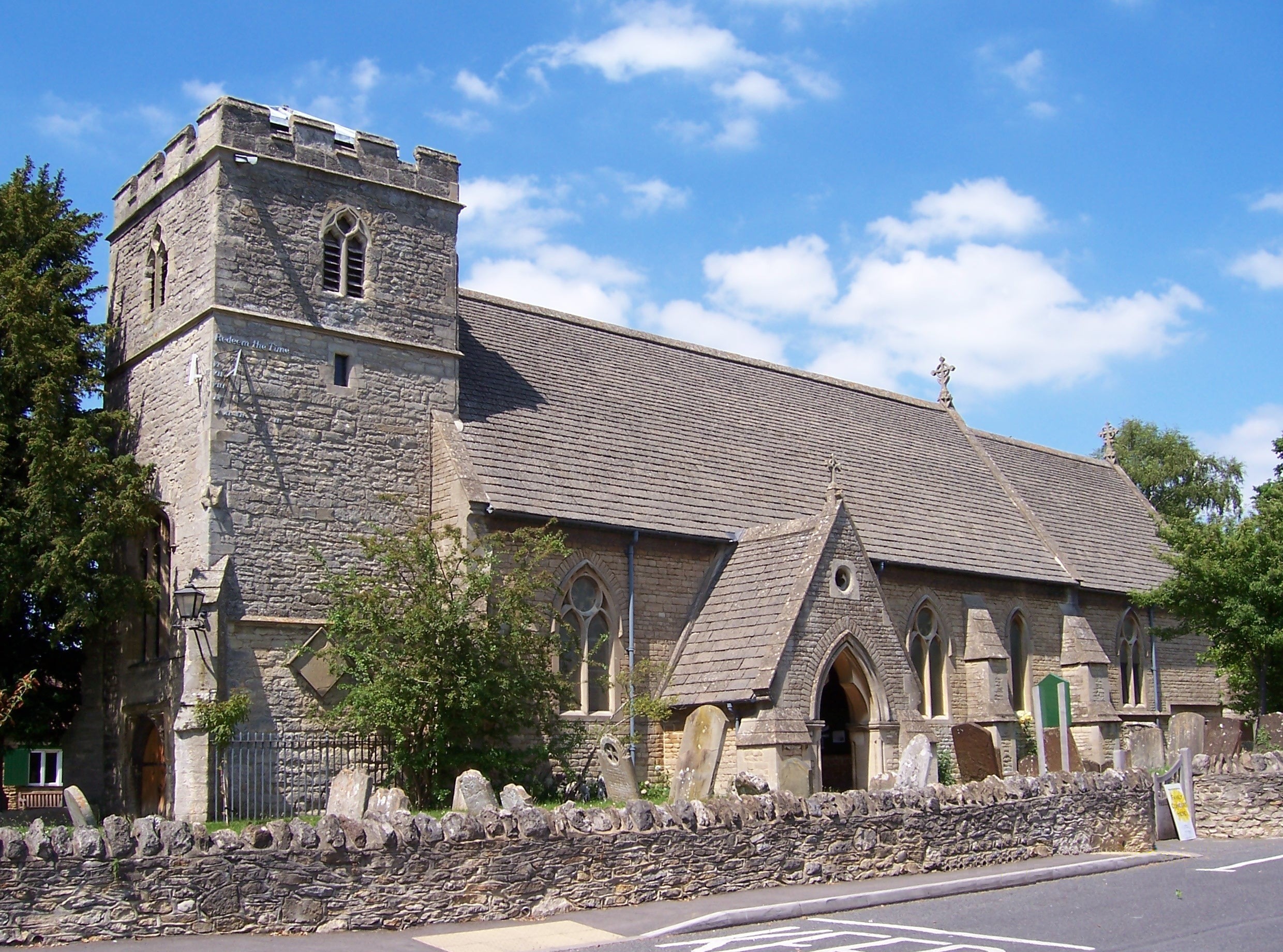
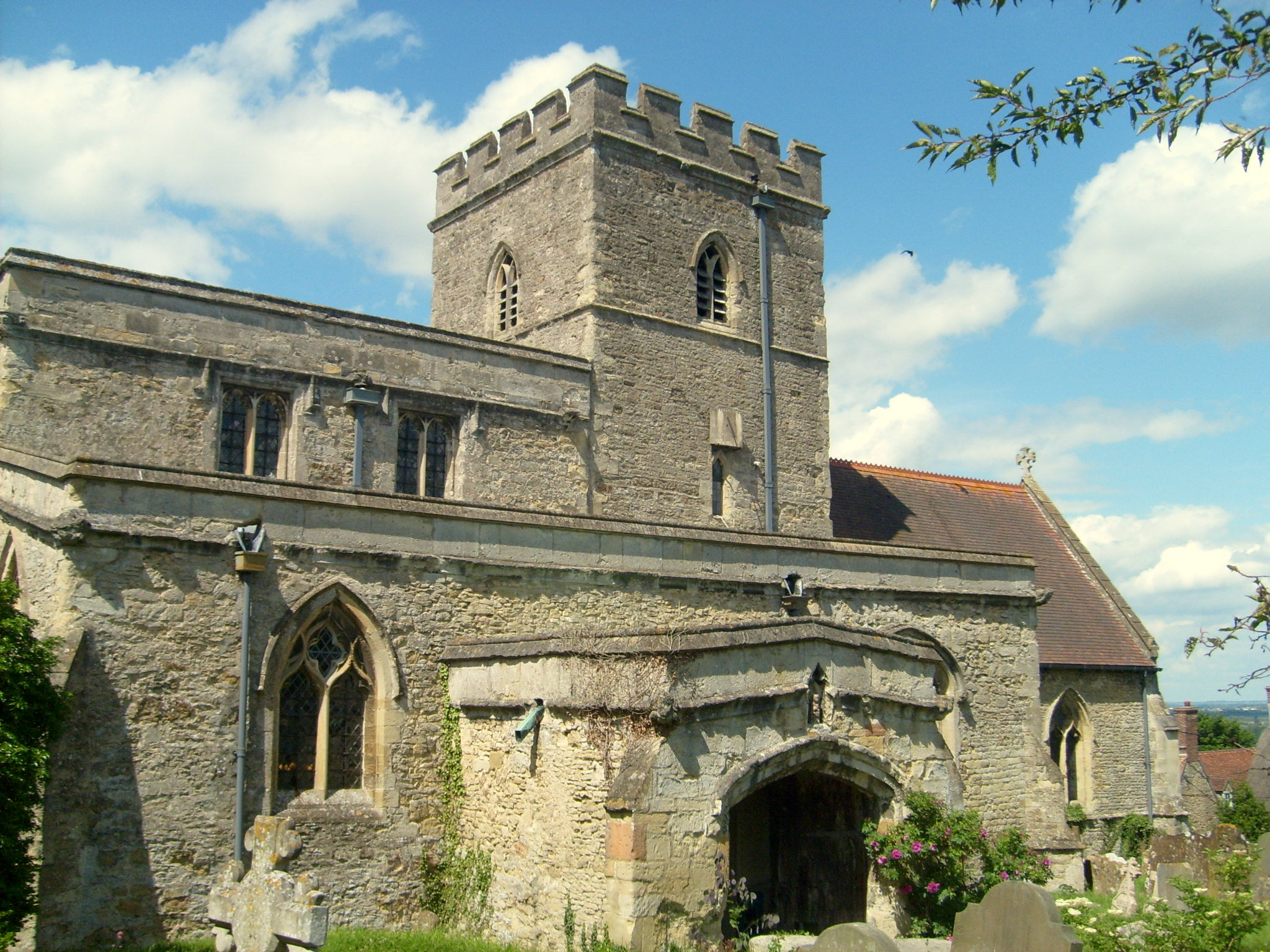
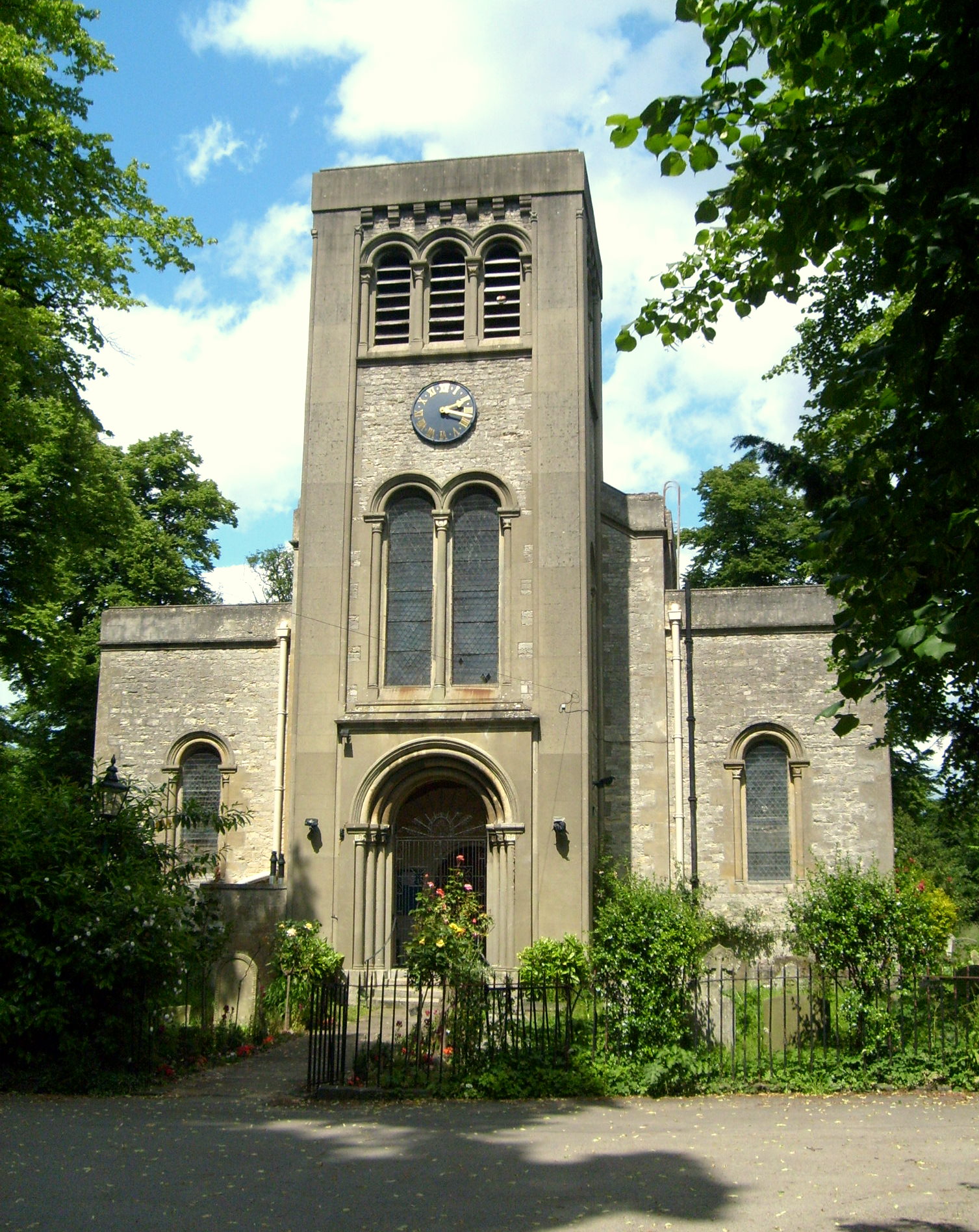
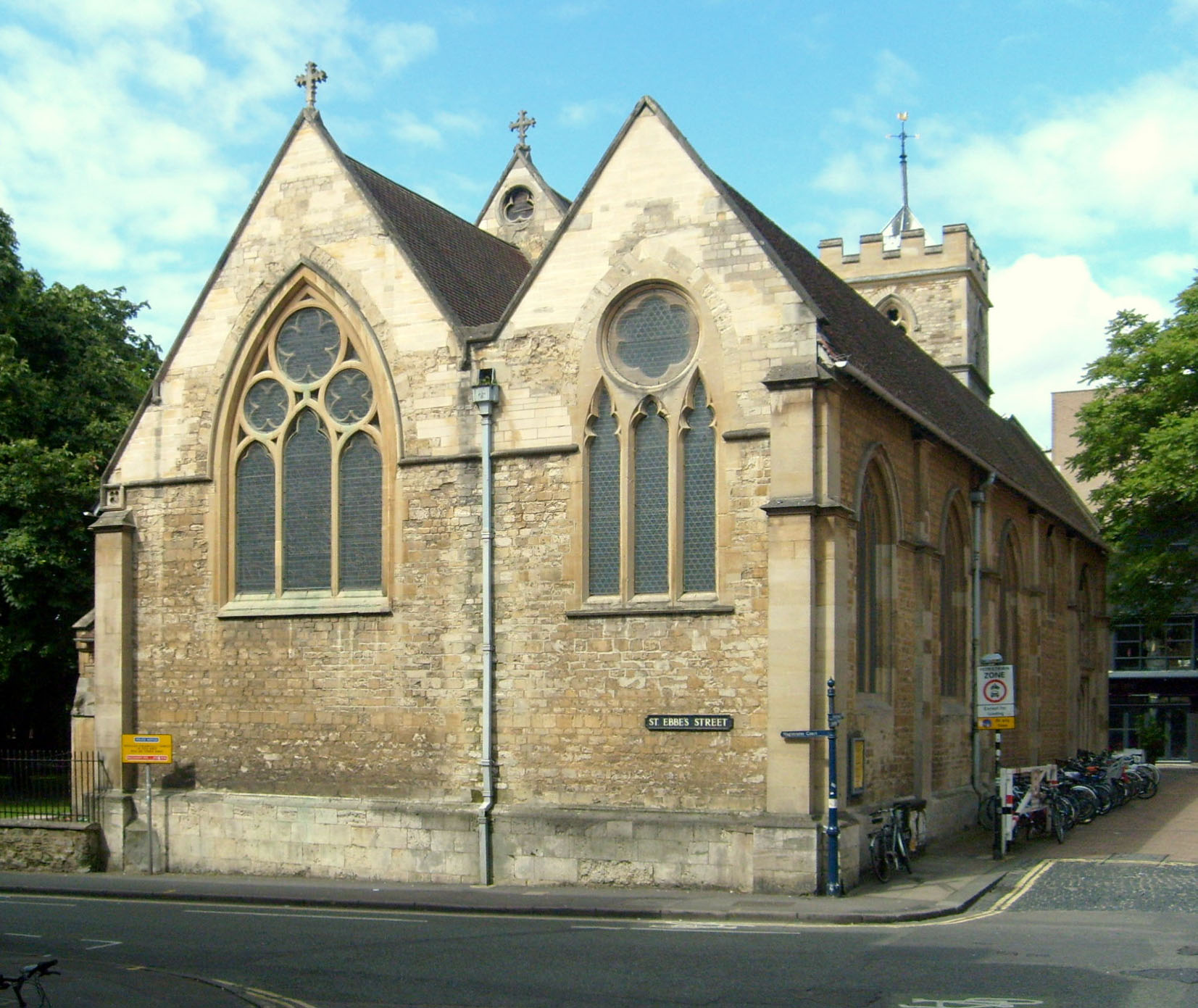
Paul Lucas. All of the smaller tower pictures can be enlarged by clicking on them.
Bell Details
Most of these details come from
Dove's Guide for Church Bell Ringers and from Frederick Sharpe (1953)
The Church Bells of Oxfordshire J Smart & Co Brackley. Weights given as cwt-qr-lb are exact measurements to the nearest pound. Those given as cwt only are approximations calculated from the bell's dimensions and its strike note. In the manner of Sharpe, a slash ( / ) in the inscription indicates a new line in the text or a change to a new side of the bell. Details missing from the former sources were supplied by the relevant steeple keepers themselves. Spelling errors in the inscriptions are taken literally from Sharpe, except for those errors in his text which are not explicitly marked as
sic by him. For example, at St Giles
excelsis is here used instead of Sharpe's
exelsis on the 3rd, and
conscendat instead of
consendat on the 6th. In general, such details have not been confirmed by the steeple keepers themselves. A translation from Latin to English is given by pointing the mouse to the Latin phrase in question. Other notes on the inscriptions may also be obtained in this way. Although details of the bells can be found on
Dove's Guide, here you can find their inscriptions and other information that is not shown there.
In addition to the MP3 recordings of the bells ringing, on this page are uncompressed WAV recordings of the individual bells themselves. From these were measured the hum, prime and nominal frequencies in Hertz (cycles per second) using Bill Hibbert's Wavanal. Wavanal was also used to calculate the given note names using a twelve-tone equal tempered scale (12-TET) with A at 440Hz. As is conventional with church bell notation, C1 is middle C (C4 on the piano) and B0 is the note immediately below it. The +/- figure after the note gives the measured number of cents above or below that value (100 cents = 1 semi-tone). Because bells are unlikely to have been tuned to an equally tempered scale, deviation from the exact note does not necessarily indicate the bell is out of tune. It does, however, tell us whether these partials (hum, prime and nominal) are in tune relative to each other, since each should be exactly one octave apart. Note I have neglected to mention other partials, such as the tierce (minor third [three semitones] above the prime), quint (perfect fifth [seven semitones] above the prime), superquint (an octave above the quint) and octave nominal.
The WAV recordings mentioned above may be used within Abel to reproduce the sound of the given tower. After downloading the ZIP file, open it and view the Readme file within. Please note that these downloads may take some time to complete if your Internet connection is slow.
Section 1 · 14 Practising Towers
St Aldates · Oxford OX1 1BP
Rehung 1959 6 bells · 11-1-12 cwt-qr-lb · Key of G
St James · Cowley · Oxford OX4 3LF
6 bells · GF · 5-3-3 cwt-qr-lb · 293 kg · Key of C
All Saints · Cuddesdon · Oxon OX44 9HG
Rehung 2018 6 bells · 12-3-7 cwt-qr-lb · Key of F
St Mary · Garsington · Oxon OX44 9DJ
Rehung 2013 6 bells · 8-1-6 cwt-qr-lb · Key of G
St Giles · Oxford OX2 6HT
Rehung 2011 8 bells · 14-0-1 cwt-qr-lb · Key of F♯
St Andrew · Headington · Oxford OX3 9DL
Rehung 2000 8 bells · 7-3-0 cwt-qr-lb · Key of A♭
St Lawrence · Hinksey · Oxford OX2 0LZ
6 bells · 5-2-27 cwt-qr-lb · 292 kg · Key of B
St Giles · Horspath · Oxon OX33 1SE
6 bells · GF · 5-2-9 cwt-qr-lb · 283 kg · Key of B♭
SMV · Kidlington · Oxon OX5 2AZ
Rehung 1990 8 bells · 21-2-27 cwt-qr-lb · Key of D
St Nicholas · Old Marston · Oxford OX3 0PR
Rehung 2015 6 bells · 4-3-17 cwt-qr-lb · Key of C
St John · Stanton St John· Oxon OX33 1DN
Rehung 2019 5 bells · 9¼ cwt · 470 kg · Key of G♯
St Mary · Wheatley · Oxon OX33 1LZ
Rehung 1996 6 bells · 9-3-10 cwt-qr-lb · Key of A♭
St Peter · Wolvercote · Oxford OX2 8BW
6 bells · GF · 8-0-2 cwt-qr-lb · 407 kg · Key of B♭
Section 2 · 9 Other Towers
ABVM · Beckley · Oxon OX3 9UT
5 bells · 11-1-13 cwt-qr-lb · 577 kg · Key of F♯
St Clement · St Clements · Oxford OX4 1BG
Originally a chime of three
St Ebbe · Oxford OX1 1QF
8 bells · 4-3-19 cwt-qr-lb · 250 kg · Key of B♭
St Nicolas · Forest Hill · Oxon OX33 1EB
A chime of three
St Barnabas · Jericho · Oxford OX2 6BH
10 tubular bells plus one hung for ringing
St Michael · Northgate · Oxford OX1 3EY
6 bells · 12 cwt · 610 kg · Key of F♯
St Andrew · Sandford · Oxon OX4 4YR
3 bells · 3¾ cwt · 191 kg
All Saints · Wytham · Oxon OX2 8QA
A chime of 10 bells
These first towers hold a regular practice session in the evening as shown. If you would like to attend, then please click on the Correspondent link, so that you can check whether the practice will be well enough attended to take place. This is especially true for those towers which may now alternate their practice with another.
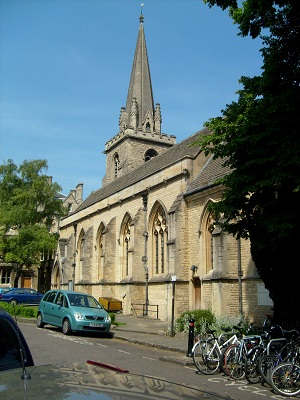
St Aldates · City Centre
City Centre
St Aldates SP513060
40 Pembroke Street
Oxford OX1 1BP
6 bells 11-1-12 cwt-qr-lb in
G
Practice: Monday 19:30 - 21:00
Service ringing: Sunday 09:25 - 09:40
A simulator is available
Correspondent
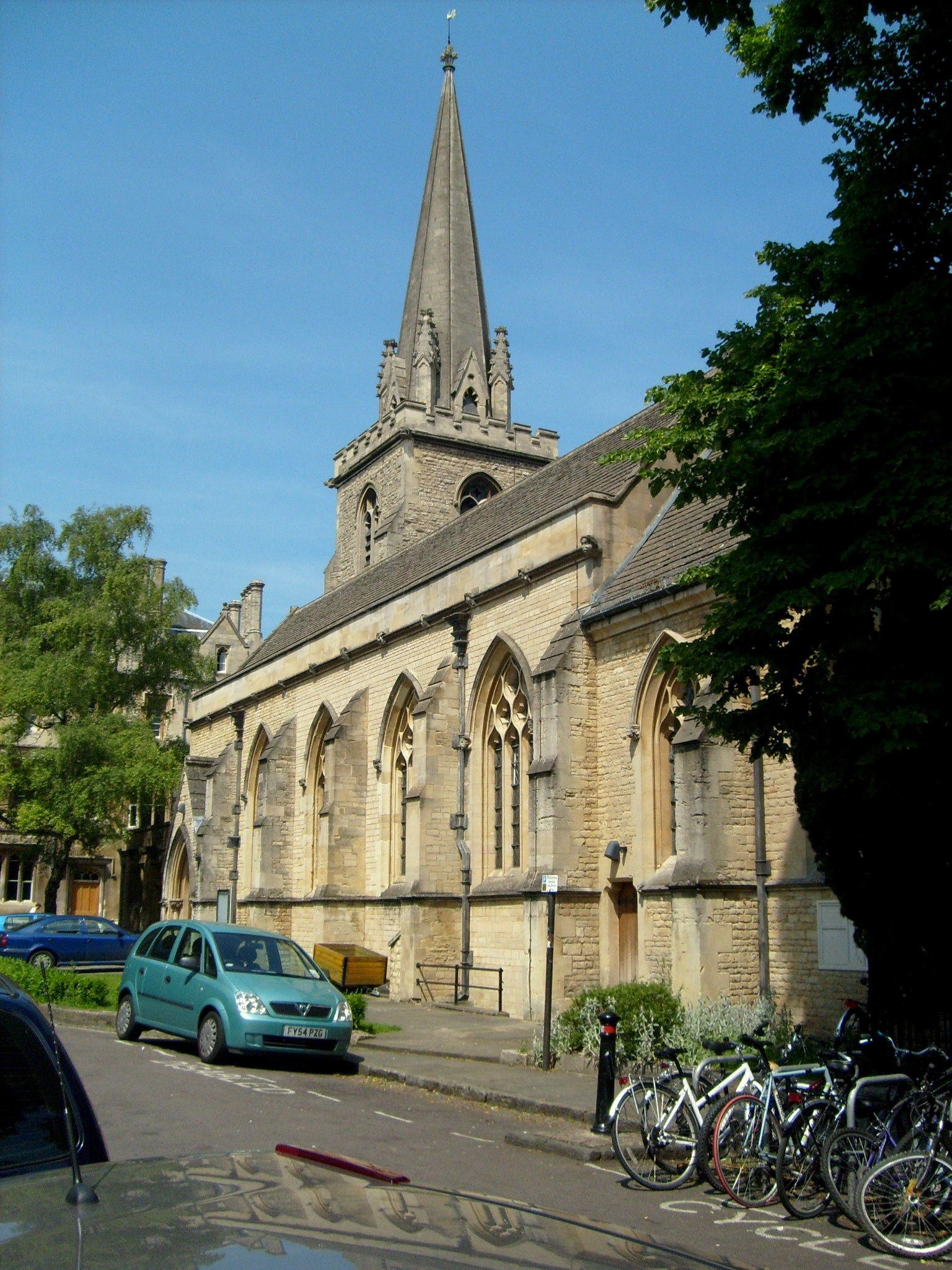
St Aldates · Oxford City The historic street of St Aldate’s leads south from the epicentre that is Carfax. It boasts a rich variety of architecture in the Town Hall, the C16th facade of Christ Church and Christopher Wren’s inspirational Tom Tower, with St Aldates’ Church directly across the road. The majority of the building is the work of JT Christopher, who heavily restored the church in 1862, and then again in 1873. This embroiderment subsumed most of the original Norman work. It still retains its C14th crypt, below the east end of the south aisle, that was the work of John de Dockington. The church has long been noted for its revivalist outlook to worship that has ensured larger congregations than many similar centralised churches. The bells here are an engaging six with a tenor which, when working, requires fine-spun handling. A ringing simulator has now been added, allowing practices to take place every Monday.
Hugh Deam
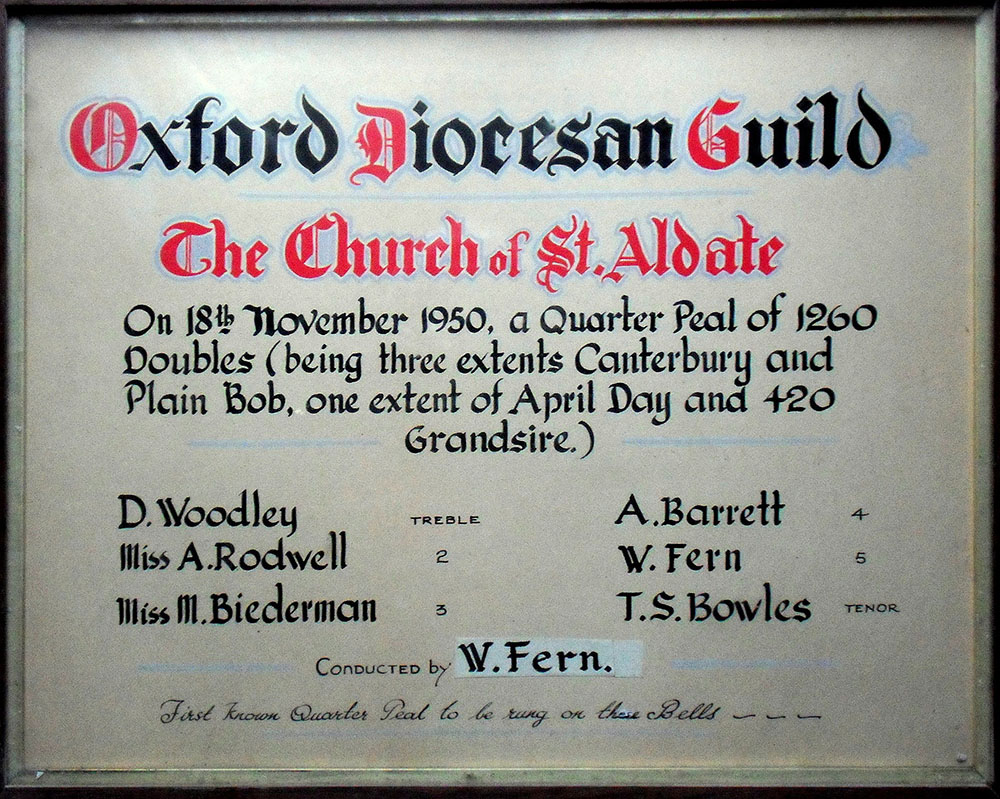
First known quarter peal to be rung on these bells
Saint Aldates · City Centre · Oxford
A ring of six holding a weekly practice
Rehung in 1959 by the Loughborough Bell Foundry. They continue to ring very well.
|
| Bell | Weight
CWT-QR-LB | Diameter
INCHES | Note
HUM
PRIME
NOMINAL | Cast | Founder | Inscription |
|---|
| 1 | 3-3-0 | 26.25 | E
F1-28 · 343.5Hz
E♭2+02 · 623Hz
E3+20 · 1334Hz | 1873 | Mears & Stainbank | MEARS & STAINBANK, FOUNDERS, LONDON. 1874. |
| 2 | 5-0-5 | 28.38 | D
E1-37 · 322.5Hz
D2-32 · 576.5Hz
D3+12 · 1183.5Hz | 1654 | Michael Darbie | MICHAEL DARBIE MADE MEE 1654 |
| 3 | 5-3-12 | 30.38 | C
D1-33 · 288Hz
C2+41 · 536Hz
C3+17 · 1057Hz | 1654 | Michael Darbie | MICHAEL DARBIE MADE MEE 1654 |
| 4 | 6-3-16 | 32.75 | B
C1+05 · 262.5Hz
B♭1+43 · 478Hz
B2+15 · 996.5Hz | 1627 | Ellis Knight I | PRAYES YE THE LORD 1627 |
| 5 | 8-3-12 | 35.88 | A
B♭0+43 · 239Hz
A1-29 · 432.5Hz
A2+16 · 888.5Hz | 1620 | Henry Knight I | HENRX NXGHT MADE MEE X620 |
| 6 | 11-1-12 | 40.13 | G
F♯0+41 · 189.5Hz
G1+15 · 395.5Hz
G2+19 · 793Hz | 1847 | William Taylor | + REVD. CHARLES WARNER, B.A., CURATE. REVD. WILLIAM HAWKINS, M.A., RECTOR. WILLIAM BAXTER AND WILLIAM RINGROSE CHURCHWARDENS. 1847. WM. TAYLOR, OXFORD, FECIT.
[Scroll border] |
Saunce
unhung | 1-0-7 | 16.25 | | 1780 | Thomas Rudhall | T RUDHALL
[Bell] 1780
[Bell]
|
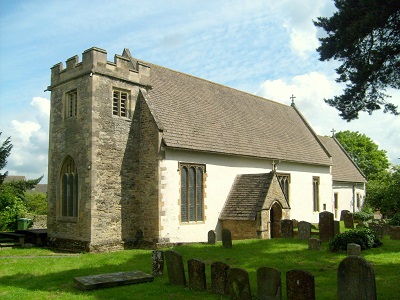
St James the Apostle · Cowley
Cowley
St James the Apostle SP540039
Beauchamp Lane · Cowley
Oxford OX4 3LF
6 bells GF
5-3-3 cwt-qr-lb in
C
Practice: 3rd Monday 19:30 - 21:00
Service ringing: Please check
Correspondent
St James · Cowley · Oxford The first documentation of a settlement here was in 1004, when the area was known as Couelea “Cofa’s clearing”, and later Covelie in the Domesday Book. The church was once in the possession of Osney Abbey (1149), and is situated between Church Hill Road and the narrow Beauchamp Lane. The lane still evokes memories of the old Cowley village, despite being adjacent to the incongruous Templars Square multi-storey car park at the bottom end. The capacious tree-lined churchyard on the eastern side of the church exudes an air that belies just how built up an area there is surrounding it. The somewhat stunted appearance of the tower is a consequence of the heightening of the nave roof that formed part of the restoration by GE Street from 1862. This was more of a rebuilding in all truth, leaving few Norman parts remaining. The bells are a light ground-floor six, with the front three sallies set quite close together. Hugh Deam
Saint James · Cowley · Oxford
A ring of six holding a weekly practice
|
| Bell | Weight
CWT-QR-LB | Diameter
INCHES | Note
HUM
PRIME
NOMINAL | Cast | Founder | Inscription |
|---|
| 1 | 2-3-20 | | A
A♭1+44 · 426Hz
A♭2+49 · 854.5Hz
A3-46 · 1713.5Hz | 1949 | Mears & Stainbank | + REMEMBER 1939-1945. MAY THEY REST IN PEACE. [Obverse and reverse of a half-crown]
19  49 49
MEARS & STAINBANK. |
| 2 | 3-0-21 | | G
G1-42 · 382.5Hz
G2-35 · 768Hz
G3-33 · 1538Hz | 1949 | Mears & Stainbank | DANIEL WHITE. WALTER DAY. CHURCH = WARDENS

E : HEMINS FECIT. J738
19 49
RECAST BY MEARS & STAINBANK. |
| 3 | 3-2-22 | | F
F1-48 · 339.5Hz
F2-37 · 683.5Hz
F3-42 · 1363Hz | 1949 | Mears & Stainbank | DANIEL WHITE. WALTAR DAY. CHURCH = WARDENS
EDWARD HEMINS
FECIT. J738
RECAST BY MEARS &
STAINBANK 1949. |
| 4 | 4-1-12 | | E
E1-43 · 321.5Hz
E♭2+40 · 637Hz
E♭3+42 · 1275.5Hz | 1949 | Mears & Stainbank |  BENEDICTA SIT BENEDICTA SIT
SANCTA TRINITAS
Ed : HEMINS : FECIT
SEPTEMBER 3. J739
19 49
RECAST BY MEARS & STAINBANK. |
| 5 | 5-0-2 | | D
D1-33 · 288Hz
D2-48 · 571Hz
D3-31 · 1153.5Hz | 1949 | Mears & Stainbank | 1693
RECAST BY MEARS &
STAINBANK. 1949. |
| 6 | 5-3-3 | 32.00 | C
C1-44 · 255Hz
C2-39 · 511.5Hz
C3-35 · 1025.5Hz | 1949 | Mears & Stainbank | WILL TERRELL 1694
C.W. IAMES WHIT
RECAST BY MEARS &
STAINBANK. 1949. |
Saunce
unhung | | 13.75 | | 1691 | Richard Keene | Not Known |
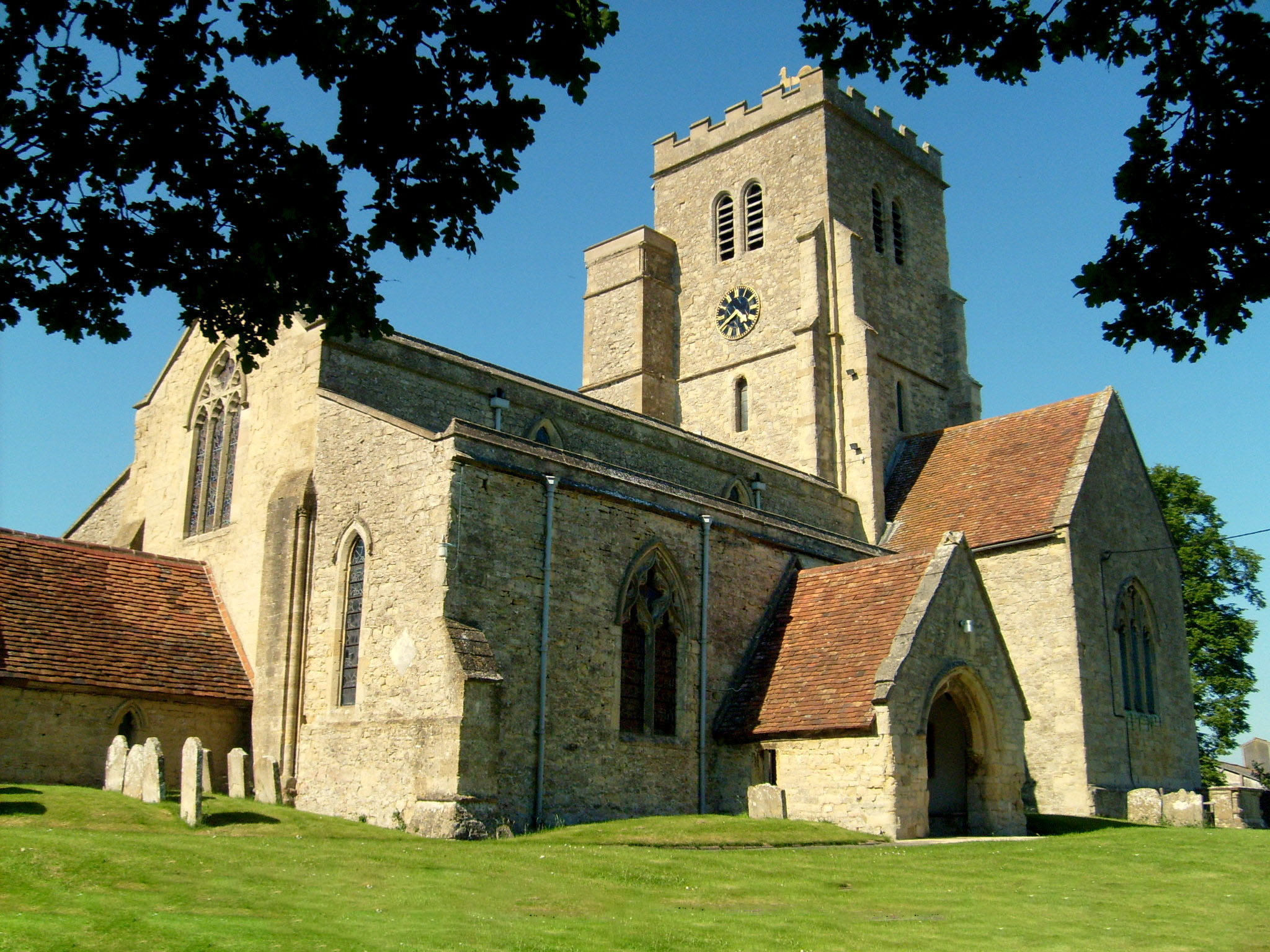
All Saints · Cuddesdon
Cuddesdon
All Saints SP601031
Church Road · Cuddesdon
Oxfordshire OX44 9HG
6 bells 12-3-7 cwt-qr-lb in
F
Practice: Thursday 19:30 - 21:00
Service ringing: Sunday 09:00 - 09:30
Correspondent
All Saints · Cuddesdon · Oxfordshire In view of the fact that the bells had become difficult to ring, a new treble was made at the Whitechapel Bell Foundry on the 22nd March 2017. This was part of their final batch of casting work of five in total. It then joined the remaining bells, all of which were retuned and fully refitted by White’s of Appleton. Now that the canons have been removed from the 5th and Tenor, those have become lighter in weight. They were returned to the tower into their, now reinforced, oaken frame of
circa 1699. They go beautifully but sound very loud within the chamber. The first
quarter peal since refurbishment took place on the 16th August 2018 and there is now a weekly practice.
NOTE: The old treble was replaced because it was found to be porous. It was acquired by a gentleman from within the village and its inscription reads:
THE GIFT OF DR. E. SMALLWELL BPT OF OXFORD & Co. IOHN BRIANT HERTFORD FECIT AN : DOM : 1795. It has a weight of 5½ cwt and a diameter of 31.63 inches. This handsome Cruciform church was built
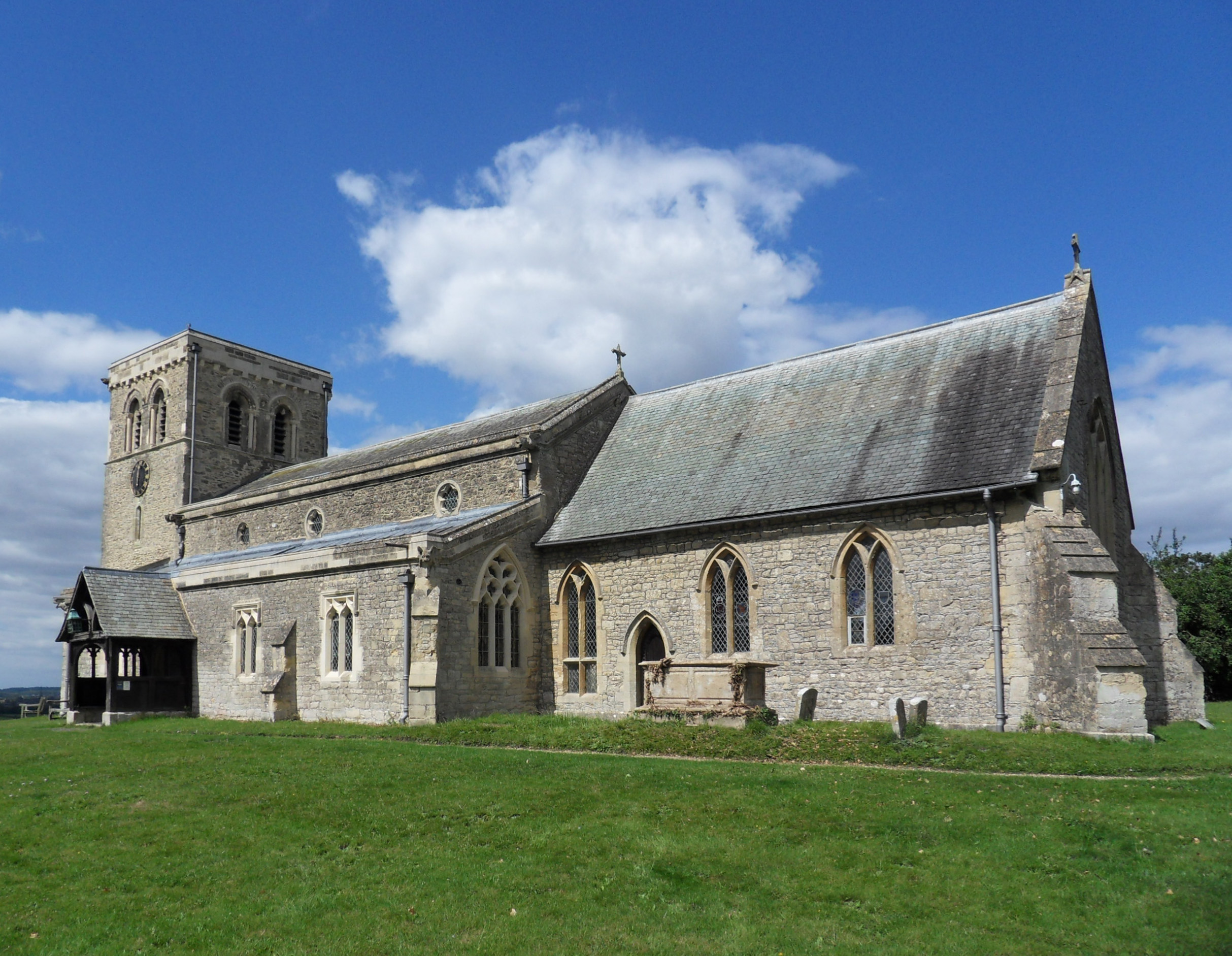
circa 1180 at the behest of Abingdon Abbey. It enjoys a superb view over rolling countryside out towards Buckinghamshire. The west entrance is particularly impressive, ideal for wedding photographs, as is the churchyard gateway. This is one of the most aesthetically pleasing churches within the branch and the bells have an excellent tone. Only a short step away is the Theological College, and in less than a minute’s walk is the singular Bat & Ball public house, which is crammed with an eclectic array of cricketing memorabilia.
Brian Lowe &
Hugh Deam
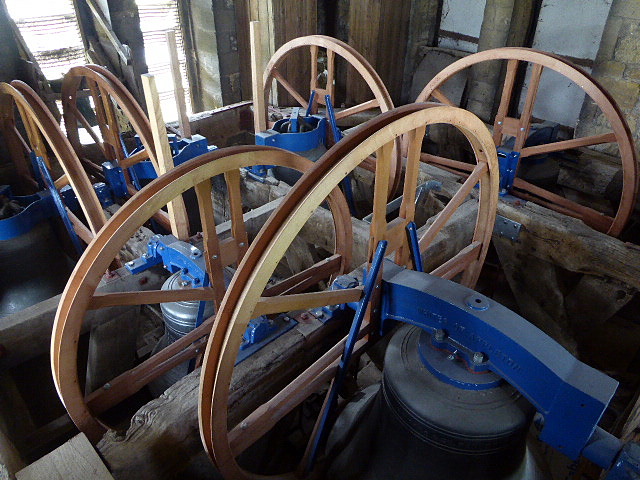
Newly rehung
All Saints · Cuddesdon · Oxfordshire
A full-circle ring of six holding a weekly practice
Bells and frame restored in 2018 by White's
|
| Bell | Weight
CWT-QR-LB | Diameter
INCHES | Note
NOMINAL | Cast | Founder | Inscription |
|---|
| 1 | 5-2-0 | 29.81 | D
D3-14 · 1165.2Hz | 2017 | Whitechapel Bell
Foundry Ltd |
THE GIFT OF DR. E. SMALLWELL BPT OF OXFORD & Co. IOHN BRIANT HERTFORD FECIT AN : DOM : 1795.
TO THE GLORY OF GOD AND IN LOVING MEMORY OF DR. CHRISTOPHER WARE
1955-2006
THIS BELL WAS ONE OF THE LAST CAST IN WHITECHAPEL REPLACES THE FORMER TREBLE
1570 2017
WHITECHAPEL |
| 2 | 5-2-23 | 31.31 | C
C3-04 · 1044.1Hz | 1617 | Henry I Knight |
+ HENRX KNXGHT MAdE
MEE X6X7
|
| 3 | 7-0-23 | 33.75 | B♭
B2♭+01 · 932.9Hz | 1617 | Henry I Knight |
+ HENRX KNXGHT MAdE THXS BELL X6X7
|
| 4 | 7-3-22 | 34.88 | A
A2-13 · 873.4Hz | 1617 | Henry I Knight |
+ HENRX KNXGHT MAdE MEE ANO X6X7
|
| 5 | 8-2-26 | 38.19 | G
G2+01 · 784.4Hz | 1863 | G Mears & Co | G. MEARS & CO. FOUNDERS LONDON 1863 |
| 6 | 12-3-7 | 43.69 | F
F2-02 · 697.6Hz | 1863 | G Mears & Co | G. MEARS & CO. FOUNDERS LONDON 1863 |
| Saunce | ½ cwt | 13.00 | E | 1748 | Thomas Lester | 1748 |
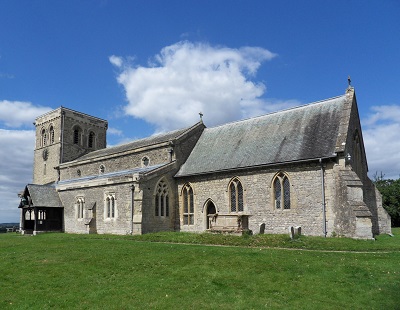
St Mary · Garsington
Garsington
St Mary SP580020
Southend · Garsington
Oxfordshire OX44 9DJ
6 bells GF
8-1-6 cwt-qr-lb in
G
Practice: Monday 19:30 - 21:00
Service ringing: Usually monthly
Correspondent
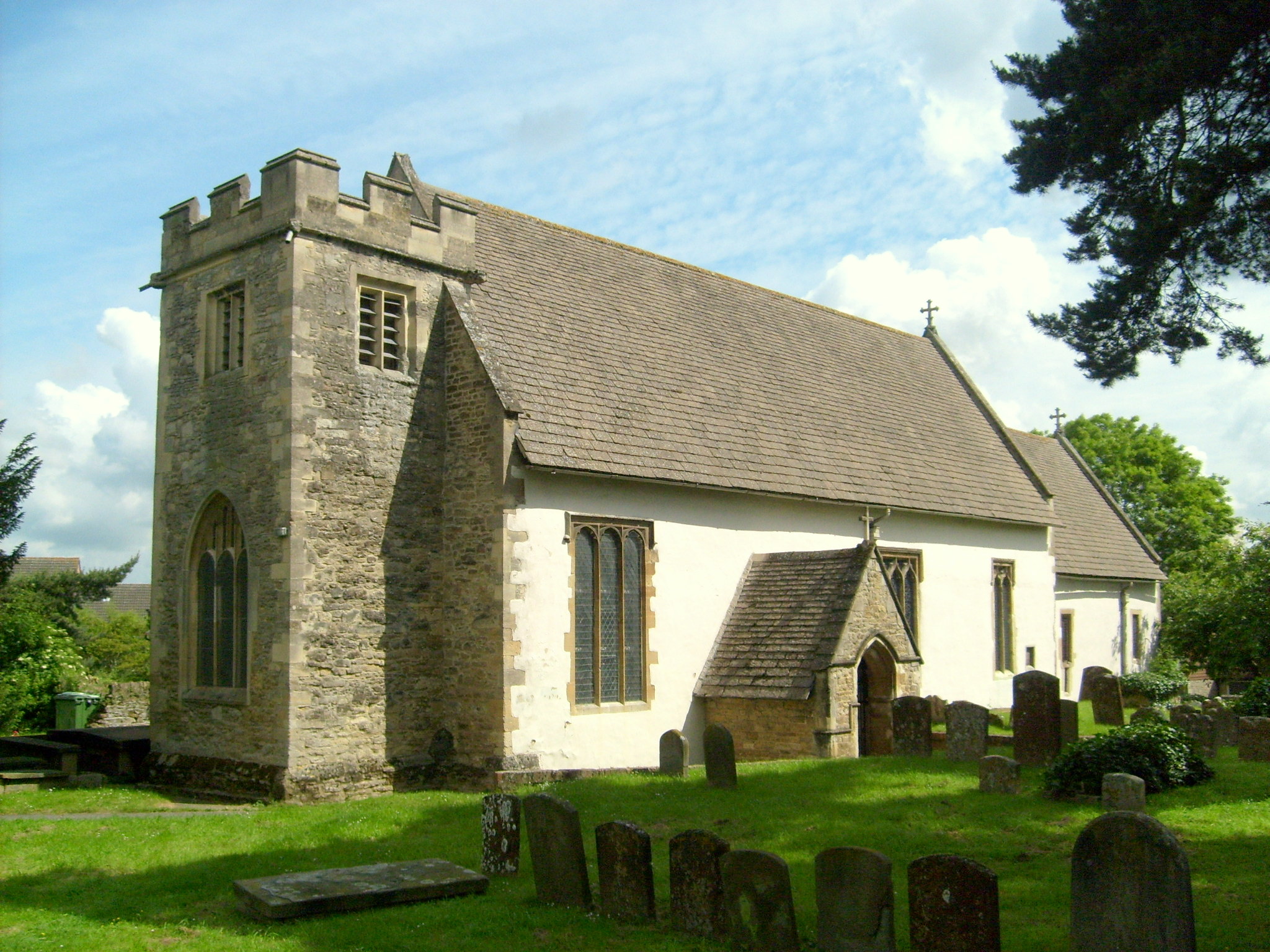
St Mary’s · Garsington · Oxfordshire is circa 1200, with a transitional period tower, and is located on high ground that affords views for some ten miles out over Wittenham Clumps. Its exposed situation does mean that it can get very windy. The picturesque manor house here is where Cromwell and Fairfax met to plot the siege of Oxford. More recently, the manor was the venue of the famous Garsington Opera, during the summers of 1989 until 2010. The main body of the church was subject to restoration in 1849, giving it a 14th century style. It is approached through an old lych-gate. Before the restoration of June 2013, this ground-floor ring of six was both heavy going and odd struck, and so it was recommended for those who demand a challenge. The exterior of the tower was repaired in 2007, since it has endured the brunt of the elements over the years. Note there is very limited parking outside. Nearby, the Three Horseshoes is a cosy country pub, with a function room added at the rear. It makes for a good lunchtime stopover for larger groups of visiting ringers. Hugh Deam
Saint Mary · Garsington · Oxfordshire
A ring of six holding a weekly practice
These bells were restored in June 2013 by White's
|
| Bell | Weight
CWT-QR-LB | Diameter
INCHES | Note
HUM
PRIME
NOMINAL | Cast | Founder | Inscription |
|---|
| 1 | 2-3-8 | 24.50 | E
F1-36 · 342.0Hz
E♭2-28 · 612.0Hz
E♭3+49 · 1280.5Hz | 1696 | Richard Keene | 1696 |
| 2 | 3-3-7 | 27.94 | D
D1-42 · 286.5Hz
D2-48 · 571.0Hz
D3-48 · 1142.5Hz | 1720 | Abraham Rudhall II | PEACE & GOOD NEIGHBOVRHOOD
A [Bell] R
1720 |
| 3 | 4-3-4 | 30.06 | C
D♭1-42 · 270.5Hz
C2-47 · 509.0Hz
C3-42 · 1021.0Hz | 1733 | Henry Bagley III | EDMVND HARPER HENRY MOLLENEVX CHVRCH WARDENS H B MADE ME J733 |
| 4 | 5-0-11 | 31.56 | B
C1-47 · 254.5Hz
B♭1-26 · 459.0Hz
B♭2+44 · 956.5Hz | 1929 | Mears & Stainbank | MEARS & STAINBANK, FOUNDERS, LONDON.
CAST 1732. RECAST 1929. |
| 5 | 6-1-24 | 35.00 | A
A0-47 · 214.0Hz
A♭1+48 · 427.0Hz
A2-48 · 855.5Hz | 1825 | W & J Taylor | RECAST BY SUBSCRIPTION : 1825. RICHD. HARPER & THOS. POULTON CHURCH WARDENS. W : & J. TAYLOR FEC-T OXON. |
| 6 | 8-1-6 | 37.75 | G
G0-31 · 192.5Hz
G1-33 · 384.5Hz
G2-48 · 762.5Hz | 1788 | John Rudhall | INO. MACKINESS & WM. PIKE CHURCH WARDENS 1788 I : RUDHALL FECIT [Border] |
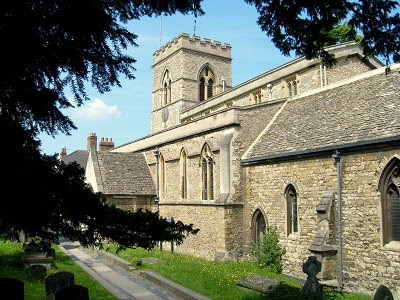
St Giles · City Centre
City Centre
St Giles SP511070
10 Woodstock Road
Oxford OX2 6HT
8 bells 14-0-1 cwt-qr-lb in
F♯
Practice: Thursday 19:30 - 21:00
Service ringing: Sunday 09:45 & 17:45
A simulator is available
Correspondent
St Giles · Oxford City This primarily Norman church is situated at the northern end of St Giles and it marks the convergence of the Banbury and Woodstock Roads. The church is first mentioned in 1138, with the lower part of the tower dating from before 1200. The 13th century saw the completion of the tower and the addition of the nave arcades. At that time, the parish encompassed an area from the River Cherwell in the east, to Jericho in the west and Summertown to the north. The south chapel was rebuilt between 1850 and 1852 using the original materials in the main. The large and well maintained churchyard enjoys a splendid view along what is the widest main street in the country. The eponymous St Giles Fair takes place on the first Monday and Tuesday after St Giles Day on the 1st of September. Traditionally, a quarter peal is rung on the Sunday evening before the start of the fair. The sound of the bells is immortalised by
New Bats In Old Belfries (1945), a collection of poems by Sir John Betjeman.
Before the Anaesthetic, or A Real Fright describes a stay at the nearby Radcliffe Infirmary: "Intolerably sad, profound St Giles's bells are ringing round, They bring the slanting summer rain To tap the chestnut boughs again." Eight syllables per line (as iambic tetrameters) match the number of bells here precisely. They were
retuned and rehung in 2011.
Hugh Deam
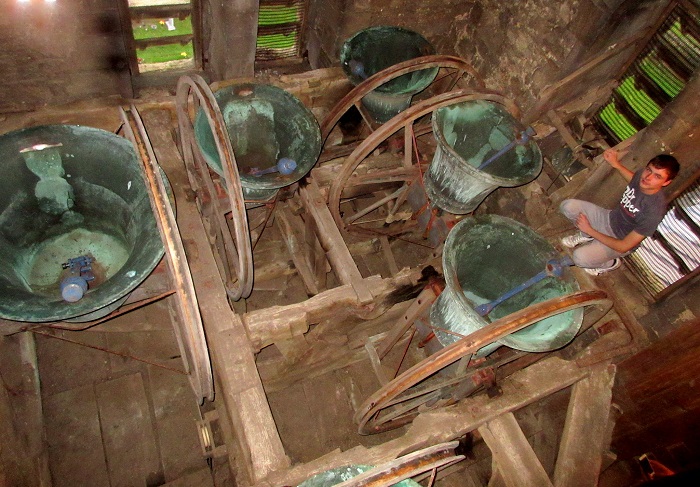
The bells before restoration
Saint Giles · City Centre · Oxford
A ring of eight holding a weekly practice
Retuned by Whitechapel and rehung in 2011 by White's. The inscriptions were checked by me at that time. I measured their musical notes after retuning, while the Tuning page gives a comparison of the new and old values.
|
| Bell | Weight
CWT-QR-LB | Diameter
INCHES | Note
HUM
PRIME
NOMINAL | Cast | Founder | Inscription |
|---|
| 1 | 4-1-4 | 26.50 | F♯
G1-24 · 386.5Hz
F♯2-31 · 726.5Hz
F♯3-31 · 1453.5Hz | 1927 | Mears & Stainbank | M & S. LONDON
[Six coins]
Venite Exultemus Domino.
D.D. Henricus Wylie Hughes. 1927. |
| 2 | 4-1-16 | 27.13 | E♯
F♯1-35 · 362.5Hz
E2+01 · 660Hz
F3-42 · 1363Hz | 1927 | Mears & Stainbank | [Six coins] MEARS & STAINBANK, FOUNDERS, LONDON.
Te Deum Laudemus. 1927. |
| 3 | 5-0-21 | 29.50 | D♯
E1-32 · 323.5Hz
D♭2+20 · 561Hz
E♭3-16 · 1232.5Hz | 1850 | William Taylor | Gloria in excelsis
[Two coins] + [Two coins] |
| 4 | 5-1-11 | 30.75 | C♯
D1-45 · 286Hz
D♭2-45 · 540Hz
D♭3-40 · 1083Hz | 1850 | William Taylor | Benedictus qui venit in nomine Domine [Two coins] + [Two coins] |
| 5 | 6-2-6 | 33.00 | B
C1-37 · 256Hz
B♭1+03 · 467Hz
B2-33 · 969Hz | 1850 | William Taylor | Magnificat anima mea Dominum ait Maria [Two coins] [Crossed sword and key] [Two coins] |
| 6 | 8-0-15 | 35.25 | A♯
B0-49 · 240Hz
B♭1-47 · 453.5Hz
B♭2-46 · 907.5Hz | 1850 | William Taylor | Sonitus Ogidii conscendat culmina Coeli [Two coins] + [Two coins] |
| 7 | 8-3-6 | 38.00 | G♯
A♭0+39 · 212.5Hz
G1+39 · 401Hz
A♭2-36 · 813.5Hz | 1850 | William Taylor | Sum Rosa pulsata mundi Katerrina vocata [Two coins] + [Two coins] |
| 8 | 14-0-1 | 42.50 | F♯
F♯0-37 · 181Hz
F♯1-37 · 362Hz
F♯2-36 · 724.5Hz | 1632 | Ellis Knight I | FEARE GOD HONAR THE KXNG X632 |
The bells before restoration
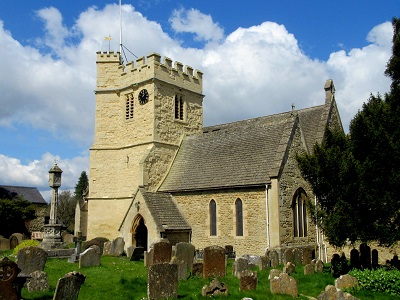
St Andrew · Headington
Headington
St Andrew SP544076
33 St Andrew's Road · Headington
Oxford OX3 9DL
8 bells 7-3-0 cwt-qr-lb in
A♭
Practice: Wednesday 19:30 - 21:00
Service ringing: Sunday 09:20 - 10:00
A simulator is available
Correspondent
St Andrew · Headington · Oxford belongs to an ancient parish some 2 miles north of the centre of Oxford. It straddles the escarpment of the Oxford Heights, a ridge of hills that stretches from Faringdon to Brill. The Corallian limestone and sandstone resulted in Headington becoming synonymous with quarrying. King Ethelred the Unready (
c.968 - 1016) is thought to have been christened here. The first documentary reference to the church here was in a charter of Henry I from 1122, granting the chapel at Headington to the Canons of St Frideswide’s. The tower and south aisle are 14th century, with a chancel from a century later, and the nave is 19th century, as is the north aisle extension and vestry. The church sits at the heart of Old Headington, and its eight bells are ideal for very fluent ringing. A simulator here now allows additional practices to take place.
Hugh Deam
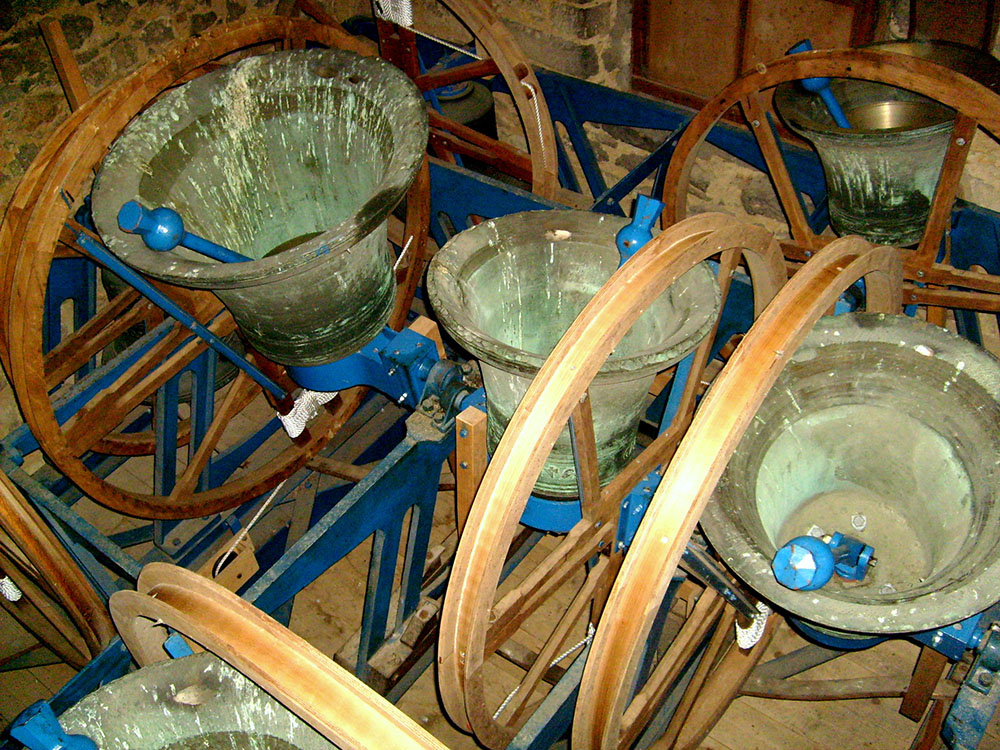
Photo by Paul Lucas December 2007
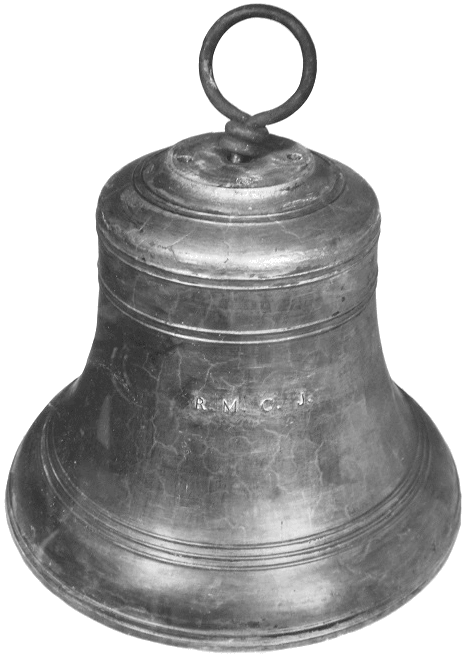 Treble
1974 Whitechapel
Replaced 2000 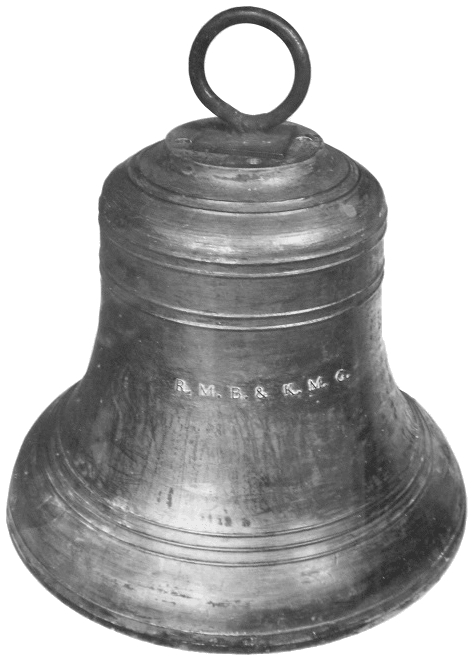 Second
1974 Whitechapel
Replaced 2000 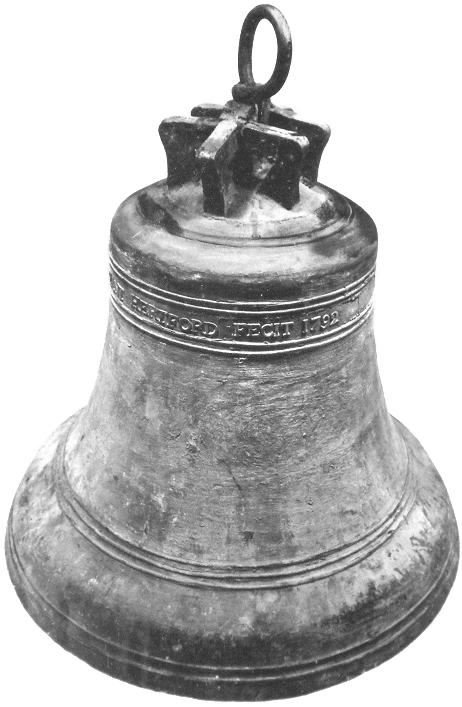 Third
John Briant
1792 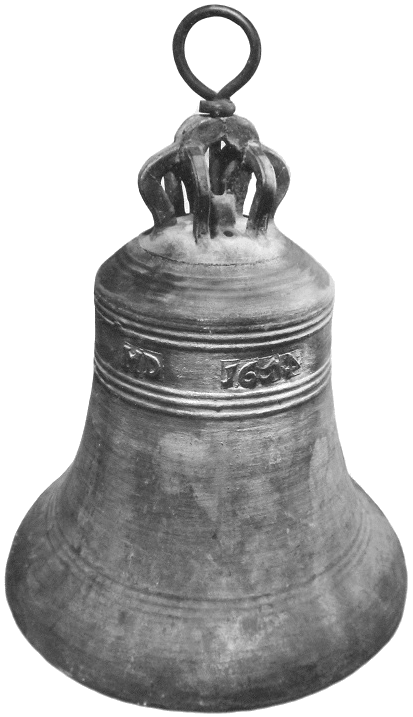 Fourth
Michael Darbie
1654
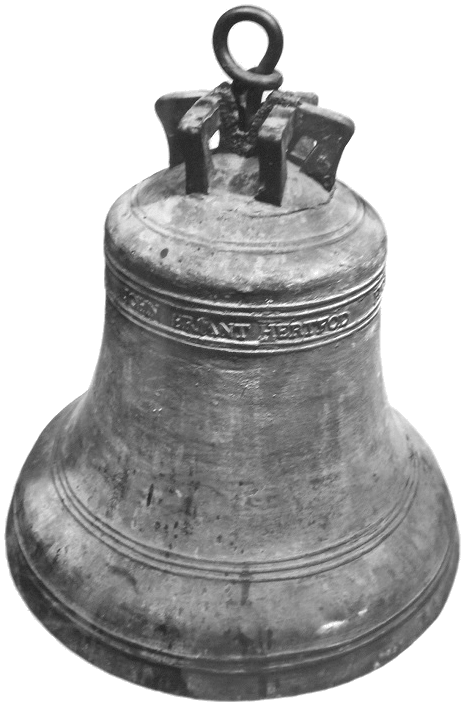 Fifth
John Briant
1792 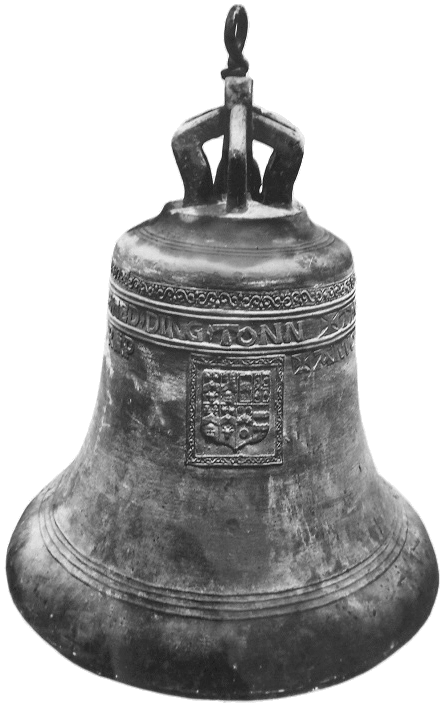 Sixth
Richard Purdue I
1624 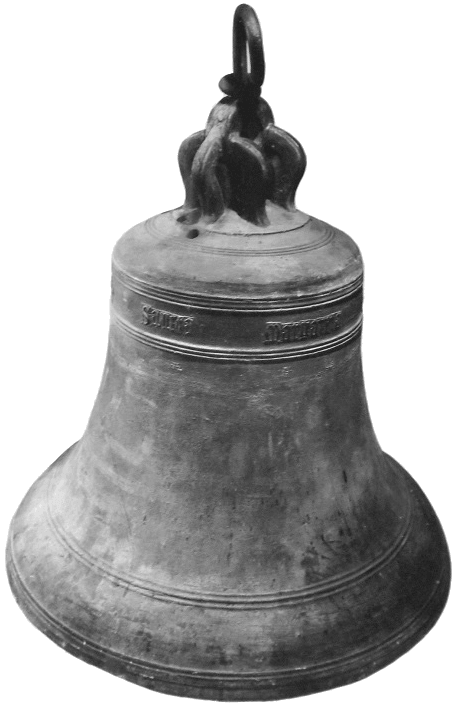 Seventh
Brede mark
c.1470  Tenor
William Yare
1613
|
Saint Andrew · Headington · Oxford
A ring of eight holding a weekly practice
Overhauled in 2000 by White's of Appleton. This tower contains the
oldest ringable bell in the branch.
|
| Bell | Weight
CWT-QR-LB | Diameter
INCHES | Note | Cast | Founder | Inscription |
|---|
| 1 | 3-2-1 | 23.75 | A♭ | 2000 | Whitechapel Bell Foundry Ltd |
WHITES OF APPLETON CHURCH BELLHANGERS AD 2000 WHITECHAPEL RECAST IN MEMORY OF J.E.C. & O.E.C. VICAR W.M.B.
|
| 2 | 3-3-9 | 24.50 | G | 2000 | Whitechapel Bell Foundry Ltd |
WHITES OF APPLETON CHURCH BELLHANGERS AD 2000 WHITECHAPEL RECAST IN MEMORY OF G.A.M. & C.E.M.M.
|
| 3 | 3-2-22 | 26.06 | F | 1792 | John Briant |
JOHN BRIANT HERTFORD FECIT 1792
|
| 4 | 4-2-16 | 27.13 | E♭ | 1654 | Michael Darbie |
M D 1654
|
| 5 | 4-0-0 | 27.63 | D♭ | 1792 | John Briant |
JOHN BRIANT HERTFORD FECIT 1792
|
| 6 | 5-3-4 | 30.31 | C | 1624 | Richard Purdue I | [ Border ]
 THOMAS  WHORWOOD E SPVIRE LORD OF HED DING TONN
ANNO DOMINI 1624 [ Crest of the Prince of Wales] R [ Bell] P [ Crest of Thomas Whorwood]
|
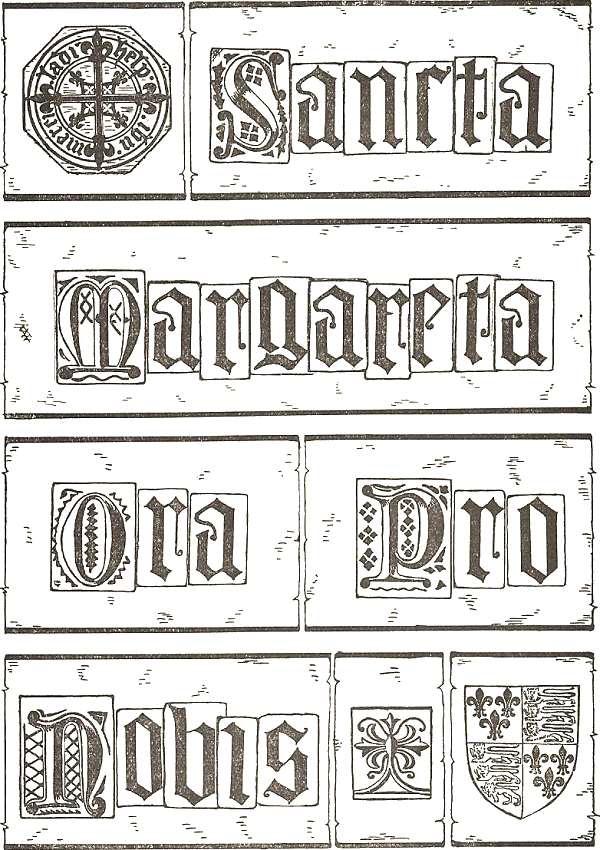
| 7 | 7-0-8 | 33.56 | B♭ | c1470 | London
Brede mark
Generally attributed to John Danyell's unknown successor |
|
| 8 | 7-3-0 | 36.19 | A♭ | 1613 | William Yare |
EDWARD FFISHE OWEN GVRDEN 1613
W  Y
|
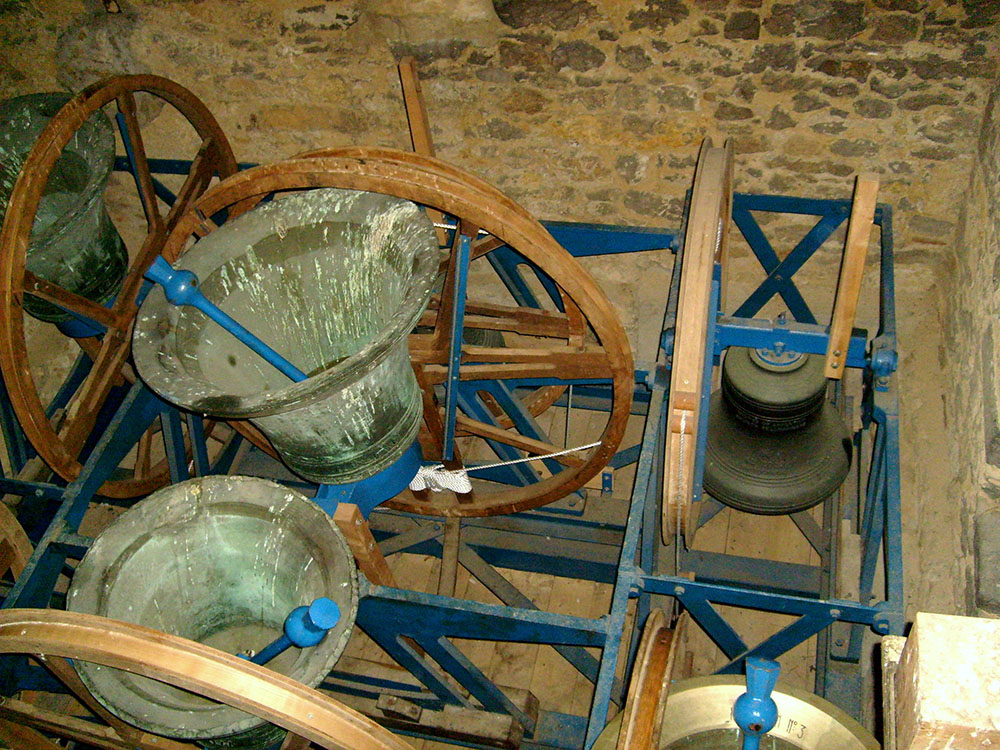
Photo by Paul Lucas December 2007
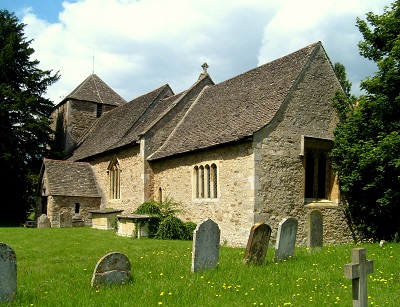
St Lawrence · North Hinksey
North Hinksey
St Lawrence SP495055
North Hinksey Lane · North Hinksey
Oxford OX2 0LZ
6 bells 5-2-27 cwt-qr-lb in
B
Practice: Fridays though please check
Service ringing: Sunday 10:50 - 11:25
Most Sundays
Correspondent
The Hinksey villages were a rural haunt of Matthew Arnold’s Scholar Gypsy, and despite being not much more than a mile from the centre of Oxford, they were actually in the county of Berkshire. Much of the area is now suburbanised or penned in by the Oxford Ring Road, with the church of St Laurence · North Hinksey · Oxford being accessible directly from the southbound A34. At the time of the local government boundary reorganisation in 1972, with Hinksey moving from Berkshire to Oxfordshire, the four bells in the church were augmented to a six. A plaque, made from a section of the old frame, now hangs within the ringing-room. The first peal on the bells did not take place until 1981. The church, set on high ground, is basically Norman, with an Early English tower that had to be partly rebuilt after suffering damage during the English Civil War. Hugh Deam
Saint Lawrence · North Hinksey · Oxford
A ring of six holding a weekly practice
The tenor's rope can jump from the wheel if not handled correctly
|
| Bell | Weight
CWT-QR-LB | Diameter
INCHES | Note | Cast | Founder | Inscription |
|---|
| 1 | 2-2-6 | 22.75 | G♯ | 1972 | Whitechapel Bell Foundry Ltd | The gift of Winifred Toynbee 1972
|
| 2 | 3-0-16 | 24.50 | F♯ | 1972 | Whitechapel Bell Foundry Ltd | John W Larter B C Vicar K G Goff H Lockwood Curchwardens 1972
|
| 3 | 3-1-19 | 25.50 | E | 1972 | Whitechapel Bell Foundry Ltd | 1676 Recast 1972
|
| 4 | 3-2-21 | 26.50 | D♯ | 1972 | Whitechapel Bell Foundry Ltd | 1661 Christopher Hodson made me Recast 1972
|
| 5 | 4-0-25 | 28.63 | C♯ | 1675 | Richard Keene | R K |
| 6 | 5-2-27 | 31.13 | B | 1907 | John Taylor
& Co | William Yare made me 1614 Recast 1907 [Crest of John Taylor and Co Loughborough] |
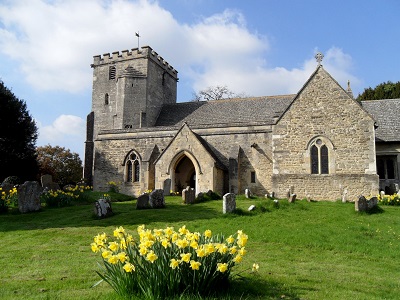
St Giles · Horspath
Horspath
St Giles SP571049
Church Road · Horspath
Oxfordshire OX33 1SE
6 bells GF
5-2-9 cwt-qr-lb in
B♭
Practice: Tuesday 19:30 - 20:45
Service ringing: Sunday 10:30 - 11:00
Correspondent
St Giles · Horspath · Oxfordshire The village lies below the viewpoint of Shotover Hill and retains many groups of attractive cottages. Horspath is one of the very few villages around Oxford still to have a feast every September, where its centre is transformed on the Monday night by quite a few of the fairground attractions still in the area after St Giles Fair in Oxford. The 13th century church was drastically altered during the 19th century, with the chancel being rebuilt and north transept added. The church contains medieval stained glass and, amongst a number of notable details, a handsome Jacobean pulpit. The tower is 15th century, and the bells are an extremely smooth flowing ring of six, with long ropes which might suit exceptionally short ringers. Hugh Deam
Saint Giles · Horspath · Oxfordshire
A ring of six holding a weekly practice
|
| Bell | Weight
CWT-QR-LB | Diameter
INCHES | Note
HUM
PRIME
NOMINAL | Cast | Founder | Inscription |
|---|
| 1 | 2-3-18 | 24.00 | G
A♭1-05 · 414Hz
F2+44 · 716.5Hz
G3+35 · 1600.5Hz | 1866 | Mears & Stainbank | + DEUM : LAUDO : DIGNIS : PLAUDO. / GIVEN BY THE / REV. H. R. BRAMLEY, M.A. CURATE. / 1866. / MEARS AND STAINBANK, FOUNDERS, LONDON. |
| 2 | 3-2-13 | 25.25 | F
F♯1+25 · 375.5Hz
E♭2+26 · 632Hz
F3+37 · 1427.5Hz | 1719 | Abraham Rudhall II | PROSPERITY TO ALL OVR BENEFACTORS
A [Bell] R 1719
|
| 3 | 3-2-13 | 27.00 | E♭
E♭1+29 · 316.5Hz
D2+28 · 597Hz
E♭3+29 · 1266Hz | 1719 | Abraham Rudhall II | IOHN CHANCELOR & THO HEISTER CHURCHWARDENS 1719 A [Bell] R 1719
|
| 4 | 4-0-13 | 28.13 | D
D1-27 · 289Hz
D2+34 · 599Hz
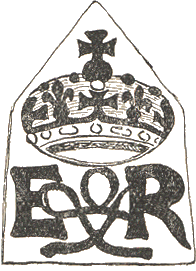
D3+20 · 1188.5Hz | 1602 | Joseph Carter | This × Bell × Was × Made
× 1602 J × c ×
 |
| 5 | 4-2-24 | 29.63 | C
D♭1-01 · 277Hz
B1+09 · 496.5Hz
C3+31 · 1066Hz | 1838 | W & J Taylor | TAYLORS BELLFOUNDERS OXFORD 1838 DEO ET ECCLESIÆ |
| 6 | 5-2-9 | 32.00 | B♭
B♭0+10 · 234.5Hz
B♭1+27 · 473.5Hz
B♭2+12 · 939Hz | 1611 | William Yare | THIS BELL WAS MADE 1611
W Y
|
| Saunce | ½ cwt | 12.50 | A | 1811 | James Wells | JAMES WELLS
ALDBOURN FECIT 1811
  |
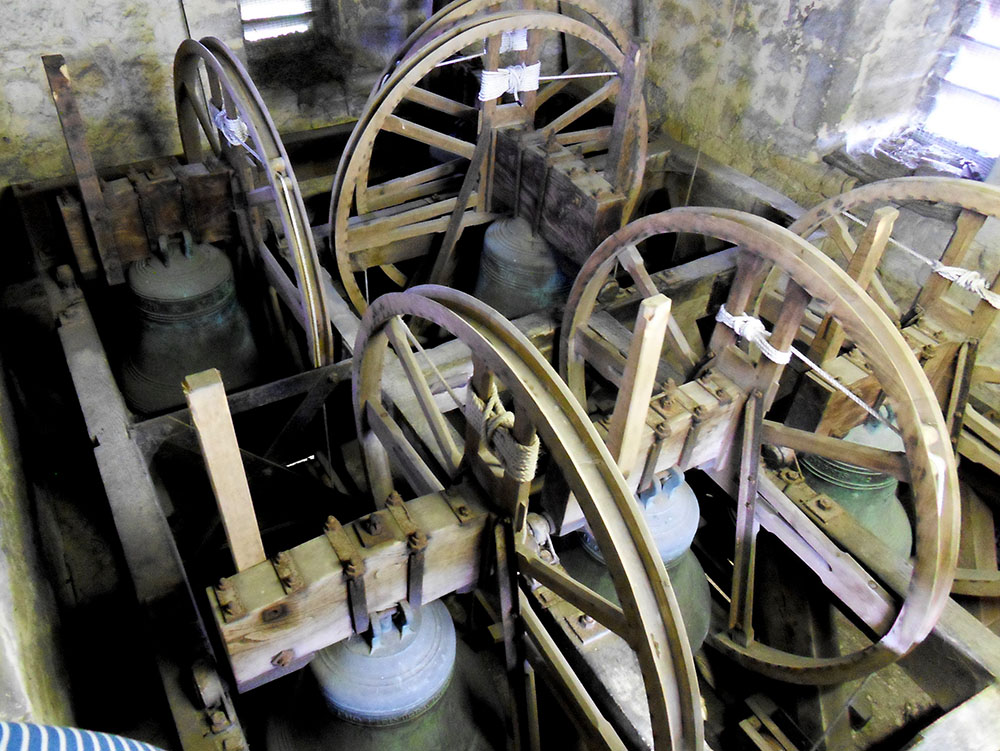
Photo by Paul Lucas · September 2014
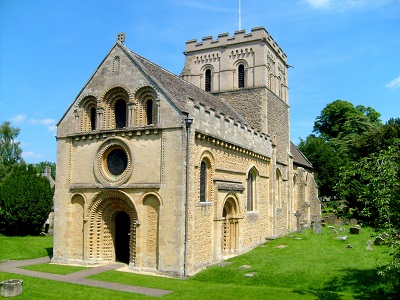
St Mary the Virgin · Iffley
Iffley
St Mary the Virgin SP527035
Church Road · Iffley
Oxford OX4 4EJ
6 bells 10 cwt in
A♭
Practice: Wednesday 19:30 - 21:00
Service ringing: Sunday 09:30 - 10:00
Correspondent
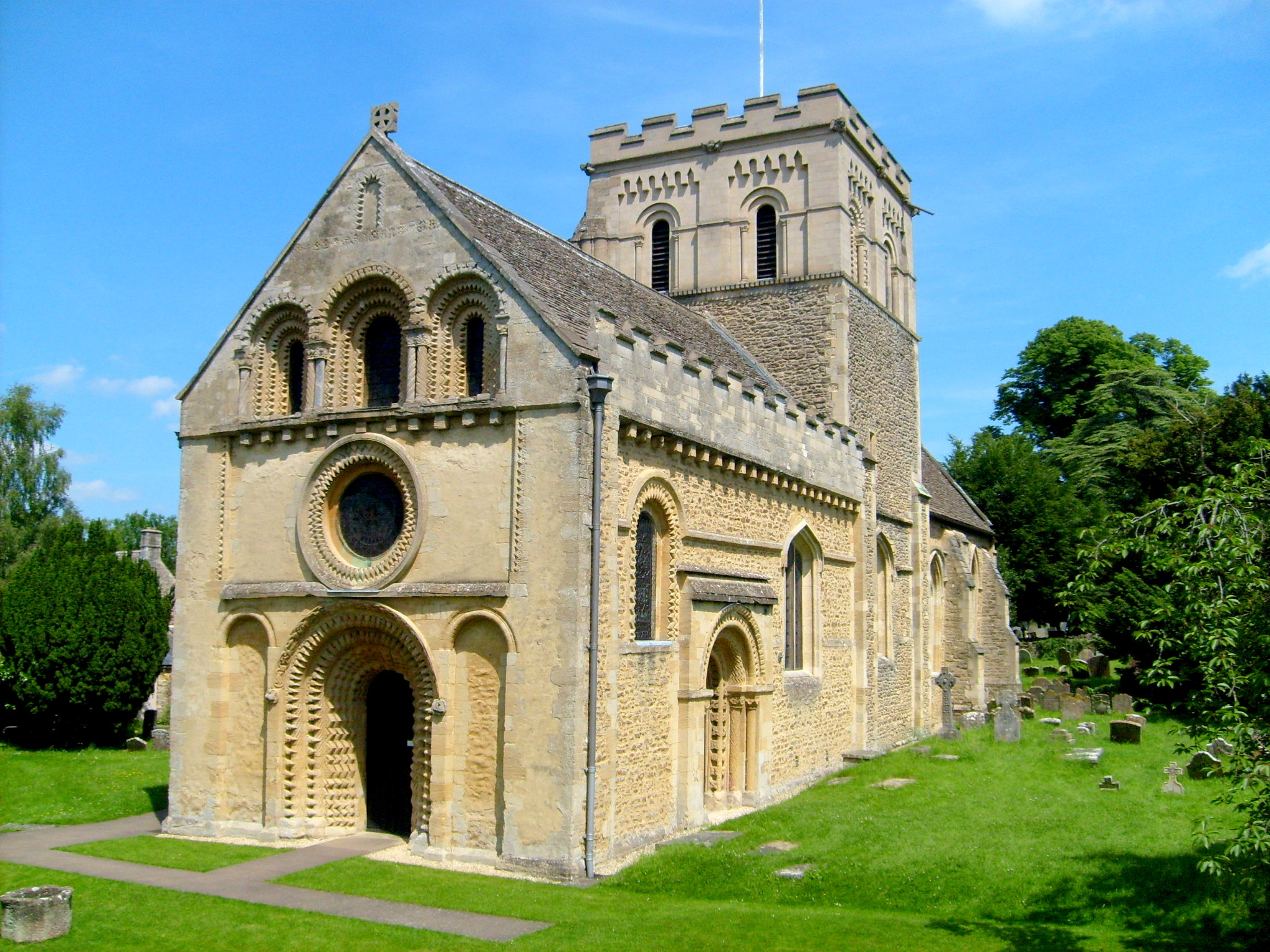
SMV · Iffley · Oxford was built circa 1170, due to the gift of a rich patron. It is one of the best preserved in the country, with fine carvings, and a priest’s chair and desk fashioned out of a 1600 year-old yew tree. There is a superb south-west window, designed by John Piper, that allows light to diffuse to best advantage within the church. The tower formed part of the original design, with the current timber bell-frame having been installed in 1911. The spacious ringing chamber is reached via a spiral staircase of about 40 steps. The church is generally open from 8am – 7pm. Toilet facilities are available in the vestry on the north side of the churchyard. The nearest pubs are The Isis Tavern, adjacent to Iffley Lock, or The Prince of Wales, on the road through the village which leads to the church.
Hugh Deam
Saint Mary the Virgin · Iffley · Oxford
A ring of six holding a weekly practice
|
| Bell | Weight
CWT-QR-LB | Diameter
INCHES | Note
HUM
PRIME
NOMINAL | Cast | Founder | Inscription |
|---|
| 1 | 3¾ cwt | 26.38 | F
G1-49 · 381Hz
E2+27 · 670Hz
F♯3-31 · 1453.5Hz | 1785 | Thomas Janaway | THOMAS JANAWAY FECIT J785 |
| 2 | 4 cwt | 27.38 | E♭
E1+15 · 332.5Hz
E♭2+04 · 624Hz
E3-13 · 1308Hz | 1785 | Thomas Janaway | THOS. JANAWAY FECIT J785 |
| 3 | 4-2-26 | 29.25 | D♭
D1+16 · 296.5Hz
D♭2+08 · 557Hz
D3-46 · 1143.5Hz | 1869 | Mears & Stainbank | MEARS & STAINBANK, FOUNDERS, LONDON. / VIVOS VOCO. MORTUOS PLANGO. FULGARA FRANGO / T. A. WARBURTON, VICAR / R. REID, J. FRENCH, WARDENS. / CAST 1592. / RECAST 1869. |
| 4 | 5½ cwt | 31.38 | C
C1+02 · 262Hz
B2-24 · 487Hz
C3+19 · 1058.5Hz | 1592 | Joseph Carter | prayse ye the lorde j
 c 1592 c 1592 |
| 5 | 7½ cwt | 34.50 | B♭
C1-17 · 259Hz
A2+17 · 444.5Hz
B♭3+27 · 947Hz | c1699 | Abraham Rudhall I | None |
| 6 | 10 cwt | 38.00 | A♭
B♭0-19 · 230.5Hz
A♭1-05 · 414Hz
A♭2+31 · 846Hz | 1626 | Ellis Knight I | OVR HOPE XS XN THE LORD X626 |
| Saunce | 1 cwt | 16.00 | G | 1709 | Abraham Rudhall I | GOD SEND VS PEACE
AR [Bell] 1709
|
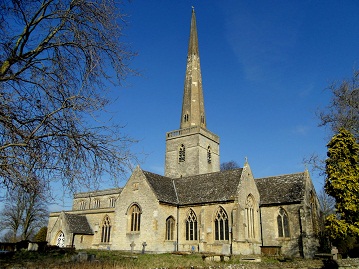
St Mary · Kidlington
Kidlington
St Mary the Virgin SP497148
Church Street · Kidlington
Oxfordshire OX5 2AZ
8 bells 21-2-27 cwt-qr-lb in
D
Practice: Tuesday 19:30 - 21:00
Service ringing: Sunday 09:20 - 09:55
Correspondent
St Mary · Kidlington · Oxfordshire Being England’s second largest village (Cranleigh in Surrey currently claims the distinction of being the largest), Kidlington derives its name from the Old English description for an estate owned by Cydela. The Domesday Book notes it as being called Chedelintone. The Georgian houses of the village are somewhat hidden by new developments which dominate the central, southern and western sides. The original design of this primarily Early English church was of a cruciform nature with a central tower and no aisles. A series of major additions during the later Decorated period have drastically altered the layout. There are a plethora of monuments within, including memorials to two Bishops of Exeter. The imposing spire is surprisingly not apparent from the road entrances to the village, the church being tucked away on the north-east side of Kidlington and backed by large areas of open ground. Funds have been raised in recent years to restore and maintain the tower and spire, with the superb eight bells installed here being the heaviest in the branch.
Hugh Deam
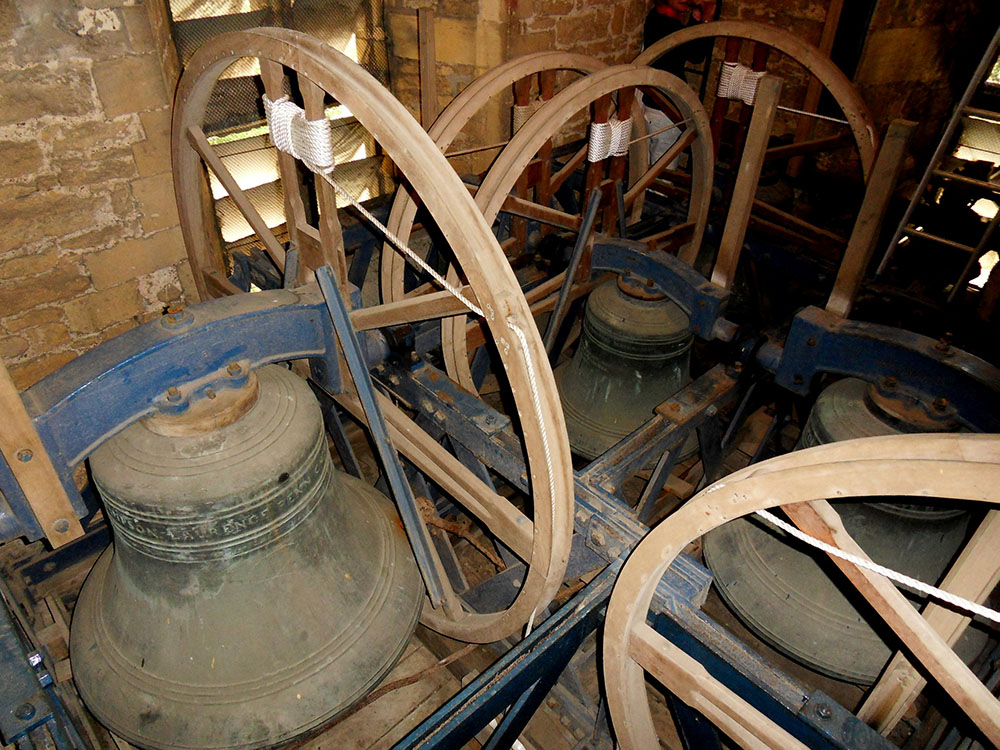
The tenor to the left
Saint Mary · Kidlington · Oxfordshire
A ring of eight holding a weekly practice
|
| Bell | Weight
CWT-QR-LB | Diameter
INCHES | Note | Cast | Founder | Inscription |
|---|
| 1 | 6-0-8 | 31.88 | D | 1897 | Mears & Stainbank | MEARS & STAINBANK, FOUNDERS, LONDON. 1879. / PRESENTED BY WILLIAM BRAIN, ESQ: / IN MEMORY OF HIS GRANDPARENTS / WILLIAM AND MARY BRAIN. / A.C.R. FREEBORN, VICAR. / W. BRAIN, E. H. MARTIN, } CHURCHWARDENS. / WEBB & BENNETT, BELLHANGERS, KIDLINGTON. |
| 2 | 6-2-18 | 32.50 | C♯ | 1897 | Mears & Stainbank | MEARS & STAINBANK, FOUNDERS, LONDON. 1879. / PRESENTED BY WILLIAM BRAIN, ESQ: / IN MEMORY OF HIS GRANDPARENTS / WILLIAM AND MARY BRAIN. / A.C.R. FREEBORN, VICAR. / W. BRAIN, E. H. MARTIN, } CHURCHWARDENS. |
| 3 | 7-2-12 | 34.75 | B | 1897 | Mears & Stainbank | RICHARD KEENE MADE ME 1661 / RECAST BY MEARS & STAINBANK, LONDON. 1897. / A.C.R. FREEBORN , VICAR. / W. BRAIN, E. H. MARTIN, } CHURCHWARDENS. |
| 4 | 8-2-23 | 37.00 | A | 1897 | Mears & Stainbank | BARTHOLOMEW * ATTON * MADE * ME * THE * TREBLELL * TO * BE * 1621 / RECAST BY MEARS & STAINBANK, LONDON. / A.C.R. FREEBORN, VICAR. / W. BRAIN, E. H. MARTIN, } CHURCHWARDENS. / 1897. |
| 5 | 11-2-0 | 40.38 | G | 1715 | Abraham Rudhall I | WM : COSIER THO : DAWSON WM : TURRELL CH : WARDENS 1715
A [Bell] R
|
| 6 | 12-1-5 | 43.13 | F♯ | 1897 | Mears & Stainbank | THIS BELL WAS MADE 1610 W + Y / RECAST BY MEARS & STAINBANK, LONDON. / A.C.R. FREEBORN, VICAR. / W. BRAIN, E. H. MARTIN, } CHURCHWARDENS. / 1897. |
| 7 | 16-2-1 | 47.75 | E | 1700 | Richard Chandler III | IOHN SANDERS IOHN SPRINGALL LAURENC PENN C W 1700 |
| 8 | 21-2-27 | 52.38 | D | 1708 | Abraham Rudhall I | THO : DAWSON RICH : STIMSON. LAURENCE PENN CHURCHWARDENS
A : R [Bell] 1708
|
| Saunce | 1¼ cwt | | | 1800 | Thomas Mears I | THOMAS MEARS OF LONDON FECIT 1800. |
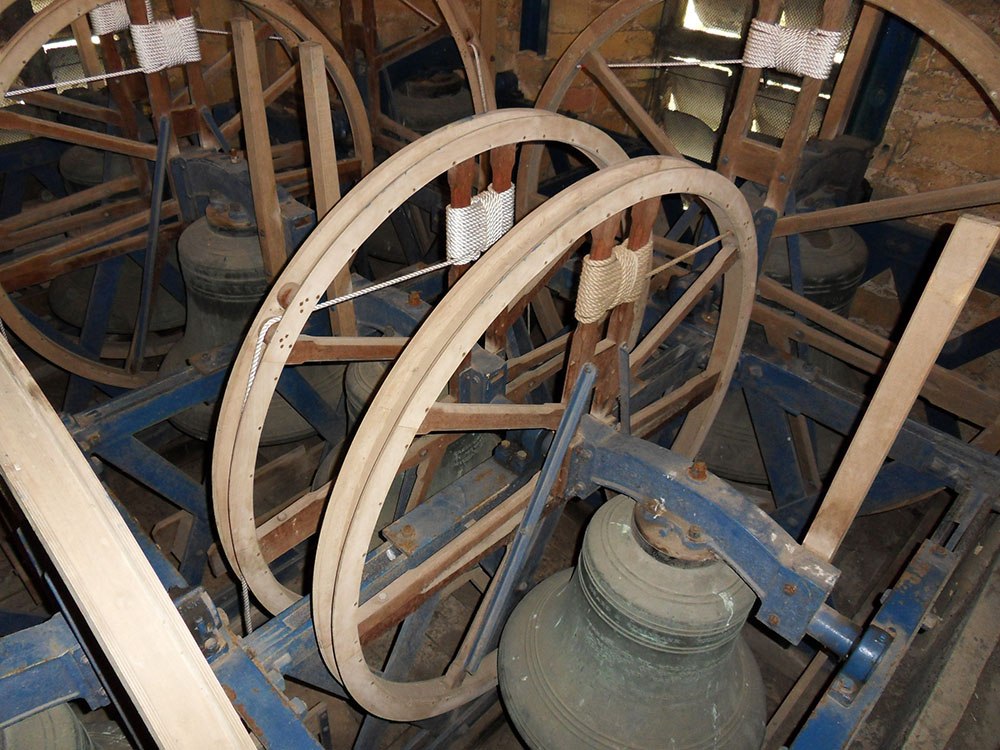
Nearest is the treble
St Nicholas · Marston
Marston
St Nicholas SP527089
Elsfield Road · Old Marston
Oxford OX3 0PR
6 bells 4-3-17 cwt-qr-lb in
C
Practice: Friday 19:15 - 21:00
Service: 1st Sunday 17:20 - 18:00
3rd Sunday 15:00 - 16:00
Correspondent
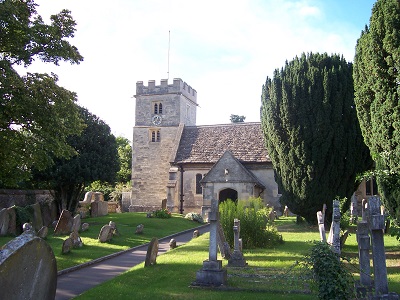
St Nicholas · Marston · Oxford The toponym Marston references its origins as a farmstead in marshy ground. Several brooks wend their way almost unnoticed through and around the village on their way to feeding into the River Cherwell. The low-lying nature of the village has resulted in certain areas being prone to flash-flooding down the years. During the English Civil War in 1646, Sir Thomas Fairfax accepted the surrender of Oxford by representatives of Charles I in the manor house behind the church, the house now being known as Cromwell House. Although not conclusively established, Oliver Cromwell is thought to have met with Fairfax at the house prior to the surrender, but he was not present at the time of the surrender, contrary to some sources. During the 20th century, two of the most notable members of the Oxford penicillin team, Howard Florey and Norman Heatley, lived in the village. The 12th century church was once partly surrounded by a moat. These short-draughted six were augmented from five in 1972. They are rung from a floor reached by a straight staircase of 12 steps. A toilet is available, with tea and coffee facilities in the new vestry. Visitors are welcome 09:30 - 17:30 on weekdays. Peals are attempted three times per year. Food is available from the
Victoria Arms and the
Red Lion. St Nicholas Church is in Elsfield Road, Old Marston, near to the A40 Marston Flyover on the Northern Bypass. Please click on the Ordnance Survey reference number (above) to see a map.
Captain Anthony Hughes,
Vice Captain Judy Kirby,
Secretary Hugh Deam.
Hugh Deam
Saint Nicholas · Marston · Oxford
A ring of six holding a weekly practice
These bells were re-tuned (Whitechapel) and re-hung (White's) in December 2015
|
| Bell | Weight
CWT-QR-LB | Diameter
INCHES | Note | Cast | Founder | Inscription |
|---|
| 1 | 3-0-9 | 22.81 | A | 1972 | Whitechapel Bell Foundry Ltd |
No inscription in this band
19 72 WHITECHAPEL P.N. RIMMER VICAR V.C. CARDY / A.W. SIDEBOTTOM } CHURCHWARDENS
|
| 2 | 3-0-11 | 24.00 | G | 1823 | W & J Taylor | None |
| 3 | 3-0-8 | 25.06 | F | 1823 | W & J Taylor | None |
| 4 | 3-1-16 | 26.75 | E | 1823 | W & J Taylor | None |
| 5 | 4-0-5 | 28.50 | D | 1823 | W & J Taylor | None |
| 6 | 4-3-17 | 30.94 | C | 1823 | W & J Taylor | THIS PEAL WAS RECAST BY W. & J. TAYLOR OXFORD OCTR 17. 1823. JOHN CANNON & WILLM LEAKE C.W. |
St John · Stanton
Stanton St John
St John the Baptist SP577094
Middle Road · Stanton St John
Oxfordshire OX33 1DN
5 bells 9¼ cwt in
G♯
Practice: Please check
Service: Sunday 09:00 - 09:30
Please check
Correspondent
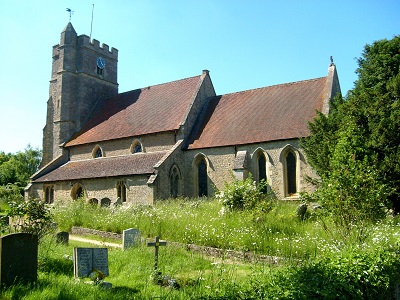
The village of Stanton St John lies adjacent to the Roman road between Dorchester and Alcester. It is well known to television viewers as its shop and main street have featured in several episodes of Midsomer Murders. Close by is a large pick-your-own farm that is popular for its strawberries and asparagus. The son of John White of Stanton St John, Revd John White of Dorchester (1575-1648), went on to become a founder of the New England colony of Massachusetts. The grandparents of John Milton are buried in the churchyard here. St John has a 12th century chancel arch and a perpendicular gothic period tower. Although the bells were deemed unringable circa 1982, the ODG reclassified them as safe to ring in 2008, after the work that was carried out by Rod Bickerton. However, a fund-raising campaign has been under way to re-hang these bells. Hugh Deam
The completion of the bell restoration project was achieved in June 2019. The works were carried out by Whites of Appleton, and included rehanging the bells on replacement headstocks and ball bearings, as well as quarter turning three of the bells. In addition the bell frame was strengthened, and sliders, stays, pulleys and running boards replaced. Whites also did an excellent job of repairing the existing wheels. The project was a big success, and was very well supported by the community, the ODG & OCB, a number of grants, and a lot of fund-raising in the village. Paul Lansdowne
Saint John · Stanton St John · Oxfordshire
A ring of five holding a weekly practice
Re-hung by White's in June 2019. The exact weights remain unknown.
|
| Bell | Weight
CWT-QR-LB | Diameter
INCHES | Note | Cast | Founder | Inscription |
|---|
| 1 | 4 cwt | 27.63 | D♯ | 1652 | Ellis & Francis Knight | 1652 |
| 2 | 4¾ cwt | 29.50 | C♯ | 1716 | Henry Bagley III | -:- HENREY LODER WILLIAM GRANT CHVRCH WARDENS -:- HENREY BAGLEY MADE MEE J7J6 -:- |
| 3 | 5½ cwt | 31.25 | B♯ | 1656 | Michael Derbie | MICHAEL DERBIE MADE ME 1656 |
| 4 | 7 cwt | 33.75 | A♯ | 1652 | Ellis & Francis Knight | 1652 |
| 5 | 9¼ cwt | 37.75 | G♯ | 1724 | Abraham Rudhall II | PEACE & GOOD NEIGHBOVRHOOD
A [Bell] R
1724
|
St Mary · Wheatley
Wheatley
St Mary SP597058
Church Road · Wheatley
Oxfordshire OX33 1LZ
6 bells 9-3-10 cwt-qr-lb in
A♭
Practice: Friday 19:30 - 21:00
Service ringing: Sunday 09:30
Correspondent
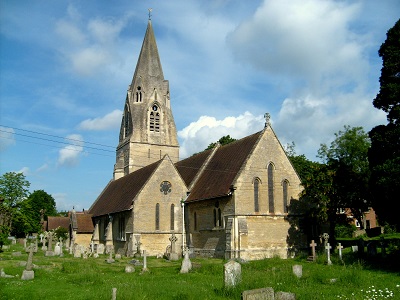
St Mary · Wheatley · Oxfordshire is situated on the route of the old London to Gloucester road, with the River Thame running through the lower part of the village. This area was the site of a Roman settlement and later a Saxon cemetery. The old stone lock-up of the village is still preserved. The church is 18th century, but was subject to a rebuilding 1855-57 in C13th style at the instigation of Bishop Samuel Wilberforce, although the distinctive broach-spire faceted tower was not completed until 1868. The bells were re-hung to great effect in 1996.
Hugh Deam
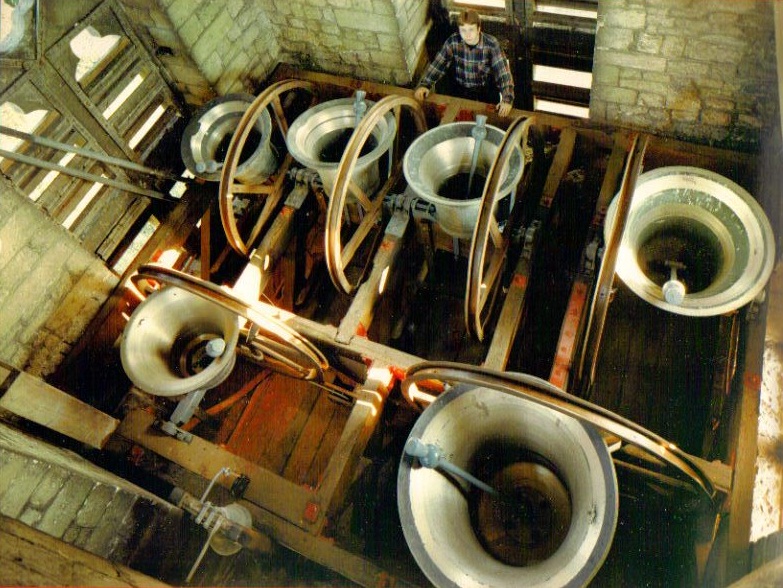
Mark J Walker at the newly re-hung installation in 1996
Saint Mary · Wheatley · Oxfordshire
A ring of six holding a weekly practice
The 2 strikes late at hand
|
| Bell | Weight
CWT-QR-LB | Diameter
INCHES | Note
HUM
PRIME
NOMINAL | Cast | Founder | Inscription |
|---|
| 1 | 4-2-3 | 26.69 | F
F1-18 · 345.5Hz
F2-17 · 691.5Hz
F3-19 · 1381Hz | 1996 | Whitechapel Bell Foundry Ltd | MEARS AND STAINBANK, FOUNDERS, LONDON. / "PRAISE GOD IN HIS SANCTUARY" PS.150. / EDWARD ELTON, VICAR. / GEORGE ROSE, / CHARLES BUSHNELL, } CHURCHWARDENS. 1879. RECAST 1996 WHITECHAPEL |
| 2 | 4-2-25 | 28.75 | E♭
E♭1-14 · 308.5Hz
D♭2+34 · 565.5Hz
E♭3-20 · 1230Hz | 1794 | John Briant | J. BRIANT HERTFORD.
FECIT. 1794 : |
| 3 | 5-1-15 | 30.50 | D♭
D♭1-10 · 275.5Hz
C2+02 · 524Hz
D♭3-16 · 1098.5Hz | 1794 | John Briant | JOHN BRIANT HARTFORD.
FECIT. 1794 : |
| 4 | 5-1-0 | 30.75 | C
C1+35 · 267Hz
B2-03 · 493Hz
C3-13 · 1038.5Hz | 1794 | John Briant | J : BRIANT HERTFORD :
FECIT : 1794 : |
| 5 | 6-3-27 | 33.75 | B♭
B0-45 · 240.5Hz
B♭1-15 · 462Hz
B♭2-17 · 923Hz | 1794 | John Briant | : J : BRIANT HERTFORD. FECIT. 1794 : GLORIA DEO IN EXCELSIS : |
| 6 | 9-3-10 | 37.75 | A♭
A♭0-18 · 205.5Hz
A♭1-15 · 411.5Hz
A♭2-20 · 821Hz | 1996 | Whitechapel Bell Foundry Ltd | JOHN BRIANT. OF HERTFORD. FECIT. 1793. / GLORIA DEO IN EXCELSIS. [Four coins] / RECAST 1996 WHITECHAPEL |
| Saunce | 0-0-20 | 9.00 | | | Olovyani-
shnikov | Made in the factory of Olovyanishnikov in Yaroslavl |
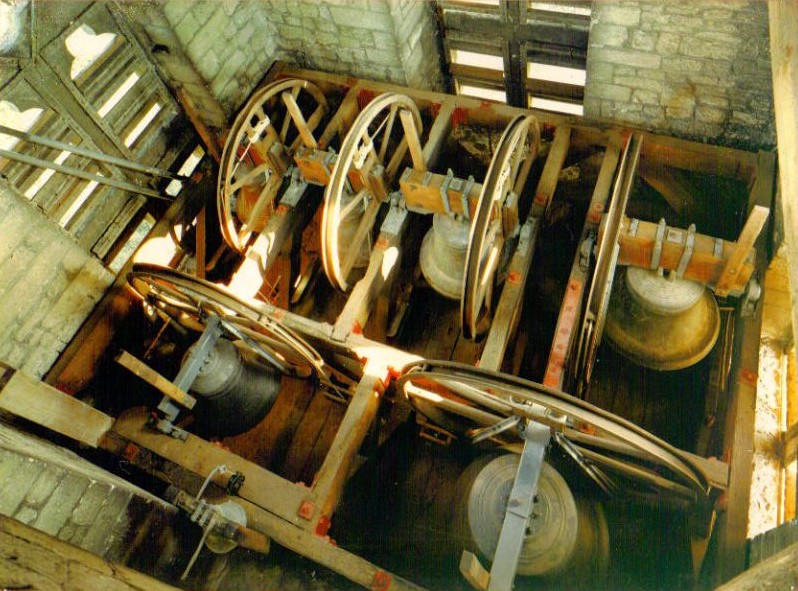
The bells now down
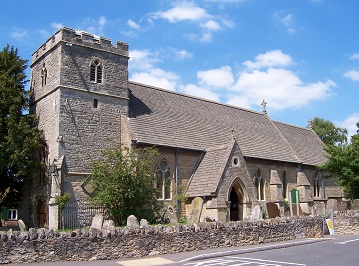
St Peter · Wolvercote
Wolvercote
St Peter SP497099
First Turn · Wolvercote
Oxford OX2 8BW
6 bells GF
8-0-2 cwt-qr-lb in
B♭
Practice: Thursday 20:00 - 21:00
Service ringing: Sunday 09:30 - 09:55
A simulator is available
Correspondent
Known as Ulfgarcote (Wulfgar’s Cottage) in the Domesday Book, Wolvercote manages to retain a strong village identity, with a wealth of local organisations, a thriving Sunday Market and many fetes and festivals organised and well supported throughout the year. Wolvercote was the scene of much bloody skirmishing during the English Civil War, including a raid on the church in 1644. In the more peaceful years that followed, Wolvercote became synonymous with its paper-mill, which supplied the paper for printing books for Oxford University. Although she did not adopt the religious life, Lord Clifford’s daughter, Rosamund did spend her later years in Godstow Nunnery after falling out of favour as mistress of King Henry II. Fair Rosamund as she became known is buried within the precincts of the Nunnery, and her ghost, red rose in hand, is said to haunt the garden. The ghost of the first Duke of Marlborough is reputed to drive a coach and horses past Wolvercote early on New Year’s Day. St Peter’s Church retains its Saxon font carved out of a single block of stone and ornamented with a diamond design round the rim. During the 19th century the parish became notable as a stepping stone to the Episcopacy, with several curates here eventually going on to become bishops of significance at Salisbury, Colchester, London and Zanzibar. The main body of the originally Perpendicular period church was rebuilt in 1859. The bells are rung from the ground floor and the enthusiastic band of ringers is very much an integral part of the community. A dumbbell and projector screen allow simulated ringing to take place at the same time as the regular practice. Hugh Deam
Saint Peter · Wolvercote · Oxford
A ring of six holding a weekly practice
The 2 requires tight handling
|
| Bell | Weight
CWT-QR-LB | Diameter
INCHES | Note
HUM
PRIME
NOMINAL | Cast | Founder | Inscription |
|---|
| 1 | 2-3-19 | 23.50 | G
G1-04 · 391Hz
G2+02 · 785Hz
G3+02 · 1570.5Hz | 1957 | John Taylor
& Co | Meers and Stainbank, Founders London / A Deo - A.D Deum / Walter Dmitri Sargent, Vicar / Joseph Castle / Henry Osborn King ] Churchwardens / A.D. 1900 / Recast by John / Taylor and co. / Loughbrough / 1957 |
| 2 | 2-3-24 | 24.25 | F
F1-11 · 347Hz
F2-12 · 693.5Hz
F3+00 · 1397Hz | 1957 | John Taylor
& Co | William Bagley Made Mee 1707 / Recast by John / Taylor and co. / Loughbrough / 1957 |
| 3 | 3-1-0 | 25.75 | E♭
E♭1-25 · 306.5Hz
E♭2-04 · 620.5Hz
E♭3+00 · 1244Hz | 1957 | John Taylor
& Co | JOHN SMITH JOHN ROWLAND CHURCH WARDENS / MATTHEW & JAMES BAGLEY MADE MEE 1747 / Recast by John / Taylor and co. / Loughbrough / 1957 |
| 4 | 4-0-4 | 27.25 | D
D1-12 · 291.5Hz
D2-08 · 584.5Hz
D3-07 · 1169.5Hz | 1957 | John Taylor
& Co | James Rovlan Joseph Hall Churchwardens 1707 / Recast in memory of / Henry David Chainberlain / Eden Henwood / William Edward Hewlett / Henry Osborn King / Recast by John / Taylor and co. / Loughbrough / 1957 |
| 5 | 5-1-17 | 30.38 | C
C1-07 · 260.5Hz
C2-15 · 518.5Hz
C3-14 · 1037.5Hz | 1957 | John Taylor
& Co | Mears & Swithenbank Founders / London 1881 / Recast by John / Taylor and co. / Loughbrough / 1957 |
| 6 | 8-0-2 | 34.50 | B♭
B♭0-11 · 231.5Hz
B♭1-11 · 463Hz
B♭2-15 · 924Hz | 1957 | John Taylor
& Co | PETER / Michael John Ottaway - Vicar / Wilfrid Godwin / Henry Jack Harrison ] Church wardens / A.D. 1957 / Mears & Swithenbank Founders / London 1881 / Recast by John / Taylor and co. / Loughbrough / 1957 |
These remaining towers mainly do not hold a regular practice. This is either because there isn't sufficient demand for one, they aren't hung for full-circle ringing or they may have been declared unsafe to ring. Alternatively, they may have moved to a different branch.
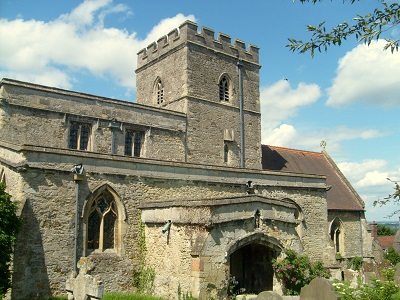
ABVM · Beckley
Beckley
ABMV SP562113
Church Street · Beckley
Oxfordshire OX3 9UT
5 bells 11-1-13 cwt-qr-lb in
F♯
Unringable full-circle
The Assumption of the Blessed Virgin Mary · Beckley · Oxfordshire Some five miles north east of Oxford, the village, along with the adjoining hamlet of Stowood, was the site of a Romano-British villa and is crossed by the Roman road from Alcester to Dorchester. Set on high ground, it enjoys fine views over Otmoor and across to Oxford. The Tudor residence of Beckley Park occupies the site referred to in King Alfred’s will. It became known as the Honour of St Valery after the Norman Conquest and was given by Henry III to Richard, Earl of Cornwall. This parish church is early Norman, with a massive 14th century tower that belies the fact that there are only five bells housed within. Last rung in the late 1970's, the configuration of the bells has an unconventional pattern, but they have become unringable due to a weak frame. Hugh Deam
ABVM · Beckley · Oxfordshire
A full-circle unringable five
Unringable due to a weak frame
|
| Bell | Weight
CWT-QR-LB | Diameter
INCHES | Note | Cast | Founder | Inscription |
|---|
| 1 | 5 cwt | | C♯ | 1660 | Richard Keene | 0661 |
| 2 | 6 cwt | | B | 1707 | Henry Bagley III | -:- WILLIAM LEDWELL SAMVWELL POWELL : C : W : HENREY BAGLEY MADE ME 1707 |
| 3 | 7 cwt | | A♯ | 1664 | Richard Keene | 1664 |
| 4 | 8½ cwt | | G♯ | 1705 | Richard Chandler III | WILLIAM LEDWELL C W 170S |
| 5 | 11-1-13 | 41.00 | F♯ | 1881 | Mears & Stainbank | MEARS & STAINBANK, FOUNDERS, LONDON. 1881. |
| Saunce | | 13.50 | | c1699 | | None |
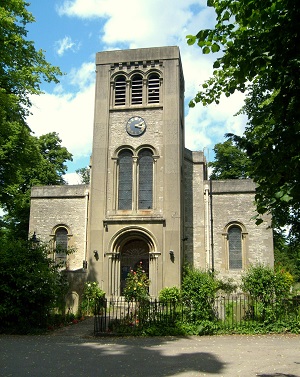
St Clement · St Clements
St Clements
St Clement SP527063
Marston Road · Oxford OX4 1BG
Originally a chime of two
St Clement · St Clements · Oxford This area of Oxford is sited to the east of the centre and is considered to be the direct route out of the city to London. Consequently, a decision eventually had to be taken to widen the road, a move which signalled the demolition of Harpsichord Row in 1929, although the similar terrace of London Place still survives. The Morrell family, famous for their brewing, long owned South Park until selling 50 acres to the Oxford Preservation Trust in 1959. Although the church now stands at the beginning of the Marston Road, in the wooded shadow of Headington Hill, it was originally situated just to the east of Magdalen Bridge, at what is now called The Plain. It was rebuilt in 1828 under the supervision of D Robertson. The style of the main body of the church, and the square west tower, are what is known as Georgian Norman. The windows are from the former church of St Martin at Carfax. This was originally a chime of three bells, but the two largest have been removed from the tower. They are now displayed within the church. One probably dates from the 13th century, making it the oldest in Oxford. Hugh Deam
Saint Clement · St Clements · Oxford
A former chime of three
The saunce remains in the tower, with the 1 and 2, now removed, on display within the church itself. On the evidence of its shape, the 1 is believed to have been cast in the latter part of the 13th century (1250-1299), thus making it the oldest bell within the City of Oxford. The Guinness Book of Records has stated: "The oldest tower bell in Great Britain is one of 50kg (1cwt) at St Botolph, Hardham, Sussex, still in use and date[s from about] AD 1100". The oldest inscribed bell is the Gargate bell, on display at Caversfield church in Oxfordshire, from about 1200-1210. The oldest dated bell in England is one hanging in Lisset church near Bridlington, East Yorkshire bearing the date MCCLIIII (1254).
|
| Bell | Weight
CWT-QR-LB | Diameter
INCHES | Note | Cast | Founder | Inscription |
|---|
| 1 | | 20.50 | | C13th | | None |
| 2 | | 21.50 | | 1636 | Woodstock bell foundry | RICHARD SHVRLY
ROBERT GRIFFIN C W 1636 |
| Saunce | | | | 1731 | Edward Hemins | + W: HACKINS. E: HARRIS.
CHURCH = WARDENS

E: HEMINS. BISSITER.
FECIT. J73J. |
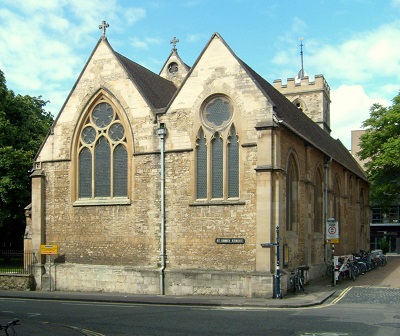
St Ebbe · City Centre
City Centre
St Ebbe SP512060
Pennyfarthing Place
Oxford OX1 1QF
8 bells 4-3-19 cwt-qr-lb in
B♭
A full-circle ring with no practice
St Ebbe This area of the city and its church are named after Ebba, daughter of Aethelfrith, King of Northumbria. Her brothers, Oswald and Oswy, both went on to rule the county. After the death of her father, in a battle during 617, she became a nun and founded a religious house of which she was Abbess. Records show St Ebbe’s to be the earliest church in the city to be mentioned in print, with it being given to Eynsham Abbey in 1141. It has been rebuilt and enlarged on a number of occasions, most extensively in 1813, with just the tower and a south-west corner remaining exempt. William Fisher began the work, but later in C19th, the grandiloquent GE Street gave it his early Gothic revival treatment. The church has been dwarfed and partly surrounded by the Westgate shopping centre since the early 1970s. This development signalled the end for one of Oxford’s most loved department stores, F Cape & Co, which had long enticed shoppers into the area. The bells are an unusually light ring of eight that require great accuracy in handling. There is limited ringing due to their proximity to the shops and offices. Although this is a City Branch tower, the bells are rung by the Oxford University Society, on a Sunday at 11am during term time. Hugh Deam
Saint Ebbe · City Centre · Oxford
A ring of eight with no practice
|
| Bell | Weight
CWT-QR-LB | Diameter
INCHES | Note | Cast | Founder | Inscription |
|---|
| 1 | 2-2-20 | 22.00 | B♭ | 1925 | Mears & Stainbank | IN MEMORIAM J. W. WASHBROOK, 1925. |
| 2 | 2-3-10 | 22.00 | A | 1925 | Mears & Stainbank | IN MEMORIAM J. W. WASHBROOK, 1925. |
| 3 | 3-1-12 | 24.13 | G | 1789 | John Briant | J. BRIANT HARTFORD FECIT 1789 |
| 4 | 3-2-2 | 24.50 | F | 1789 | John Briant | J. BRIANT HARTFORD FECIT 1789 |
| 5 | 3-2-24 | 25.50 | E♭ | 1790 | John Briant | J. BRIANT HARTFORD FECIT 1790 |
| 6 | 4-0-12 | 27.00 | D | 1790 | John Briant | J. BRIANT. / HARTFORD FECIT / UNFEIGNED PRAISE TO HEAVENS ALMIGHTY KING, / FOR HEALTH RESTORED TO GEORGE THE THIRD WE SING. / HÆC SEXTA ACCESSIT A.D. 1790. |
| 7 | 3-3-23 | 28.75 | C | 1789 | John Briant | J. BRIANT HARTFORD FECIT 1789 |
| 8 | 4-3-19 | 31.00 | B♭ | 1789 | John Briant | THIS PEAL WAS RAISD BY VOLONTARY SUBSCRIPTION. H. RICHARDS, RECTOR. E. GOODYER, J. W. CLUFF, CHURCHWARDENS. J. BRIANT HARTFORD FECIT 1789. |
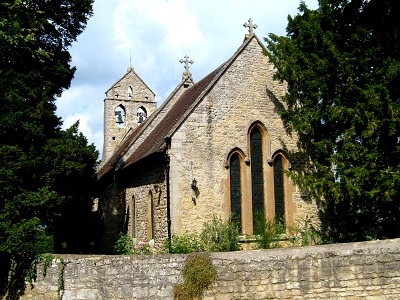
St Nicolas · Forest Hill
Forest Hill
St Nicolas SP582075
Main Street · Forest Hill
Oxfordshire OX33 1EB
A chime of two
St Nicolas The parish of Forest Hill with Shotover was formed in 1883 and comes under the Wheatley Benefice which in turn is in the Aston & Cuddesdon Deanery. The church here was consecrated in 1273 by Reginald, Bishop of Cloyne acting on behalf of the Lincoln Diocese when a remodelling took place. The estate and chapel formed part of a grant by Robert D’Oiley to the church of St George at Oxford Castle, and later to Osney Abbey. The patronage has now long been held by Lincoln College, Oxford. The church consists of a chancel and nave under a single roof, with the western end dominated by a large Early English period gabled double bell-cote which houses two bells. The north aisle of the church saw a fine full pedal-board organ chamber added in 1852 during several years of general restoration to the interior of the building.
Hugh Deam
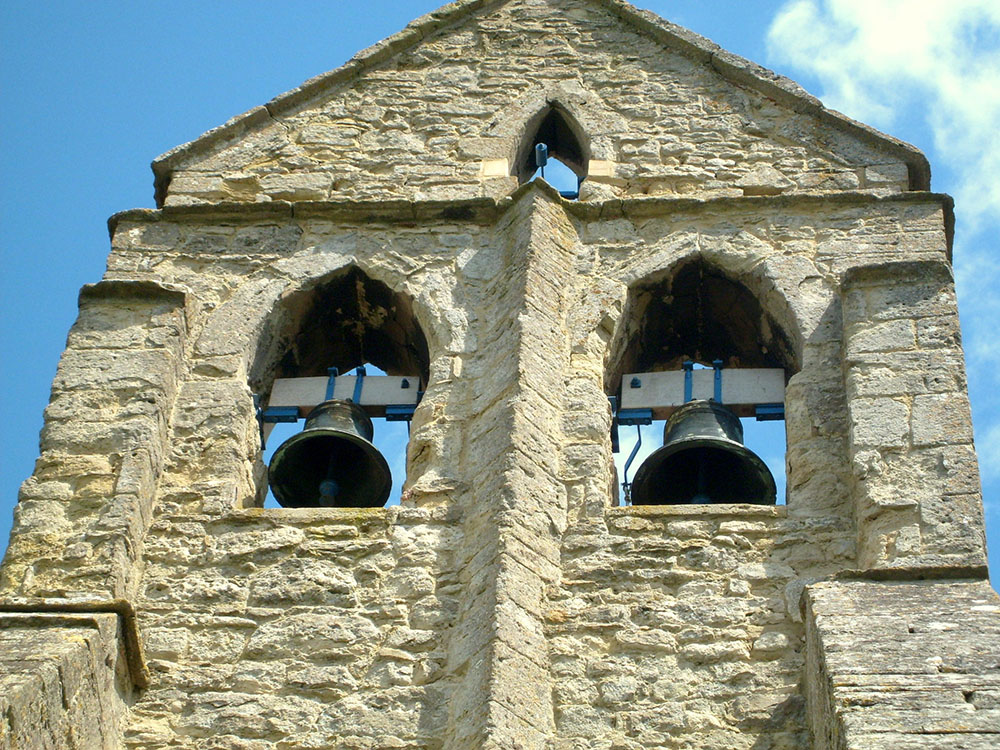
Photo by Paul Lucas June 2007
Saint Nicolas · Forest Hill · Oxfordshire
A chime of two
The bells were rehung by Mr Richard White in 1933
|
| Bell | Weight
CWT-QR-LB | Diameter
INCHES | Note | Cast | Founder | Inscription |
|---|
| 1 | | 20½ | | 1652 | Ellis & Henry Knight | |
| 2 | | 23¼ | | 1652 | Ellis & Henry Knight | |
| Saunce | | 10 | | 1852 | | TAYLOR OXFORD 1852 |
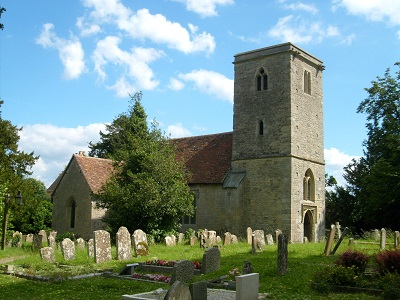
St Bartholomew · Holton
Holton
St Bartholomew SP605064
Holton · Oxfordshire OX33 1PR
A chime of three 8 cwt
St Bartholomew · Holton · Oxfordshire This small village is now almost adjacent to Wheatley and derives its name from the Old English for a farmstead in a nook of land, being described as Healhtun as far back as 956 AD. With the exception of a doorway and a couple of arches, very little remains of the original transitional period church of circa 1200. The chancel dates from the early C14th, when there was a major restoration carried out by William Brome. The west tower is also known to date from around the same time, with the bells having been re-hung for chiming only. St Bartholomew has three bells, two of which are medieval with the other being C17th. The tenor weighs about 8 cwt. Hugh Deam
St Bartholomew · Holton · Oxfordshire
A chime of three
Tuned to a minor scale. The given strike notes are approximate. In 1948, Sharpe described this as a "ring of 3 bells". They were later rehung for chiming.
|
| Bell | Weight
CWT-QR-LB | Diameter
INCHES | Note | Cast | Founder | Inscription |
|---|
| 1 | 5 cwt | | C | | Richard Keene | RICHARD WISE
WILLIAM WILLINS
C W 1662 |
| 2 | 6¼ cwt | | B | c1450 | John Sturdy | Sancta Anna
Ora Pro Nobis

J [Coin] S
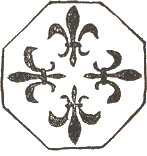 |
| 3 | 8 cwt | 36 | A | c1590 | probably
William Watts | 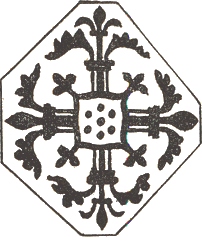
c u S i i

S R
 |
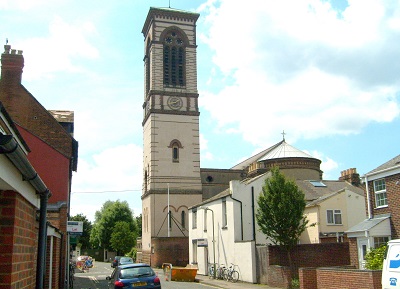
St Barnabas · Jericho
Jericho
St Barnabas SP505069
Cardigan Street · Jericho
Oxford OX2 6BH
10 tubular bells plus one
other bell hung for ringing
Struck by the clock
The church of St Barnabas is situated at the heart of Jericho on Cardigan Street. It was the concept of Thomas Combe, then superintendent of Clarendon Press, who was a renowned Anglo-Catholic and avowed patron of the early Pre-Raphaelites. Arthur Blomfield was commissioned in 1869 to design this Italian Romanesque building. It is considered to be nearest to the Sicilian style, with a sumptuous and unabashed interior. The Campanile was built in 1872 and re-roofed in 1893. The church cost £6,500 and the Campanile £800 to build. This area of Oxford grew up during the 19th century alongside the canal. It experienced a rapid influx of inhabitants due to several major employers, such as the Oxford University Press and Lucy’s Iron & Brass Foundry, setting up here. Hugh Deam
Saint Barnabas · Jericho · Oxford
A chime of ten plus a ring of one
The 10 tubes hang from a wooden frame in the centre of the tower and are struck by hammers, operated by an Ellacombe chiming manual, in the vestry. Tuned to a diatonic scale in the key of A, each is stamped with its musical note and a number depicting its position within the scale. Each also bears the inscription G. & J. / HARRINGTON'S PATENT TUBULAR BELLS / TRADE-MARK. The bell founder is Gillet & Johnson of Croydon. The treble measures 60″ long by 3¾″ diameter. The tenor is 103″ by 4″. They were first hung in 1890.
|
Weight
CWT-QR-LB | Diameter
INCHES | Note | Cast | Founder | Inscription |
|---|
| 3-0-25 | 24 | | 1869 | John Taylor
& Co | J. TAYLOR & CO. FOUNDERS LOUGHBOROUGH 1869. |
St Peter · Marsh Baldon
Marsh Baldon
St Peter SU562991
Baldon Lane · The Baldons
Oxfordshire OX44 9LS
5 bells GF
7½ cwt in
A
Originally affiliated with the
City Branch, this tower moved to
the
South Oxon Branch in 2012.
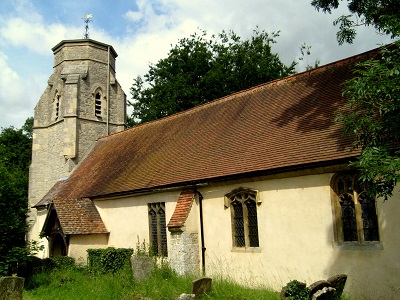
St Peter · Marsh Baldon · Oxfordshire is located on the right, just inside the western gated entrance to the village. The C14th tower has been transformed into an octagonal shape, with squinches at its upper bell-stage, and is unlike any other tower in the branch. The Early Decorated church was totally rebuilt in 1890, and the wooden porch has a sundial over the doorway. The bells are rung from the ground floor and require sensible handling. After an inspection by White's of Appleton, a
quarter peal was rung on the 27th June 2009 to celebrate Marsh Baldon's Lunch on the Green. The village is replete with half-timbered and thatched cottages, and the extremely capacious village green is used for cricket matches in summer. The present name of the village derives from the De Le Meres family, who owned much land here in the 13th century. The picturesque and long established Seven Stars Inn is widely regarded and possesses a large log fire and friendly ambience.
Hugh Deam
Saint Peter · Marsh Baldon · Oxfordshire
A ring of five holding a weekly practice
|
| Bell | Weight
CWT-QR-LB | Diameter
INCHES | Note | Cast | Founder | Inscription |
|---|
| 1 | 3-1-22 | 26.00 | E | 1954 | Mears & Stainbank | Not Known |
| 2 | 4-0-22 | | D | 1902 | Mears & Stainbank | MEARS & STAINBANK, FOUNDERS, LONDON.
RENOVATUM MDCCCCII.
GAUDEMUS GAUDENTIBUS,
DOLEMUS DOLENTIBUS. |
| 3 | 4¾ cwt | | C♯ | c1628 | Ellis Knight I | PRAYES THE LORD |
| 4 | 5¾ cwt | | B | c1530 | John White |  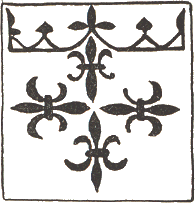

  |
| 5 | 7½ cwt | 35.00 | A | 1628 | Ellis Knight I | X · AS · TENAR · HVM · ALL · ROVND X628 |
| Saunce | | | F♯ | c1760 | Robert Wells I | ROBT. WELLS ∴ ALBOURN
∴ ∴ ∴ ∴ ∴ ∴ |
St Michael · City Centre
City Centre
St Michael Northgate SP513064
Cornmarket Street
Oxford OX1 3EY
6 bells
12 cwt in
F♯
Hung dead as an Ellacombe chime
Situated on the corner of Ship Street and Cornmarket, the
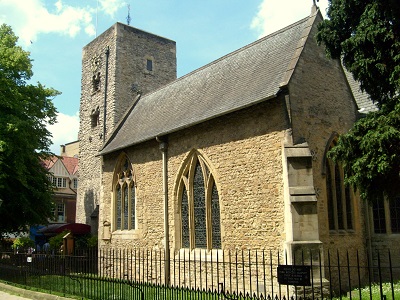
City Church of St Michael-at-the-Northgate is not only Oxford city centre’s oldest building, with its late Anglo-Saxon tower, but also lends its name to the road opposite (St Michael’s Street). The main body of the church dates primarily to C13th, although the north aisle was totally rebuilt by John Plowman in 1833, with a general restoration overseen by the prolific GE Street in 1853/4. The damage done to the building following a severe fire in 1953 is not really visible today. This tiny enclave of the city has a somewhat Bohemian atmosphere with street buskers, a coffee stall and a silk garments seller. The magnificent church tower is much photographed and scaled by tourists, the roof allowing a splendid view of the city. The Protestant martyrs Cranmer, Latimer and Ridley were imprisoned here in a cell known as the Bocardo. The very extensive gift shop is open nearly every day of the year, and includes a wide selection of Fairtrade goods. The church is known for its practical help for charities, having long permitted its grounds to be used for street collections on certain days of the year. If they were rung full circle, the six bells would be too heavy for the tower to support, so they are hung dead for chiming only.
Hugh Deam
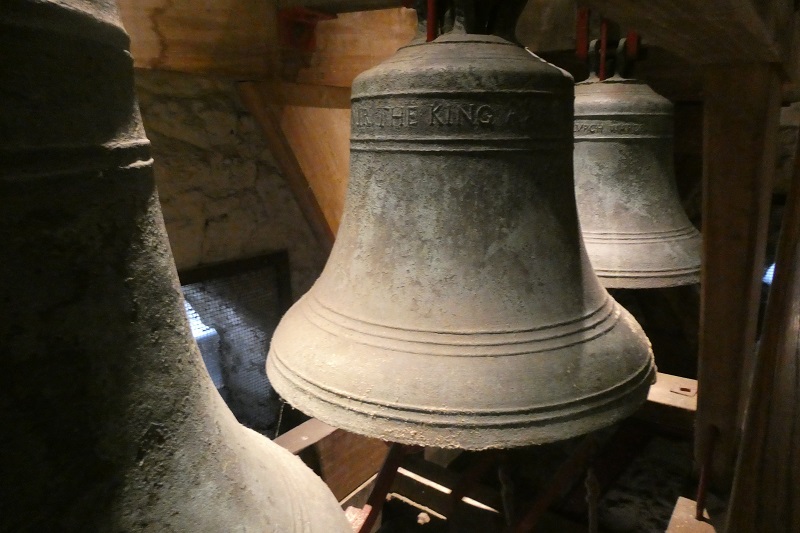
FEAR GOD HONOUR THE KING
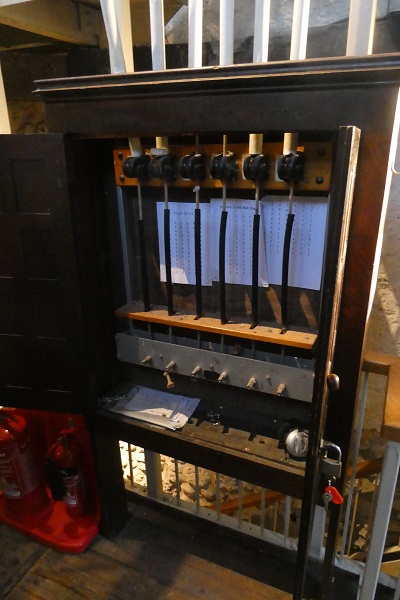
Ellacombe manual
St Michael-at-the-Northgate · Oxford
A chime of six
The bells were formerly hung for full-circle ringing. The frame was removed in 1898 and the bells were then hung "dead" for chiming by Mr F White Sharpe 1953. Bells 1, 2, 4 & 5 rehung in 1987 by John Taylor & Company in a partial new timber frame over the existing White's one. Numbers 3 & 6 hang below in the old frame. Operated via a JT & Co Ellacombe [chiming mechanism]. The Sanctus bell still hangs in the west window as a swing chime with a lever Mike Chester.
|
| Bell | Weight
CWT-QR-LB | Diameter
INCHES | Note
HUM
PRIME
NOMINAL | Cast | Founder | Inscription |
|---|
| 1 | 4½ cwt | | D♯
323.5Hz · E1-31
586.0Hz · D2-3
1221.5Hz · E♭3-31 | 1708 | Abraham Rudhall I | IOHN HERRING IOHN ROYSTON CHVRCH WARDENS
1708 AR [Bell]
|
| 2 | 4¾ cwt | | C♯
290.5Hz · D1-18
540.0Hz · D♭2-44
1102.5Hz · D♭3-9 | 1755 | Abel Rudhall | FEAR GOD HONOUR THE KING
A [Bell] R 1755
|
| 3 | 5¼ cwt | | B
245.5Hz · B0-9
529.0Hz · C2+19
971.0Hz · B2-29 | 1668 | Richard Keene | 1668 |
| 4 | 7 cwt | | A♯
233.0Hz · B♭0+0
472.5Hz · B♭1+23
905.0Hz · A2+48 | 1668 | Richard Keene | 1668 |
| 5 | 9 cwt | | G♯
412.0Hz · A♭1-13
689.0Hz · F2-23
1439.0Hz · F♯3-48 | 1668 | Richard Keene | RICHARD KEENE CAST THIS RING 1668 |
| 6 | 12 cwt | 42 | F♯
205.5Hz · A♭0-17
378.5Hz · F♯1+39
727.0Hz · F#2-30 | 1668 | Richard Keene | SAMPSON RAWLINS ROBERT KEATE C W 1668 |
| Saunce | | 17.25 | | 1784 | Robert Patrick | ROBT. PATRICK OF LONDON FOUNDER 1784 |
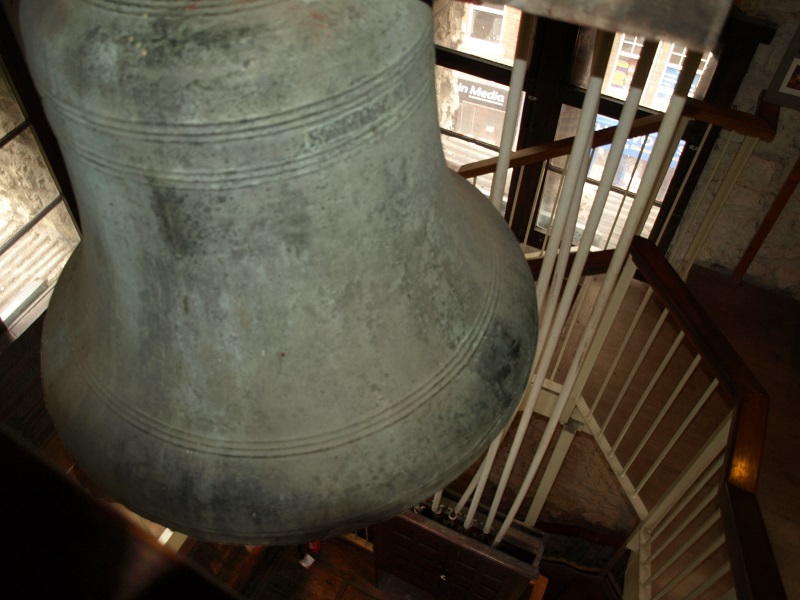
Tenor with manual below
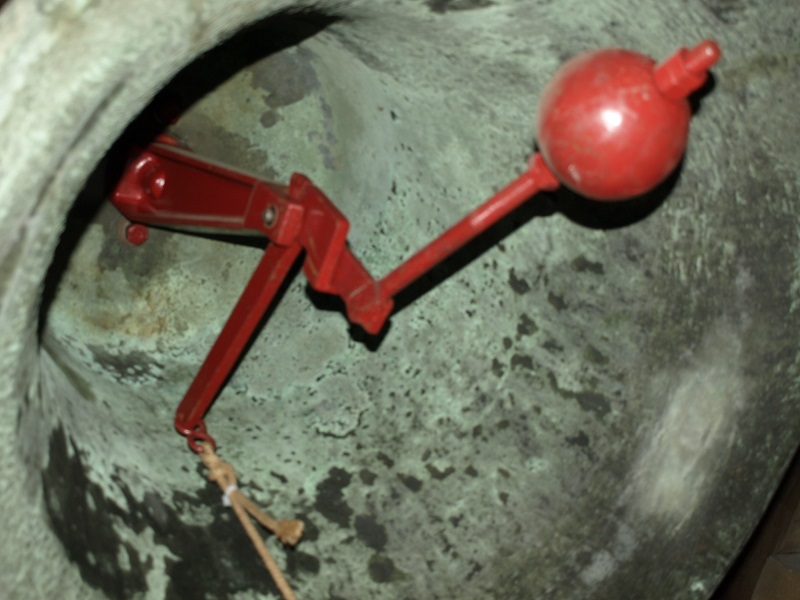
Tenor showing clapper
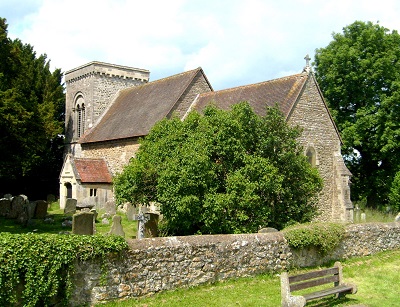
St Andrew · Sandford
Sandford
St Andrew SP534018
Church Road · Sandford on Thames
Oxfordshire OX4 4XZ
A chime of 3 bells 3¾ cwt
St Andrew · Sandford-on-Thames · Oxfordshire A settlement known as Sandforda, “a sandy ford”, existed here as far back as 1050. An early Norman church was built at the end of that century. Parts of the east and south walls of the chancel and nave still survive as does a small chancel window. Considerable alterations were made during Victorian times with the present Norman-style tower, dating to 1840, having replaced the previous wooden structure. The elegant porch was built at the behest of Eliza Isham in 1652, to whom an inscription is detailed: “Thanks to thy charitie religious dame, which found me old and made me new againe.” The church is situated close to the river, on the route of an ancient footpath leading to Toot Baldon. There is known to have been a preceptor of the Knights Templar here during the 13th century. Hugh Deam
Saint Andrew · Sandford · Oxfordshire
A chime of three
Sharpe was unable to examine the bells himself. The treble may be cracked.
|
| Bell | Weight
CWT-QR-LB | Diameter
INCHES | Note | Cast | Founder | Inscription |
|---|
| 1 | 2½ cwt | | | 1592 | | prayse ye the lorde + J + c 1592 |
| 2 | 3¼ cwt | | | | | B Q M E L Y Q b o f |
| 3 | 3¾ cwt | 26 | | 1606 | | THIS BELL WAS MADE 1606 j + c |
| Saunce | | | | | | None |
All Saints · Wytham
Wytham
All Saints SP475086
Abbey Entrance · Wytham
Oxfordshire OX2 8QA
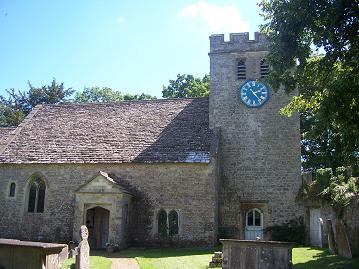
A chime of 10 bells
All Saints · Wytham · Oxfordshire Although barely a mile west of Oxford, the village was actually in Berkshire until the boundary changes of the early 1970s. Documented as Wihtham in 957 AD, it appositely takes its name from the Old English for a homestead in a river bend. The land in this area was gifted to Abingdon Abbey by King Edgar, with Wytham Abbey long being the seat of the Earls of Abingdon and dating from the early C16th. The late C14th church at Wytham was rebuilt in 1811/12, by the Bertie family, using materials from their former manor house of Cumnor Place. For example, the entrance to the churchyard is via a small doorway taken from the manor. Some fine stained glass also remains from that earlier period. The ten bells, made by Gillett & Johnston, were installed in 1951 and are chimed by means of a baton keyboard. This was the last work done by Gillett & Johnston before they stopped working with bells. Wytham has long been known for its strawberry teas and the village shop still opens its garden for afternoon teas. The woods surrounding Wytham are now permanently used for nature studies and research purposes. Hugh Deam
All Saints · Wytham · Oxfordshire
A chime of ten
The ten bells, made by Gillett & Johnston of Croydon, were installed in 1951 and are chimed by means of a baton keyboard. This was the last work done by Gillett & Johnston before they stopped working with bells. Mark Walker
|